The next 2 weeks of my trip in brief tidbits:
September 22 – Muang Khua hospital. No 6 year doctors seeing patients, but good facilities and equipment, and polite and engaged staff (3 year doctors and nurses) providing patient care. We didn’t round with them. If they had a pediatrician and an Internist (Ok, and a surgeon and OB) they could be a great small hospital.
September 23 – Travel to Muang Sing – Muang Khua to Udomxai (3 hours), Udomxai to Luang Nam Tha (3 hours) both on lovely roads. Luang Nam Tha to Muang Sing – 3 hours, longer than usual due to several large mud slides on the road. Arrived in Muang sing to Bryan and a crowd of 10-20 Lao children who were super happy to see Leila and shy to meet me. Dinner on their lovely balcony overlooking the army barracks, road, and countryside while the sun set.
September 24 – Market trip and butterfly children’s center in the morning – great to see Leila and Bryan in their element. Bike ride in the afternoon, then made spaghetti sauce from scratch to eat with rice noodles and Chinese cabernet (terrible!) for dinner.
September 25 – Mitchell Montessori Cinco De Mayo paper flowers at the childrens center. Bike ride to Koma’s Akha village in the afternoon – 6 KM up hill and lovely views on the return. Purchasing of large amounts of beautifully woven local handicrafts at a private market put on by local girls in Leila and Bryan’s house in the evening.
September 26 – Bike ride in the morning, children’s center for jump rope and puzzle games in the afternoon.
September 27 – One more walk through the weaving village and a few more purchases in the early afternoon, Last evening at the children’s center.
September 28th – up early and packed 4-5 kilos of new belongings tightly into my travel pack. Minibus to Luang Nam Tha where I rounded with 2010 graduate Veokham, who appears to be doing a fabulous job on his ward. Like recent residency graduates worldwide, he complained that we had not taught him enough musculoskeletal diagnosis and treatment – but he had managed to (accurately, I think) diagnose a patient with spinal chord stenosis anyway. Bike ride in the afternoon during which I took a wrong turn and ended up riding more than 20 KM, much of it on village trails. Luang Nam Tha valley is beautiful with rice fields and mountains, and the last leg was with beautiful late-afternoon lighting (but home before dark despite my miscalcuation.)
September 29th – attended teaching by Dr. Veokham to hospital staff in the morning – Dengue fever with all slides in Lao language! Wow! Gave the staff in the blood bank some excitement by donating blood – several cell phone camera photos were taken to document the occasion. Said a sad goodbye to Leila after lunch and had a relaxed afternoon.
September 30th and October 1st – travel to Mae Sot – LNT to Bokeo, across the Mekong into Thailand, and on to Chiang Rai the first day. Chiang Ria – splurged on Pizza and Salad after 2 weeks of not enough wheat or cheese. Chiang Rai seems like a nice little town. The next day, Chiang Rai -> Chiang Mai (bus station only) where 7-11 provided a safe but unappetizing lunch during my 2 hour layover, then on to Mae Sot. Thai buses and roads are much nicer than Lao, - there are assigned seats and I bought my ticket relatively early! But the movie on the first bus was so disturbingly violent I literally had to keep my eyes shut for much of the first 2 hours. Too bad,t the golden triangle has beautiful karsts. Arrived just in time for dinner with Cindy’s friends, delicious Thai food.
October 2 – Sunday in Mae Sot, a town on the Thai – Myanmar border. Brunch! at a Canadian run diner and a bike ride to the border, where even more beautiful textiles were purchased. The border has been closed for over a year, so no temptation to go across for a day.
October 3 – Got to see the clinic of Dr. Cindy – former HF IM coordinator, Med-Peds doctor, and now doing research and clinical care in very resource limited settings for Burmese migrant workers. Very impressed with the level of care, but more so with the training, skill, and motivation of clinic workers, most of who have less than a high school education, and are themselves ‘undocumented’ workers. Amazing work Cindy and her team are doing!
October 4 – Mailed 6 kg of textiles home to the US from Mae Sot, took the early afternoon bus to Sukothai, where I splurged on a hotel with a pool. Sukothai was in the process of flooding, so I would have gotten wet anyway, but the pool was a much nicer way to do it.
October 5 – trip to Old Sukothai and viewing of the ruins of an early Thai capitol city. Travel through flooding New Sukothai is probably what I will remember most about this day – flood waters are very mobile, and seem almost malicious. (I suppose I had always imagined them as static or slowly rising, not rushing and flowing, or rising quickly after spilling over something. Now I know.) People of New Sukothai for the most part going about their business and children playing in the wakes created by trucks passing through higher (2-3 foot) water areas. Lazy and not wanting to get my feet dirty again after the pool, ate a nice dinner at the hotel.
October 6 – Bus to Chiang Mai, hotelier kind enough to take me to the bus station in his truck, so I remain dry despite worsening flooding in the city and surrounding areas. My friend Ken arrives to find the hotel has cancelled our reservation and finds a nice replacement hotel (with pool!) Swimming, fruit shakes, pancakes, and an evening jaunt around Chaing Mai. Ken is MUCH slower at the night market than I am – isn’t that backwards? I must remember he’s seeing much of this for the first time, while I’ve been in Asian tourist market situations for a year now. Also, he’s pretty sleep deprived by now after an overnight bus.
Friday, October 21, 2011

Tuesday, September 27, 2011
On the Road
10 days ago I left Vientiane for a trip through Northern Lao. I spent the 48 hours before leaving dealing with a semi-crisis of resident failure on the final exam. (when 6/7 residents fail the test, is the problem the test or the residents?) And trying to convince myself I was ready to be away from home traveling for more than a month. I haven't been on the road for that long in a long time. There were a couple fairly sleepless nights. But I'm doing OK so far!
On Saturday I flew to Phongsali. I had 38 kg of checked luggage - my 12 kg travel backpack (some of the weight was a pencil sharpener, and there was some heavy food.) Then there was a 25kg bag containing 1050 posters in 21 50 poster packets and 100 rolls of colorful paper for a project for the children, 100 pipe cleaners, 1 kg of coffee from Kungs for Bryan, a graduation present for a 2010 graduate, and some chocolate and cookies. I showed the people at the counter Leila's Noma poster and explained it was outreach for sick kids, and they let me ship the heavy bag for free. Lao Airlines is such a pleasure to fly; that would never happen in America. Anyway, I arrived in Udomxai and Leila met me at the airport. Leila is an American pediatrician who now lives and works in Northern Lao, is a former pediatrics coordinator, and helps HF with resident recruiting from rural hospitals.) I carried all 38 KG of luggage to the tuk tuk in one trip by myself! (Leila had my day pack and purse, and has osteoporosis, so I didn't want her doing any heavy lifting.) We went to the guesthouse where we stowed the luggage and then I had a late lunch of pumpkin soup and delicious fried niblets. We delivered 5 packets of posters to a man who works for an NGO in Udomxai and will try to get one to each district for distribution. We walked to a temple mentioned in the Lonely planet and saw a beautiful concrete tree of life sculpture. It rained on the walk back, but we were able to deliver a (slightly wet) Fitzpatrick's guide to dermatology to the 2010 graduate in Udomxai - I had missed seeing him at CME in the spring. Our work done, we found a new hotel recommended by Leila's friends and had a massage and then a late dinner.

Tree of life sculpture, Udomxai.
Saturday we took the bus to Phongsali. In good conditions, it takes 8 hours. We left at 8 AM and arrived at 8 PM. The first part of the road was paved. Then we got to dirt road - windy, muddy (it rained almost all night Saturday night) mountain dirt roads. Our bus driver was great - he didn't try to go too fast - and he had an assistant that sat next to him and helped choose the route. When it was particularly muddy or challenging, he hopped out and walked along giving advice from the front, then got back in when we were through the rough spot. There were some narrow, muddy areas, but I was never _really_ worried the bus would slide off the edge of the cliff. I was sometimes a little bit worried about that. We didn't stop for lunch until well after noon, and we stopped at a little roadside stand that sold chips and soda. Luckily, I had brought bread and cheese from Vientiane, so we didn't go hungry. All the Lao people had packed their own lunches too. Along the way, Leila gave posters to everyone getting off the bus to hang in their towns. The last 60 KM of road (we went between 200-300 km total) was paved, but still windy and it was dark by then, so it was still pretty slow going. We passed on the first guest house we saw and stayed at the second, where we were soon to discover the Lonely planet's description of plumbing problems was correct. We had eaten the second half of the Gouda on the bus, so we just went to bed. Riding the bus all day was somehow pretty exhausting.

Buying bracelets at a roadside bathroom stop.
Monday we had breakfast at the Yee Hua restaurant, where Leila discovered that the proprietor works for an NGO that goes to rural, hard to access districts in Phongsali (which as you can see from the above is already hard to access.) He agreed to distribute posters to many villages in 2 districts. Around 10 Am we finally got the go ahead from MOH to visit the hospital, and we headed out and met with the vice director. We gave him some pocket books and Lao-language Mahosot Microbiology Reviews, and got some information about the hospital. He invited us to come back the next morning at 8:30 for rounds. We walked back to the guest house and packed the peanut butter and a roll and headed up the Phou Faa - sky mountain - for a short hike. It ended up being at least 2 KM up the road (we could have taken 400 stairs, a more direct route, but they were pretty mossy and treacherous looking.) We ate lunch overlooking the city accompanied by several very friendly butterflies. Then Leila convinced me we should go to the viewpoint. We thought it was 30 Meters, but quickly realized the sign had meant 30 minutes. About an hour later, after traveling through thick jungle on an overgrown path we arrived at what was a really fabulous view point. Leila walked first to brush away the spider webs after we found a giant spider over the trail early on. We left the big ones alone and just snuck under their webs. At the viewpoint we had almost 360 degree views of the mountains of Phongsali stretching out away from town. I discovered the friendly brown creatures persistently climbig up my shoes were leaches, not caterpillars, as I had hoped. There was no way I was going back past the giant spider, so our only choice was to go down, through the jungle, on another small trail past the tea plantation. It started to rain on the way down, but I had my poncho. The tea plantation was just a porch full of women sorting green tea from giant incredibly heavy bags, and more women and men carrying the bags up the hill from the surrounding areas of tea bushes. Unfortunately, they weren't set up to let us taste or buy tea, so we just headed on, back around the mountain on the Hat Sa road, to the town. I managed to accost one last leach who had made it to just above my knee inside my capri pants, and scrape several more off my shoes. Leila discovered 3 or 4 that had climbed up her pants when we go home (I thought I saw spots of blood appearing on her jeans, but she didn't want to stop and check) - so while my freaking out seemed kind of silly, it did prevent me from being suckered. By this time it was late afternoon, so after a brief rest we went to a restaurant recommended by the Lonely planet, where we pointed to some vegetables we wanted on their display area, and two lovely stir fries were prepared for us.

Leila at the top of Phu Faa
On Tuesday we returned for rounds. I went with the person in charge of internal medicine - a 3 year trained doctor who went to school in Vietnam. We saw 7 patients, 5 of whom were women with abdominal pain, one man with shortness of breath, and an 8 month pregnant woman who had flank pain and fever that had not improved after 8 days of Ampicillin. I called Leila in to help translate and we talked about urosepsis in pregnant woman and advised they switch to gentamyacin and ceftriaxone, then Leila gave the doctor another copy of the Lao Language MMR with sepsis guidelines. We were done rounding, so I joined Leila in the well child clinic (they had no pediatric inpatients) where she had spent the morning encouraging them to weight the children and found that all of them were underweight, and then counseling the parents about good nutrition. As we were leaving we were invited to come back for the afternoon. So after lunch we returned and spent another half an hour in well child clinic. Then a member of the hospital staff came and told us they were ready for our teaching. We hadn't prepared any teaching. Yikes! Leila talked for 30-45 minutes about weighing children and good nutrition and then for another 15-30 minutes about fever in Laos with some input from me. Leila can lecture in Lao and they understood her, especially with the help of a surgeon sitting at the front of the room who did some extra explaining. Then they said that was great, but they were ready for the adult teaching. So I talked for 15-30 minutes about prevention - I did some speaking in Lao but mostly Leila translated for me. We talked about exercise, healthy diet, not drinking a lot, and not smoking and how these four interventions could decrease diabetes, stroke, heart failure, heart attacks, and liver disease. They agreed that Lao people don't like to take medications every day and so prevention was important, and seemed engaged in my teaching as well. We took a group photo and the day was over at 4 o'clock. Leila was pretty exhausted, so she went to bed almost immediately and I had a snackish dinner.
Doctors, nurses, pharmacists who attended our impromptu teaching in Phongsali.
Wednesday we took the bus from Phongsali 22 km to Hat Sa over a very muddy, under construction dirt road. We had 2 stops - once for a digger truck that was pushing landslide dirt off the road and making it passable - and the second to widen the road where the outside edge had collapsed. The bus driver and some passengers pushed some rocks from the uphill side over the edge so the road was just wide enough for the bus to cross the narrow area. All the passengers got back in once he was across. At Hat Sa, we got in a long boat. We rode down the (very full) river for 4 hours to Meuang Kheua, arriving in mid afternoon. We passed beautiful mountains and saw some lovely birds, and our driver skillfully guided us through the rapids. The guesthouse recommended by lonely planet was full, so we checked into one two doors down which was basic but had fully functional bathroom plumbing. We relaxed for about an hour before wandering around town a bit and then getting dinner at a restaurant overlooking the river and river crossing ferry landing. the sunset was behind us, but it was still a beautiful place to have an early dinner and watch the activities on the river. And the mushrooms with ginger were quite tasty.

View from the long boat.
On Saturday I flew to Phongsali. I had 38 kg of checked luggage - my 12 kg travel backpack (some of the weight was a pencil sharpener, and there was some heavy food.) Then there was a 25kg bag containing 1050 posters in 21 50 poster packets and 100 rolls of colorful paper for a project for the children, 100 pipe cleaners, 1 kg of coffee from Kungs for Bryan, a graduation present for a 2010 graduate, and some chocolate and cookies. I showed the people at the counter Leila's Noma poster and explained it was outreach for sick kids, and they let me ship the heavy bag for free. Lao Airlines is such a pleasure to fly; that would never happen in America. Anyway, I arrived in Udomxai and Leila met me at the airport. Leila is an American pediatrician who now lives and works in Northern Lao, is a former pediatrics coordinator, and helps HF with resident recruiting from rural hospitals.) I carried all 38 KG of luggage to the tuk tuk in one trip by myself! (Leila had my day pack and purse, and has osteoporosis, so I didn't want her doing any heavy lifting.) We went to the guesthouse where we stowed the luggage and then I had a late lunch of pumpkin soup and delicious fried niblets. We delivered 5 packets of posters to a man who works for an NGO in Udomxai and will try to get one to each district for distribution. We walked to a temple mentioned in the Lonely planet and saw a beautiful concrete tree of life sculpture. It rained on the walk back, but we were able to deliver a (slightly wet) Fitzpatrick's guide to dermatology to the 2010 graduate in Udomxai - I had missed seeing him at CME in the spring. Our work done, we found a new hotel recommended by Leila's friends and had a massage and then a late dinner.

Tree of life sculpture, Udomxai.
Saturday we took the bus to Phongsali. In good conditions, it takes 8 hours. We left at 8 AM and arrived at 8 PM. The first part of the road was paved. Then we got to dirt road - windy, muddy (it rained almost all night Saturday night) mountain dirt roads. Our bus driver was great - he didn't try to go too fast - and he had an assistant that sat next to him and helped choose the route. When it was particularly muddy or challenging, he hopped out and walked along giving advice from the front, then got back in when we were through the rough spot. There were some narrow, muddy areas, but I was never _really_ worried the bus would slide off the edge of the cliff. I was sometimes a little bit worried about that. We didn't stop for lunch until well after noon, and we stopped at a little roadside stand that sold chips and soda. Luckily, I had brought bread and cheese from Vientiane, so we didn't go hungry. All the Lao people had packed their own lunches too. Along the way, Leila gave posters to everyone getting off the bus to hang in their towns. The last 60 KM of road (we went between 200-300 km total) was paved, but still windy and it was dark by then, so it was still pretty slow going. We passed on the first guest house we saw and stayed at the second, where we were soon to discover the Lonely planet's description of plumbing problems was correct. We had eaten the second half of the Gouda on the bus, so we just went to bed. Riding the bus all day was somehow pretty exhausting.

Buying bracelets at a roadside bathroom stop.
Monday we had breakfast at the Yee Hua restaurant, where Leila discovered that the proprietor works for an NGO that goes to rural, hard to access districts in Phongsali (which as you can see from the above is already hard to access.) He agreed to distribute posters to many villages in 2 districts. Around 10 Am we finally got the go ahead from MOH to visit the hospital, and we headed out and met with the vice director. We gave him some pocket books and Lao-language Mahosot Microbiology Reviews, and got some information about the hospital. He invited us to come back the next morning at 8:30 for rounds. We walked back to the guest house and packed the peanut butter and a roll and headed up the Phou Faa - sky mountain - for a short hike. It ended up being at least 2 KM up the road (we could have taken 400 stairs, a more direct route, but they were pretty mossy and treacherous looking.) We ate lunch overlooking the city accompanied by several very friendly butterflies. Then Leila convinced me we should go to the viewpoint. We thought it was 30 Meters, but quickly realized the sign had meant 30 minutes. About an hour later, after traveling through thick jungle on an overgrown path we arrived at what was a really fabulous view point. Leila walked first to brush away the spider webs after we found a giant spider over the trail early on. We left the big ones alone and just snuck under their webs. At the viewpoint we had almost 360 degree views of the mountains of Phongsali stretching out away from town. I discovered the friendly brown creatures persistently climbig up my shoes were leaches, not caterpillars, as I had hoped. There was no way I was going back past the giant spider, so our only choice was to go down, through the jungle, on another small trail past the tea plantation. It started to rain on the way down, but I had my poncho. The tea plantation was just a porch full of women sorting green tea from giant incredibly heavy bags, and more women and men carrying the bags up the hill from the surrounding areas of tea bushes. Unfortunately, they weren't set up to let us taste or buy tea, so we just headed on, back around the mountain on the Hat Sa road, to the town. I managed to accost one last leach who had made it to just above my knee inside my capri pants, and scrape several more off my shoes. Leila discovered 3 or 4 that had climbed up her pants when we go home (I thought I saw spots of blood appearing on her jeans, but she didn't want to stop and check) - so while my freaking out seemed kind of silly, it did prevent me from being suckered. By this time it was late afternoon, so after a brief rest we went to a restaurant recommended by the Lonely planet, where we pointed to some vegetables we wanted on their display area, and two lovely stir fries were prepared for us.

Leila at the top of Phu Faa
On Tuesday we returned for rounds. I went with the person in charge of internal medicine - a 3 year trained doctor who went to school in Vietnam. We saw 7 patients, 5 of whom were women with abdominal pain, one man with shortness of breath, and an 8 month pregnant woman who had flank pain and fever that had not improved after 8 days of Ampicillin. I called Leila in to help translate and we talked about urosepsis in pregnant woman and advised they switch to gentamyacin and ceftriaxone, then Leila gave the doctor another copy of the Lao Language MMR with sepsis guidelines. We were done rounding, so I joined Leila in the well child clinic (they had no pediatric inpatients) where she had spent the morning encouraging them to weight the children and found that all of them were underweight, and then counseling the parents about good nutrition. As we were leaving we were invited to come back for the afternoon. So after lunch we returned and spent another half an hour in well child clinic. Then a member of the hospital staff came and told us they were ready for our teaching. We hadn't prepared any teaching. Yikes! Leila talked for 30-45 minutes about weighing children and good nutrition and then for another 15-30 minutes about fever in Laos with some input from me. Leila can lecture in Lao and they understood her, especially with the help of a surgeon sitting at the front of the room who did some extra explaining. Then they said that was great, but they were ready for the adult teaching. So I talked for 15-30 minutes about prevention - I did some speaking in Lao but mostly Leila translated for me. We talked about exercise, healthy diet, not drinking a lot, and not smoking and how these four interventions could decrease diabetes, stroke, heart failure, heart attacks, and liver disease. They agreed that Lao people don't like to take medications every day and so prevention was important, and seemed engaged in my teaching as well. We took a group photo and the day was over at 4 o'clock. Leila was pretty exhausted, so she went to bed almost immediately and I had a snackish dinner.

Doctors, nurses, pharmacists who attended our impromptu teaching in Phongsali.
Wednesday we took the bus from Phongsali 22 km to Hat Sa over a very muddy, under construction dirt road. We had 2 stops - once for a digger truck that was pushing landslide dirt off the road and making it passable - and the second to widen the road where the outside edge had collapsed. The bus driver and some passengers pushed some rocks from the uphill side over the edge so the road was just wide enough for the bus to cross the narrow area. All the passengers got back in once he was across. At Hat Sa, we got in a long boat. We rode down the (very full) river for 4 hours to Meuang Kheua, arriving in mid afternoon. We passed beautiful mountains and saw some lovely birds, and our driver skillfully guided us through the rapids. The guesthouse recommended by lonely planet was full, so we checked into one two doors down which was basic but had fully functional bathroom plumbing. We relaxed for about an hour before wandering around town a bit and then getting dinner at a restaurant overlooking the river and river crossing ferry landing. the sunset was behind us, but it was still a beautiful place to have an early dinner and watch the activities on the river. And the mushrooms with ginger were quite tasty.

View from the long boat.
Monday, September 12, 2011
Rites of Passage?
Today I got my first traffic ticket - apparently I turned left at a no-left-turn intersection. Luckily for me Margot (visiting Pediatric ID fellow and former HF peds coordinator) was in the truck with me and helped me be calm. We followed the police officer to the police stand, where we gave him 70,000 kip. Unfortunately, they were all out of bills, so we were unable to get a receipt. (IE: he will split the money with his supervisor.) I am left just feeling lucky I haven’t gotten a ticket before now - I didn’t even see this no left turn sign (apparently it was on the right side of the road; to drive here one violates traffic rules on a pretty much daily basis, (or risk interrupting the flow of traffic and confusing the other drivers) so even if I had seen it, I don’t know if I would have followed it. I’m also glad that after this week, my need to drive the truck should be pretty minimal. The steering is still weird after a couple steering failures (at very low speed) this spring, and I think it’s just ready to retire. I wonder how it will feel to get into Gordon, my geo prism, in December after driving an extended cab Isuzu with a topper for a year - probably pretty weird. I suspect my transition back to American traffic patterns may be just as hard as, or even harder than, my transition to Lao driving was. We shall see. . .
Today Novalinh and I also fixed the phone at the office without any help! Yay independent women power! The phone in Novalinh’s office (in the downstairs of my house) has been working only sporadically for about the last month - sometimes not having a dial tone and then often hanging up on people mid-call. But the fax machine is still reliable. I bought a new phone in Thailand a week ago, but that didn’t fix the problem. So I’ve been thinking about next steps. We were about to give up and call the repair man when it occurred to me to actually open and check all the connections - if it was a wire problem it should never work, so it must be a connection problem, right? The phone line comes into the house and then is split to the fax machine in the living room, and one cord goes over to the office. I had jiggled the wires going in and out of the boxes early in the phone- not working period, but not actually opened them. (And of course I’d unplugged and re-plugged all available connections.) So we opened the one in the office which looked fine, and then the one in the living room where I discovered one of 6 wires had broken and become disconnected. So Novalinh and I fixed it - I showed her how to safely use scissors to strip the insulation - she wanted to use a kitchen knife and her thumb - and we wrapped it around the little terminal and screwed it back in (using my small Phillips head screwdriver from the multi-tool I bought at REI the day I left Denver.) And the phone is working now! So hopefully we saved a few tens of thousands of kip to have someone from the phone company come out. Maybe it’s silly to be proud of such a small accomplishment, but at home I don’t know if I would have solved the problem on my own - I would have asked an electrically inclined friend to take a look at it. Here, I’m probably the HF staff with the most electrical experience of anyone (thanks science fair projects!) and was able to use logic - though it took me long enough - and basic fix-it skills to do it on my own.
I’ve been in Laos for more than a year now. My one year anniversary of life in Laos passed quietly on August 22nd, while Brent (a friend from residency) and I were in Luang Prabang. I didn’t even realize it was an anniversary until the next weekend when my Dad pointed out that I had now been here for more than a year. And now I’m getting ready to come home - the last few weeks have been a whirlwind of planning for when I am no longer teaching (making sure the residents have teaching arranged), getting things ready for the new coordinator (Emily) who will arrive while I am out of town at the end of October, updating sign outs, and planning my travels between now and December, when I come home to Denver. On Saturday I fly to Udomxai and meet up with Leila, and then we’ll go on together to Pongsali - one of the far northern Lao provinces, and one of the hardest to get to. From there, Luang Nam Tha, Muang Sing, Huay Xai, Mae Sot Thailand, and meeting up with my MN friend Ken in Chiang Mai, from whence we will return to Lao and do some ecotourism in the north, and pass through Vientiane again in mid-October on our way to Vietnam. I’m going to be quite the nomad for the next few months. I’ve also been trying to meet with all the relevant teachers, administrators, etc to discuss plans for the next 3 months, help the ID ward get started writing a fellowship curriculum (because I’m an expert on curriculum development. . . um, not.) and make sure the office will continue to function in my absence. So things in sleepy Vientiane, in the Lao PDR (Please don’t rush) have actually been pretty busy for several weeks. We’ll see if everything gets done . . . and I’ll try to blog at least once more before I go off into the wilderness.
Oh yeah, yesterday was the 10th anniversary of 9/11. I managed to almost completely avoid the coverage of the anniversary, just as I managed to pretty much avoid the 24/7 news coverage 10 years ago (I was in Budapest, Hungary studying abroad in September 2001.) I have been lucky to be in a place where I choose how, when, and how much to access US news at both times. Maybe I’m insensitive, but other than New Yorkers and people who lost loved ones or friends in the towers and planes, I’m not sure putting a lot of emotional energy into this anniversary is useful. Rather than focusing on how we were victimized 10 years ago, shouldn’t we be worried about the problems our nation and the world are facing right now? Shouldn’t we be working on economic recovery, universal health care, and thinking about the 2 wars that we started in the aftermath of 9/11/01 and what in the heck we are going to do about them? I don’t want to deny that 9/11 had a huge impact on our nation, but I would like to see us looking forward and working towards peace, reconciliation, prosperity, and human rights rather than looking back fearfully and tearfully.
Today Novalinh and I also fixed the phone at the office without any help! Yay independent women power! The phone in Novalinh’s office (in the downstairs of my house) has been working only sporadically for about the last month - sometimes not having a dial tone and then often hanging up on people mid-call. But the fax machine is still reliable. I bought a new phone in Thailand a week ago, but that didn’t fix the problem. So I’ve been thinking about next steps. We were about to give up and call the repair man when it occurred to me to actually open and check all the connections - if it was a wire problem it should never work, so it must be a connection problem, right? The phone line comes into the house and then is split to the fax machine in the living room, and one cord goes over to the office. I had jiggled the wires going in and out of the boxes early in the phone- not working period, but not actually opened them. (And of course I’d unplugged and re-plugged all available connections.) So we opened the one in the office which looked fine, and then the one in the living room where I discovered one of 6 wires had broken and become disconnected. So Novalinh and I fixed it - I showed her how to safely use scissors to strip the insulation - she wanted to use a kitchen knife and her thumb - and we wrapped it around the little terminal and screwed it back in (using my small Phillips head screwdriver from the multi-tool I bought at REI the day I left Denver.) And the phone is working now! So hopefully we saved a few tens of thousands of kip to have someone from the phone company come out. Maybe it’s silly to be proud of such a small accomplishment, but at home I don’t know if I would have solved the problem on my own - I would have asked an electrically inclined friend to take a look at it. Here, I’m probably the HF staff with the most electrical experience of anyone (thanks science fair projects!) and was able to use logic - though it took me long enough - and basic fix-it skills to do it on my own.
I’ve been in Laos for more than a year now. My one year anniversary of life in Laos passed quietly on August 22nd, while Brent (a friend from residency) and I were in Luang Prabang. I didn’t even realize it was an anniversary until the next weekend when my Dad pointed out that I had now been here for more than a year. And now I’m getting ready to come home - the last few weeks have been a whirlwind of planning for when I am no longer teaching (making sure the residents have teaching arranged), getting things ready for the new coordinator (Emily) who will arrive while I am out of town at the end of October, updating sign outs, and planning my travels between now and December, when I come home to Denver. On Saturday I fly to Udomxai and meet up with Leila, and then we’ll go on together to Pongsali - one of the far northern Lao provinces, and one of the hardest to get to. From there, Luang Nam Tha, Muang Sing, Huay Xai, Mae Sot Thailand, and meeting up with my MN friend Ken in Chiang Mai, from whence we will return to Lao and do some ecotourism in the north, and pass through Vientiane again in mid-October on our way to Vietnam. I’m going to be quite the nomad for the next few months. I’ve also been trying to meet with all the relevant teachers, administrators, etc to discuss plans for the next 3 months, help the ID ward get started writing a fellowship curriculum (because I’m an expert on curriculum development. . . um, not.) and make sure the office will continue to function in my absence. So things in sleepy Vientiane, in the Lao PDR (Please don’t rush) have actually been pretty busy for several weeks. We’ll see if everything gets done . . . and I’ll try to blog at least once more before I go off into the wilderness.
Oh yeah, yesterday was the 10th anniversary of 9/11. I managed to almost completely avoid the coverage of the anniversary, just as I managed to pretty much avoid the 24/7 news coverage 10 years ago (I was in Budapest, Hungary studying abroad in September 2001.) I have been lucky to be in a place where I choose how, when, and how much to access US news at both times. Maybe I’m insensitive, but other than New Yorkers and people who lost loved ones or friends in the towers and planes, I’m not sure putting a lot of emotional energy into this anniversary is useful. Rather than focusing on how we were victimized 10 years ago, shouldn’t we be worried about the problems our nation and the world are facing right now? Shouldn’t we be working on economic recovery, universal health care, and thinking about the 2 wars that we started in the aftermath of 9/11/01 and what in the heck we are going to do about them? I don’t want to deny that 9/11 had a huge impact on our nation, but I would like to see us looking forward and working towards peace, reconciliation, prosperity, and human rights rather than looking back fearfully and tearfully.
Thursday, July 21, 2011
An open letter
Ok, so if you check this you've probably already seen this on Facebook or Google plus, but just in case there are people who look here who aren't on one of those sites:
This Google doc is an open letter I sent to President Obama, and my congressmen and senators. It's about the debt crisis and recent proposed medicare funding changes, which have been inappropriately linked by devious republicans. I've been upset about these issues. (See 2 posts ago.) It's long, but I hope some of you might read it and find my perspective interesting.
https://docs.google.com/document/d/1fbzqePmDkogV-LT0IMqDBwoKVBVaL-NfkLSMuGufMoc/edit?hl=en_US
This Google doc is an open letter I sent to President Obama, and my congressmen and senators. It's about the debt crisis and recent proposed medicare funding changes, which have been inappropriately linked by devious republicans. I've been upset about these issues. (See 2 posts ago.) It's long, but I hope some of you might read it and find my perspective interesting.
https://docs.google.com/document/d/1fbzqePmDkogV-LT0IMqDBwoKVBVaL-NfkLSMuGufMoc/edit?hl=en_US
Monday, July 18, 2011
Planning a trip outside my comfort zone.
I came to Laos with few expectations. Not none, but I really tried to come with an open mind, so that I’d be able to enjoy my time here with lots of surprises - pleasant and odd - but few disappointments. However, if you had asked me before leaving whether I would get involved in helping to organize resident research while I was here, I would have said “No way!” I like research, don’t get me wrong. It guides my practice, and I respect people who are inspired to plan, organize, and complete valuable research projects that add to our collective knowledge base. But I’ve never had the urge to get involved in it before. Sure, I did microbiology research in college - it was fun - there are days when I miss my micropipetter and gels. (Usually these days correlate with some interpersonal relationship/communication issue at work when a patient or colleague is frustrating me, and they have been extremely uncommon since coming to Laos.) But I don’t really miss academic science - the idea of spending my entire career studying a single bacteria, or even a handful of them, just never really grabbed me. And I’m no more a clinical researcher than I am an academic scientist. I don’t think I really have the focus, drive, or organizational skills necessary to make research an integral/important part of my career.
So why am I e-mailing people left and right to help the residents organize a group senior research project? Yes, residents here do research. In fact, they’re required to complete a research project before graduating. This seems pretty crazy. Lots of american residents do research, of course. They tend to be the ones applying for competitive fellowships, and they may take up to 2 months off during residency to work on it. But it’s not a graduation requirement. Our residents get 2 weeks to do theirs. (Really they get a month of vacation/research.)
Unfortunately, they start their class on how to do research in September-October of their 3rd year, and then they’re suppose to write, revise, and have approved a proposal. So most of their actual work takes place in a few months - January-April/May - which limits the amount of valid data they can collect whether they’re doing a cross-sectional survey of behaviors related to a chronic disease or trying to chart review each patient that comes in blood cultures positive for a specific pathogen to find common presentations that should prompt provincial doctors (who don’t have access to cultures) to think of, and treat, that bacteria. This all seems kind of silly to me - but the requirement is theoretically to be sure that residents understand some basic stuff about how good research is done. In a country with very little data about what’s happening here now currently, and where there are lots of people trying to do research who might approach the residents for help once they return to their provincial hospitals, I guess it does make sense for them to have some basic understanding. After all, there is a really good chance they will be asked to participate in research, so it would be good if they had some way to assess whether to do it. But in practice, they are super stressed about finishing their projects, which tend to be small and maybe don’t contribute much to the knowledge base here.
However, this past year, Amy included the pediatrics residents in her Blue book and Oxygen projects, so all the peds residents worked on a component of a bigger project. They still had to understand the same stuff to do and write up their component, but they were able to work together more, with some support from Amy, and the data they gathered will likely be very useful and relevant to Laos. This excellent example is how I came to be e-mailing people about a group project with subcomponents for each of the 3rd year residents this year.
My idea is much less useful than Amy’s project - but it will address a topic I’m interested in - dementia - (Thus the inspiration) and if we can organize it they should come out of it with one useful assessment tool. Chronic disease is under-recognized here as well, so it might generally highlight some neglected topics as well. Now I ‘just’ have to get permission from the university, the medicine teachers, the creator of the test I want to adapt to Lao language and culture, work with the residents to map out a plan, and arrange good support for the residents when I finish work in September. In other words, what have I gotten myself into? We’ll see. . .
Last week at Setta I saw a young woman with fever and pelvic pain. She happened to also be an albino - almost certainly with occulocutaneous albinism, a disease which I only learned about when I searched the literature for “nystagmus albinism.” Her pelvic pain complaint ended up leading to a diagnosis of vaginal candidiasis. Unfortunately, she also had oral candida, and a herpes simplex virus outbreak on her face. And a folliculitis on her neck. And a resolving vasculitic looking rash on her legs. An unpleasant cornucopia of medical problems for a woman so young, and we kept our visiting dermatologist busy for several minutes figuring it all out. She was ‘not married’ but after encouraging my residents to ask again, we determined that she did have risk factors for HIV - she was sexually active. And all of the above problems in a 22 year old sexually active woman are from HIV until proven otherwise. The residents agreed she needed testing, as did the ID doctor when asked Friday afternoon. Unfortunately, the on-call person over the weekend either sent or allowed her to go home, so we’ll never know for sure. Tonight, I’m praying we were wrong.
So why am I e-mailing people left and right to help the residents organize a group senior research project? Yes, residents here do research. In fact, they’re required to complete a research project before graduating. This seems pretty crazy. Lots of american residents do research, of course. They tend to be the ones applying for competitive fellowships, and they may take up to 2 months off during residency to work on it. But it’s not a graduation requirement. Our residents get 2 weeks to do theirs. (Really they get a month of vacation/research.)
Unfortunately, they start their class on how to do research in September-October of their 3rd year, and then they’re suppose to write, revise, and have approved a proposal. So most of their actual work takes place in a few months - January-April/May - which limits the amount of valid data they can collect whether they’re doing a cross-sectional survey of behaviors related to a chronic disease or trying to chart review each patient that comes in blood cultures positive for a specific pathogen to find common presentations that should prompt provincial doctors (who don’t have access to cultures) to think of, and treat, that bacteria. This all seems kind of silly to me - but the requirement is theoretically to be sure that residents understand some basic stuff about how good research is done. In a country with very little data about what’s happening here now currently, and where there are lots of people trying to do research who might approach the residents for help once they return to their provincial hospitals, I guess it does make sense for them to have some basic understanding. After all, there is a really good chance they will be asked to participate in research, so it would be good if they had some way to assess whether to do it. But in practice, they are super stressed about finishing their projects, which tend to be small and maybe don’t contribute much to the knowledge base here.
However, this past year, Amy included the pediatrics residents in her Blue book and Oxygen projects, so all the peds residents worked on a component of a bigger project. They still had to understand the same stuff to do and write up their component, but they were able to work together more, with some support from Amy, and the data they gathered will likely be very useful and relevant to Laos. This excellent example is how I came to be e-mailing people about a group project with subcomponents for each of the 3rd year residents this year.
My idea is much less useful than Amy’s project - but it will address a topic I’m interested in - dementia - (Thus the inspiration) and if we can organize it they should come out of it with one useful assessment tool. Chronic disease is under-recognized here as well, so it might generally highlight some neglected topics as well. Now I ‘just’ have to get permission from the university, the medicine teachers, the creator of the test I want to adapt to Lao language and culture, work with the residents to map out a plan, and arrange good support for the residents when I finish work in September. In other words, what have I gotten myself into? We’ll see. . .
Last week at Setta I saw a young woman with fever and pelvic pain. She happened to also be an albino - almost certainly with occulocutaneous albinism, a disease which I only learned about when I searched the literature for “nystagmus albinism.” Her pelvic pain complaint ended up leading to a diagnosis of vaginal candidiasis. Unfortunately, she also had oral candida, and a herpes simplex virus outbreak on her face. And a folliculitis on her neck. And a resolving vasculitic looking rash on her legs. An unpleasant cornucopia of medical problems for a woman so young, and we kept our visiting dermatologist busy for several minutes figuring it all out. She was ‘not married’ but after encouraging my residents to ask again, we determined that she did have risk factors for HIV - she was sexually active. And all of the above problems in a 22 year old sexually active woman are from HIV until proven otherwise. The residents agreed she needed testing, as did the ID doctor when asked Friday afternoon. Unfortunately, the on-call person over the weekend either sent or allowed her to go home, so we’ll never know for sure. Tonight, I’m praying we were wrong.
Sunday, July 17, 2011
Politics and Health
Skip this post if you're tired of hearing about American politics particularly the ongoing discussion of health care funding.
I’m a bad blogger. It’s just that things here have been busyish, and I feel like there’s been so much to say that it’s been hard to sit down and just start writing, because then I’ll have to choose what to talk about, and inevitably some important / interesting stuff will be left out.
First, a few words about American politics: it is very tempting for me to completely ignore it. I’m not at home. It’s not my problem right now. I don’t have to seek out information on what’s going on; (because so many of my friends are actively thinking and talking about what’s going on, posting comments and articles on facebook, blogs etc.) but it also wouldn’t be hard for me to ignore it either. In residency I pretty much did that. Taking care of my patients, my team and myself was all I could worry about. I didn’t have the time or emotional energy to invest in worrying about our national health policy, or much other than how I would vote in elections for congress, the senate, and the presidency. But while things have been busy here, I’m still working a normalish work week - in the 40 hour range - and the emotional burden of patient care is much less as I am not directly responsible for any patients. Don’t get me wrong, I still care about these patients and I want to make sure they get the best possible care they can with the resources available, while raising the overall standard of care and trying to get better/ more resources. But I don’t come home and have nightmares or trouble sleeping because of worry that I forgot to order something or missed something the way I did in residency. I come home and look things up if it occurs to me that I should have thought of something else, or if there’s something I want to be able to explain better the next day, but the connection is different. So I have some time an emotional energy to devote to something else, and as a relatively well educated, thoughtful citizen, perhaps the current American political situation should be one of the things I choose.
The incredible amount of time and energy being put into talking about the republican challengers for Obama is distressing to me. The election is more than a year away still, and I think the earlier and earlier start of campaigning for the presidency is both distracting from the very real issues and problems we should be talking about, and skews this discourse when it does happen. The candidates themselves are distressing as well - it seems there is no end in sight to the dominance of the extreme christian right’s focus on ‘conservative values’ and trying to force all Americans to live by them. I would be so delighted to see an “old-school,” small government, civil liberties preserving republican have an actual chance at the nomination that I might forgive them for dominating the discourse for the next 16 months. There are so many real, important problems we could be fixing in that time - of course health care funding being the one nearest and dearest to my heart. In some ways, I’m glad we are finally talking about this in the budget negotiations. However, the direction the debate has taken is also distressing. Cutting funding even further for medicare and medicaid, and especially the proposal to cut GME (Graduate medical education) funding is an incredibly backwards approach to the problem. And I don’t understand why the democrats continually allow the republicans to set the tone and topics available for discussion. Yes, American health care is the most expensive in the world (and not the best quality for all patients) Should we be able to do more with the same amount of money? Absolutely. Should we be able to do the same amount with less money? Absolutely. Should we be talking about whether we want to do more (cover everyone with basic, decent quality care) or the same amount for less? Absolutely. Should we be talking about cuts in corporate welfare for big pharma and maybe malpractice reform, and definitely how much money the people at the top of HMOs and insurance plans are making? Absolutely. Should we be talking about who and how much we pay for various services and what they actually cost and are worth? Absolutely. Should we be cutting funding across the board, most of which goes to pay for the poorest patients, and much of which goes to primary care doctors, nurses, and ‘safety net hospitals’? No.
This is a nuanced, complicate issue and it should be approached as such. Apparently none of the people I elected have the guts to stand up and say that, though, which makes me sad. Residency doesn’t cost hospitals money, it saves them money they would otherwise pay staff physicians to do the same work. Does that mean we can cut GME money without repercussions? No - hospitals with residency programs tend to be those same ‘safety net’ hospitals that are taking care of (often very sick) uninsured or underinsured patients. That money isn’t going into the pockets of the hospital administrators or attending doctors, its going to help pay for high quality care for people who need it. Residents learn from taking care of these patients, everyone wins.
I can’t claim to know how to fix our system. I don’t know how to answer the questions I asked above. After spending 3 years intimately enmeshed in the American health care system and having this year to step back and look at the (bigger) picture and think about how my experiences relate to the bigger issues, all I know is that things are really, really broken, and that this is a complicated, nuanced issue that will take lots of critical thinking, problem solving, compromise from all parties, time, and trial and error to fix. However, it is clear that our leaders beating each other over the head with the cudgels of “you’re wasting money” and “you hate poor people” isn’t helping anything.
Umm, that turned into quite a few words. I think I shall post this with the promise to write another post soon that will have less rant and more cools stories about what’s been going on recently in Laos.
I’m a bad blogger. It’s just that things here have been busyish, and I feel like there’s been so much to say that it’s been hard to sit down and just start writing, because then I’ll have to choose what to talk about, and inevitably some important / interesting stuff will be left out.
First, a few words about American politics: it is very tempting for me to completely ignore it. I’m not at home. It’s not my problem right now. I don’t have to seek out information on what’s going on; (because so many of my friends are actively thinking and talking about what’s going on, posting comments and articles on facebook, blogs etc.) but it also wouldn’t be hard for me to ignore it either. In residency I pretty much did that. Taking care of my patients, my team and myself was all I could worry about. I didn’t have the time or emotional energy to invest in worrying about our national health policy, or much other than how I would vote in elections for congress, the senate, and the presidency. But while things have been busy here, I’m still working a normalish work week - in the 40 hour range - and the emotional burden of patient care is much less as I am not directly responsible for any patients. Don’t get me wrong, I still care about these patients and I want to make sure they get the best possible care they can with the resources available, while raising the overall standard of care and trying to get better/ more resources. But I don’t come home and have nightmares or trouble sleeping because of worry that I forgot to order something or missed something the way I did in residency. I come home and look things up if it occurs to me that I should have thought of something else, or if there’s something I want to be able to explain better the next day, but the connection is different. So I have some time an emotional energy to devote to something else, and as a relatively well educated, thoughtful citizen, perhaps the current American political situation should be one of the things I choose.
The incredible amount of time and energy being put into talking about the republican challengers for Obama is distressing to me. The election is more than a year away still, and I think the earlier and earlier start of campaigning for the presidency is both distracting from the very real issues and problems we should be talking about, and skews this discourse when it does happen. The candidates themselves are distressing as well - it seems there is no end in sight to the dominance of the extreme christian right’s focus on ‘conservative values’ and trying to force all Americans to live by them. I would be so delighted to see an “old-school,” small government, civil liberties preserving republican have an actual chance at the nomination that I might forgive them for dominating the discourse for the next 16 months. There are so many real, important problems we could be fixing in that time - of course health care funding being the one nearest and dearest to my heart. In some ways, I’m glad we are finally talking about this in the budget negotiations. However, the direction the debate has taken is also distressing. Cutting funding even further for medicare and medicaid, and especially the proposal to cut GME (Graduate medical education) funding is an incredibly backwards approach to the problem. And I don’t understand why the democrats continually allow the republicans to set the tone and topics available for discussion. Yes, American health care is the most expensive in the world (and not the best quality for all patients) Should we be able to do more with the same amount of money? Absolutely. Should we be able to do the same amount with less money? Absolutely. Should we be talking about whether we want to do more (cover everyone with basic, decent quality care) or the same amount for less? Absolutely. Should we be talking about cuts in corporate welfare for big pharma and maybe malpractice reform, and definitely how much money the people at the top of HMOs and insurance plans are making? Absolutely. Should we be talking about who and how much we pay for various services and what they actually cost and are worth? Absolutely. Should we be cutting funding across the board, most of which goes to pay for the poorest patients, and much of which goes to primary care doctors, nurses, and ‘safety net hospitals’? No.
This is a nuanced, complicate issue and it should be approached as such. Apparently none of the people I elected have the guts to stand up and say that, though, which makes me sad. Residency doesn’t cost hospitals money, it saves them money they would otherwise pay staff physicians to do the same work. Does that mean we can cut GME money without repercussions? No - hospitals with residency programs tend to be those same ‘safety net’ hospitals that are taking care of (often very sick) uninsured or underinsured patients. That money isn’t going into the pockets of the hospital administrators or attending doctors, its going to help pay for high quality care for people who need it. Residents learn from taking care of these patients, everyone wins.
I can’t claim to know how to fix our system. I don’t know how to answer the questions I asked above. After spending 3 years intimately enmeshed in the American health care system and having this year to step back and look at the (bigger) picture and think about how my experiences relate to the bigger issues, all I know is that things are really, really broken, and that this is a complicated, nuanced issue that will take lots of critical thinking, problem solving, compromise from all parties, time, and trial and error to fix. However, it is clear that our leaders beating each other over the head with the cudgels of “you’re wasting money” and “you hate poor people” isn’t helping anything.
Umm, that turned into quite a few words. I think I shall post this with the promise to write another post soon that will have less rant and more cools stories about what’s been going on recently in Laos.
Tuesday, June 14, 2011
Graduation
You may have seen my photos of our recent graduation ceremony on Facebook. Every year, we have a small ceremony at the US Ambassador’s residence, in addition to the official University of Health Sciences graduation, which is often quite late (in the fall, or even the next January one time) and big - all the residents from every program, plus the medical students. Often foreigners (AKA, HF volunteers) aren’t invited to the UHS ceremony. Having a second ceremony allows us to individually celebrate our residents, if only briefly. It was a lot of work preparing for graduation last week, but it was totally worth all the stress and errand running. I can’t remember the last time I smiled so widely and sincerely for so long. That includes my own residency graduation, about a year ago now.

Me and all 7 of my grads, plus some other residents.
Why did this event seem so much more special to me? I saw my own residency graduation as more of a formality - a “Here, you didn’t kill anyone, or otherwise royally screw up enough for us to notice you and kick you out, so take this diploma and please be on your way.” Some of that jaundiced view may have come from end-of-residency burn out. Some of it may have come from going to a big program where I didn’t really get to know many of my staff that well - I can count on one hand the number of people I had as supervising staff for more than one solid 2 week block. (Don’t get me wrong, my big program had lots of advantages, and I wouldn’t go back and go anywhere else, but being a personal, close-knit program was not one of them.) Some of it may come from the fact that in America, residency is just one more required step on the road to being an independent doctor - an important one, and one I’m glad I completed, but not something special.

The crowd looking on - the fathers of Lao medicine are in the R foreground.
In Laos, I feel like graduation IS special and meaningful. There are more than 100 Lao medical school graduates each year (and the number is growing every year.) Our programs each accept 5-8 new residents each year, and even if you add in the surgery, ob-gyne, family practice, and anesthesia residencies, still most practicing doctors in Lao have not completed a formal residency training, and there aren’t residency spots for everyone graduating from medical school. So our residents are special just by virtue of being in residency - they have taken a test for admission and many have had to move away from their families and live in dorms for 3 years to complete residency. They also give up any income they might have from private clinics during the 3 years they are here, so they have to really want to come. They are, almost uniformly, eager learners, gracious, and very concerned about doing what’s best for their patients. So it was exciting to celebrate the graduates, the new residents, the teachers, and the program in general.

Three of my residents arrived in these dapper suits - Men in Black!
The formal part of the night was relatively short - just over an hour. I welcomed everyone and introduced the Ambassador, who gave a short speech in Lao and English. The current Ambassador, Her Excellency Karen Stewart, was the Charge D’Affairs (interim head of the embassy) when the tradition of having graduation at the Ambassador’s residence was started 10 years ago, and this is her first year back as Ambassador, so that was nice. I was impressed that she spoke in both Lao and English. The Lao people were impressed by how tall she is for a woman - she is quite tall, and towered over (in a very friendly, welcoming way) all the Lao guests. I bet she gets really, really tired of comments about her height.

Libby + Ambassador Stewart
Then, Margie introduced Dr. Bounkong, one of the founders of the IM program, who has supported HF since we started working in Laos, through multiple job changes for him. His most recent promotion was to Vice-Minister of Health, so he spoke on behalf of the Ministry of Health. Then Margie introduced Dr. Alounyadeth from UHS, who welcomed everyone again and spoke briefly about the partnership with UHS. Margie’s introductions included this: “The success of the pediatric and internal medicine residency programs is built on the strong leadership of the Ministry of Health and the long-standing collaboration between the Ministry of Health and Health Frontiers. This year, Health Frontiers celebrates its 20th year of partnership with the Ministry of Health with our mutual goal of improving the capacity of the health care workforce in Lao PDR.” The same is true of UHS, so we were happy to have representative of both organizations in attendance at the ceremony. It’s also great that HF has been in Lao for 20 years this year- not many groups have been working here that long. We are small, and our mission is small, but we keep at it, and every year we finish training a few more pediatricians and internists!

Dr. Bounkong addressing the crowd.
Next, The peds section began. Dr. Khampe, the director of Settathirath hospital, gave a brief speech to the graduates. Then Amy and Margie introduced the new Peds residents and gave them their stethoscopes; each year HF buys decent-quality stethoscopes for the new residents. They gave the award for Best Teacher, and the awards for Best Resident from each class. (Voted by the Lao teachers.) This year, they added a new category - best resident by vote of their peers, and the selections all highlighted residents that Margie and Amy do consider to be excellent residents and leaders in their classes. (Despite my jaundiced view of my own graduation, I will say that our resident awards seemed to go to the appropriate people as well.) Finally, they announced all the Graduates, and gave them otoscope/opthamoscopes, certificates, and flowers.

The graduating class of Peds with the Ambassador
Then it was my turn to MC the IM section. (This was a lot of public speaking for me. I’ve gotten better at it over the years, and lecturing weekly has helped, but I still wasn’t totally comfortable.) I’m going to paste in a few more quotes from the actual ceremony, because they pretty accurately capture what I think was important to say.
“Tonight we celebrate the 7th class of internal medicine residency graduates. Upon graduation, there will be 43 Lao-trained internal medicine specialists working in Vientiane and 11 provinces. This year, we send our first graduates to work in Salavan and Louang Prabang provinces. We now also have 2 graduates who have completed sub-specialty fellowship training in Thailand, and 5 who are in fellowship training currently. It is exciting to see our graduates grow into competent and confident physicians but to also see the impact they make as they teach the next generation of medical professionals. All of this has been made possible through the hard work and dedication of the internal medicine teachers and the Lao Internal Medicine Association.” Then Dr. Vang Chu, Chair of the Cardio ward, president of the Lao Cardioloy association, and another wonderful, long term supporter of the residency program gave a short speech, in which he congratulated the residents and encouraged them to be lifelong learners, come to CME, and call their teachers if they ever needed help.

Dr. Vang Chu addresses the IM residents
Next, we introduced the new residents. “This is an exciting time of the academic year as we celebrate the graduation of one group of residents, rejoice in the promotion of our continuing residents and welcome a new group of physicians to start this amazing journey. It is a difficult decision to leave your job and for some, your home and family to pursue further medical education and all the hard work that goes with it. But we are pleased that this year, six more physicians have decided to take the challenge.” Residency selection was such a challenge for IM this year, I can sincerely say that I do rejoice in having these 6 residents finally started and learning. I’m glad they all have decent stethoscopes now, too, we can start (gently) pimping them on heart and lung findings. . .

I present Ammala with her stethoscope.
Next, we thanked last year’s chief residents, who have tirelessly, and often thanklessly, worked to make sure they had lectures scheduled (I help with this, but they usually remind the teachers the day before and make the calls for a fill in lecturer when someone cancels.) They also gently and patiently steer me back to the correct path if I’ve gone astray on some planning or communications issue, and translate English lectures into Lao for their classmates who aren’t yet fluent in English. Our chiefs are just second and third year residents, and they don’t get any extra compensation for doing this delicate job. Then the graduating chiefs presented the Best Teacher award. This year, it went to Dr. Bouachanh from the GI ward. Last year too, and probably many years before that. I think the vote was probably unanimous (Novalinh counted it for me.) So no one was surprised by that. :) Dr. Bouachanh did residency in IM in the soviet bloc, and he is a soft spoken man, but also a truly excellent clinical teacher. The GI ward gets all the patients who don’t clearly belong on the Cardio, ID, or Pulmonary wards at Mahosot, so he’s really a great general internist as well, and he knows a lot about Lao presentations of confusing diseases. He is old enough to retire, but still comes to the hospital every single day to check on the patients and teach.

Phanivone and Phonpadith present Dr. Bouachanh with his award.
Then we gave resident awards - to the outstanding residents and most improved residents in each class. Voting for this was close, and the results changed several times in the 2 days before the ceremony as more people called in last minute votes. My introductory statements were: “Each year, the teachers like to acknowledge the most improved resident in each class. I am glad that I was not asked to vote for this award, because I am continually impressed by how much each one of you has learned, and what great questions you ask that require me to learn.” and “Each year the teachers also acknowledge an outstanding resident in each class. Again, I am glad not to have to vote, because each of you exhibits excellence in different areas, and it would have been hard to choose just one.” Both of these statements are sincere - I really don’t know who I would have voted for in either category for most of the classes - because there are so many residents who exhibit a keen ability to learn and / or clinical excellence.

Chief resident Saysavath accepts the best resident award for the 2nd year class.
Finally, in the end of the formal ceremony, we announced the IM graduates. They got a certificate, flowers, and a glucometer as a parting gift. In years past we’ve given them text books, but I think the glucometer is a practical gift that will get used - even by the residents who don’t read English well enough to really make use of a text - so I’m pleased with it. Last year, the presents didn’t get here until after the ceremony, and we ended up giving them at the University ceremony for peds and at CME for IM, so it was also nice to have them to give on the actual night of the ceremony. This is what I said: “We would like to honor and congratulate the Internal medicine graduates of 2010. I have only known them for 9 short months, but I feel confident that each and every one of these doctors will go on to be a teacher and leader in the hospitals in which they practice. Four of them will be returning to provincial or district hospitals this year, and three of them will be the first specialty-trained internists in the hospital when they arrive.” Dr. Bounkong, Dr. Vang Chu, and Dr. Bouachanh presented the certificates and presents to the residents as I read their names, so they were literally each surrounded by their incredible, supportive teachers who are great role models for them as the enter independent practice again.

Dr. Chirapha surrounded by her teachers.
The Ambassador briefly closed the official part of the event, and we proceeded to a flurry of snacking and picture taking. I hope the above description captures some of why it was such a nice event for me. At 8, we cleared out of the Ambassadors house and the peds residents went for karaoke. There, I got to see a very different - less serious, less shy - side of them, which was nice. Plus there were some very inappropriate videos with the English Karaoke songs, which was, well, not so nice, but pretty hilarious.

Ambassador and all IM grads
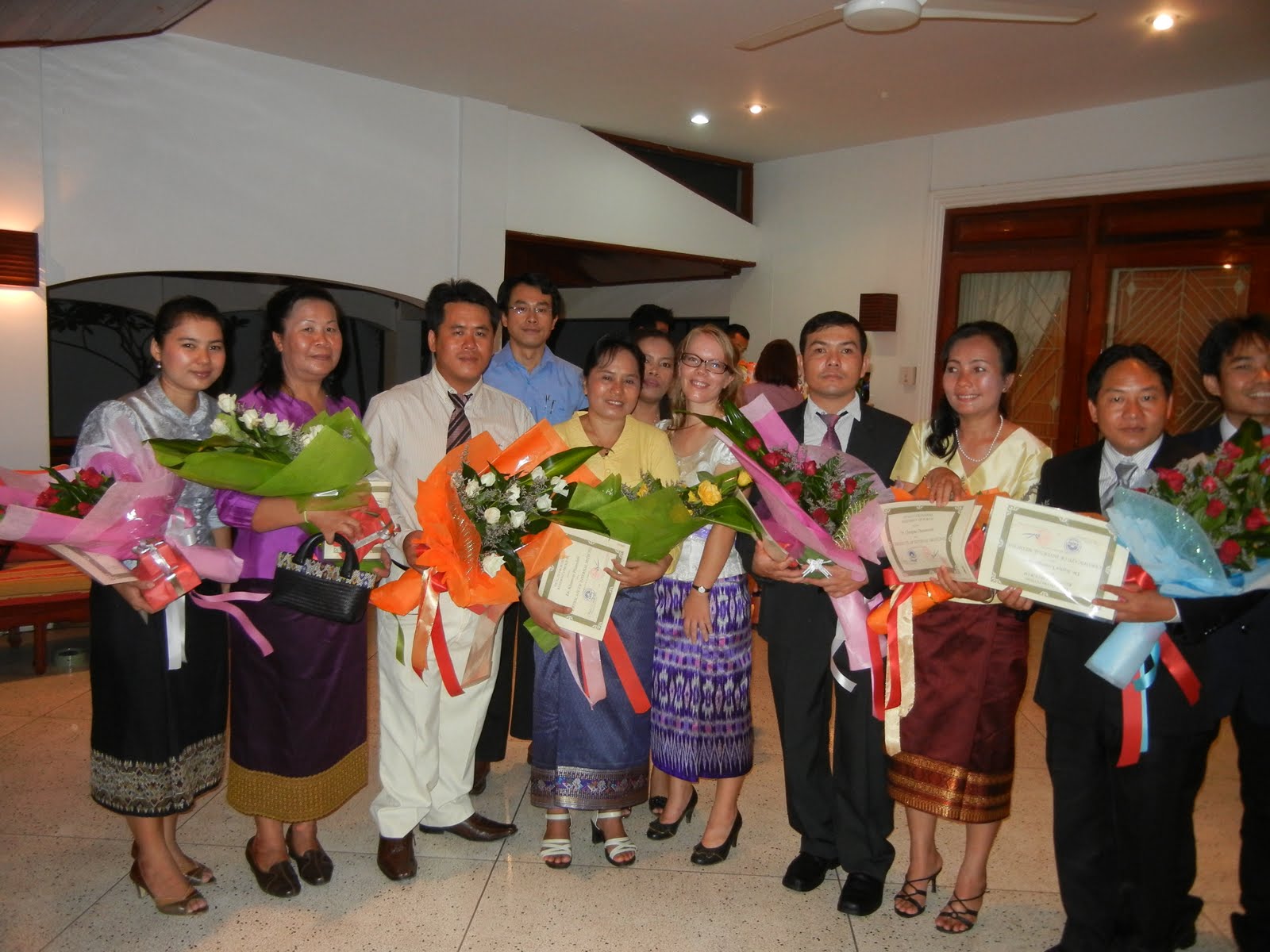
Me and all 7 of my grads, plus some other residents.
Why did this event seem so much more special to me? I saw my own residency graduation as more of a formality - a “Here, you didn’t kill anyone, or otherwise royally screw up enough for us to notice you and kick you out, so take this diploma and please be on your way.” Some of that jaundiced view may have come from end-of-residency burn out. Some of it may have come from going to a big program where I didn’t really get to know many of my staff that well - I can count on one hand the number of people I had as supervising staff for more than one solid 2 week block. (Don’t get me wrong, my big program had lots of advantages, and I wouldn’t go back and go anywhere else, but being a personal, close-knit program was not one of them.) Some of it may come from the fact that in America, residency is just one more required step on the road to being an independent doctor - an important one, and one I’m glad I completed, but not something special.

The crowd looking on - the fathers of Lao medicine are in the R foreground.
In Laos, I feel like graduation IS special and meaningful. There are more than 100 Lao medical school graduates each year (and the number is growing every year.) Our programs each accept 5-8 new residents each year, and even if you add in the surgery, ob-gyne, family practice, and anesthesia residencies, still most practicing doctors in Lao have not completed a formal residency training, and there aren’t residency spots for everyone graduating from medical school. So our residents are special just by virtue of being in residency - they have taken a test for admission and many have had to move away from their families and live in dorms for 3 years to complete residency. They also give up any income they might have from private clinics during the 3 years they are here, so they have to really want to come. They are, almost uniformly, eager learners, gracious, and very concerned about doing what’s best for their patients. So it was exciting to celebrate the graduates, the new residents, the teachers, and the program in general.

Three of my residents arrived in these dapper suits - Men in Black!
The formal part of the night was relatively short - just over an hour. I welcomed everyone and introduced the Ambassador, who gave a short speech in Lao and English. The current Ambassador, Her Excellency Karen Stewart, was the Charge D’Affairs (interim head of the embassy) when the tradition of having graduation at the Ambassador’s residence was started 10 years ago, and this is her first year back as Ambassador, so that was nice. I was impressed that she spoke in both Lao and English. The Lao people were impressed by how tall she is for a woman - she is quite tall, and towered over (in a very friendly, welcoming way) all the Lao guests. I bet she gets really, really tired of comments about her height.

Libby + Ambassador Stewart
Then, Margie introduced Dr. Bounkong, one of the founders of the IM program, who has supported HF since we started working in Laos, through multiple job changes for him. His most recent promotion was to Vice-Minister of Health, so he spoke on behalf of the Ministry of Health. Then Margie introduced Dr. Alounyadeth from UHS, who welcomed everyone again and spoke briefly about the partnership with UHS. Margie’s introductions included this: “The success of the pediatric and internal medicine residency programs is built on the strong leadership of the Ministry of Health and the long-standing collaboration between the Ministry of Health and Health Frontiers. This year, Health Frontiers celebrates its 20th year of partnership with the Ministry of Health with our mutual goal of improving the capacity of the health care workforce in Lao PDR.” The same is true of UHS, so we were happy to have representative of both organizations in attendance at the ceremony. It’s also great that HF has been in Lao for 20 years this year- not many groups have been working here that long. We are small, and our mission is small, but we keep at it, and every year we finish training a few more pediatricians and internists!
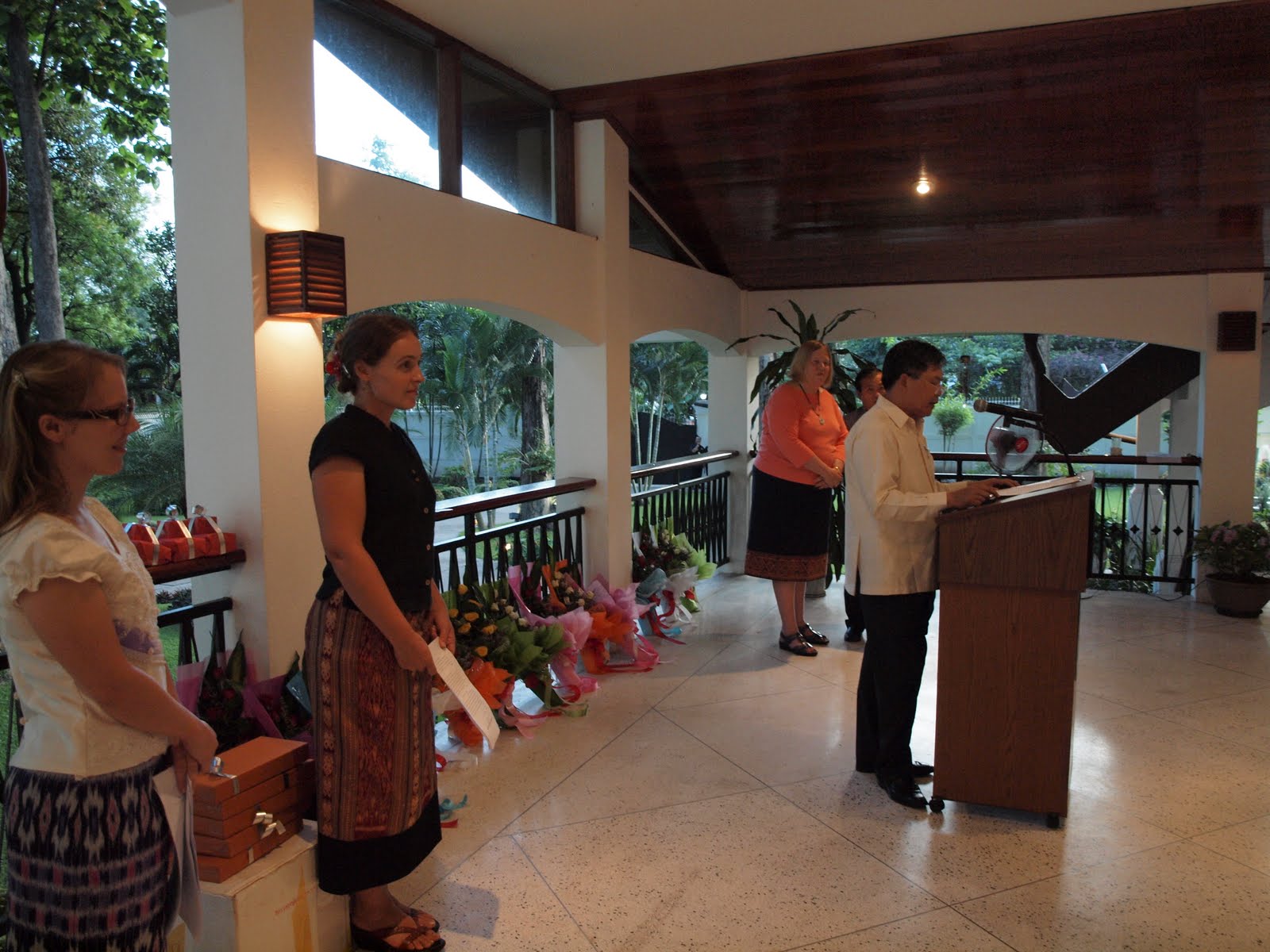
Dr. Bounkong addressing the crowd.
Next, The peds section began. Dr. Khampe, the director of Settathirath hospital, gave a brief speech to the graduates. Then Amy and Margie introduced the new Peds residents and gave them their stethoscopes; each year HF buys decent-quality stethoscopes for the new residents. They gave the award for Best Teacher, and the awards for Best Resident from each class. (Voted by the Lao teachers.) This year, they added a new category - best resident by vote of their peers, and the selections all highlighted residents that Margie and Amy do consider to be excellent residents and leaders in their classes. (Despite my jaundiced view of my own graduation, I will say that our resident awards seemed to go to the appropriate people as well.) Finally, they announced all the Graduates, and gave them otoscope/opthamoscopes, certificates, and flowers.

The graduating class of Peds with the Ambassador
Then it was my turn to MC the IM section. (This was a lot of public speaking for me. I’ve gotten better at it over the years, and lecturing weekly has helped, but I still wasn’t totally comfortable.) I’m going to paste in a few more quotes from the actual ceremony, because they pretty accurately capture what I think was important to say.
“Tonight we celebrate the 7th class of internal medicine residency graduates. Upon graduation, there will be 43 Lao-trained internal medicine specialists working in Vientiane and 11 provinces. This year, we send our first graduates to work in Salavan and Louang Prabang provinces. We now also have 2 graduates who have completed sub-specialty fellowship training in Thailand, and 5 who are in fellowship training currently. It is exciting to see our graduates grow into competent and confident physicians but to also see the impact they make as they teach the next generation of medical professionals. All of this has been made possible through the hard work and dedication of the internal medicine teachers and the Lao Internal Medicine Association.” Then Dr. Vang Chu, Chair of the Cardio ward, president of the Lao Cardioloy association, and another wonderful, long term supporter of the residency program gave a short speech, in which he congratulated the residents and encouraged them to be lifelong learners, come to CME, and call their teachers if they ever needed help.
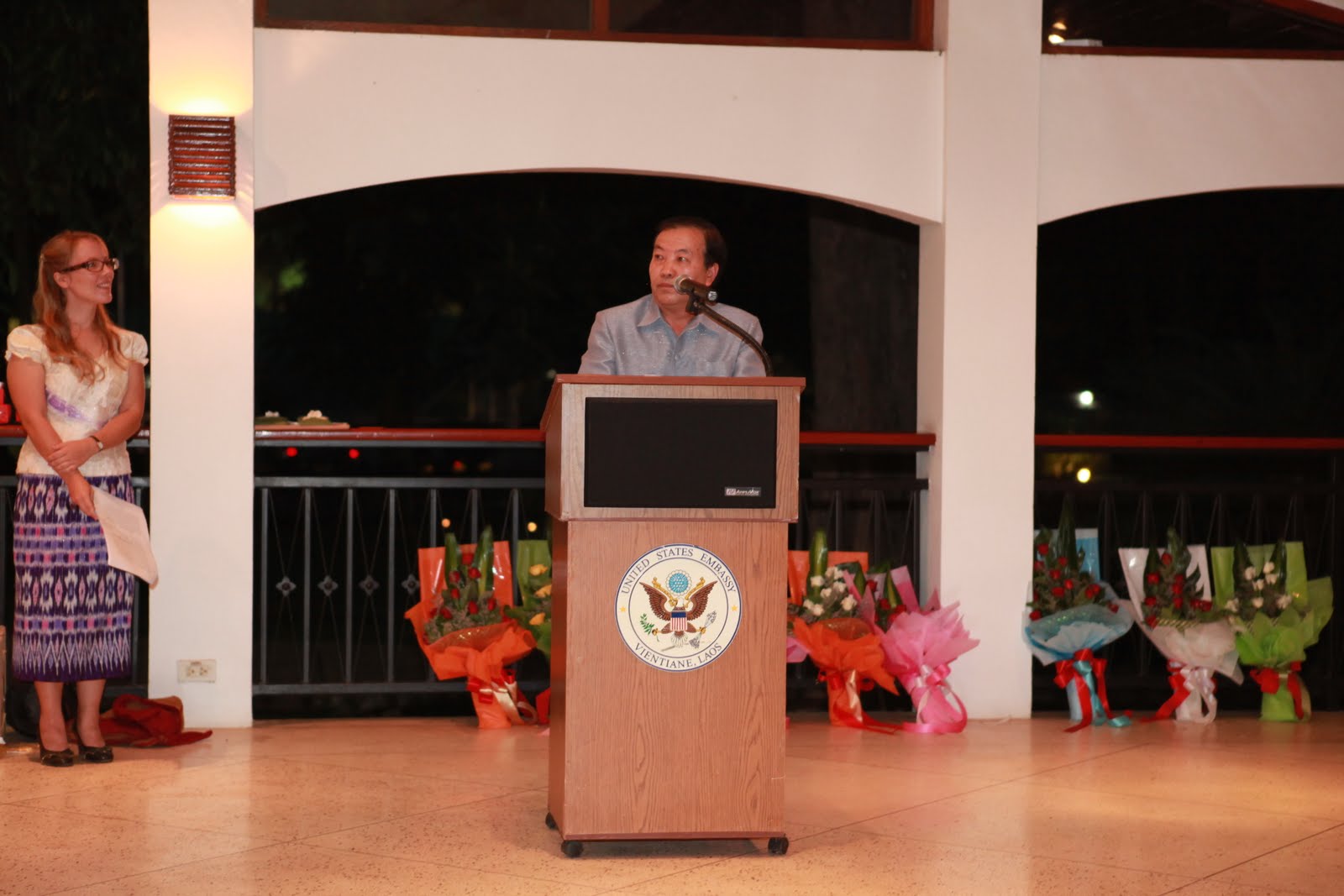
Dr. Vang Chu addresses the IM residents
Next, we introduced the new residents. “This is an exciting time of the academic year as we celebrate the graduation of one group of residents, rejoice in the promotion of our continuing residents and welcome a new group of physicians to start this amazing journey. It is a difficult decision to leave your job and for some, your home and family to pursue further medical education and all the hard work that goes with it. But we are pleased that this year, six more physicians have decided to take the challenge.” Residency selection was such a challenge for IM this year, I can sincerely say that I do rejoice in having these 6 residents finally started and learning. I’m glad they all have decent stethoscopes now, too, we can start (gently) pimping them on heart and lung findings. . .

I present Ammala with her stethoscope.
Next, we thanked last year’s chief residents, who have tirelessly, and often thanklessly, worked to make sure they had lectures scheduled (I help with this, but they usually remind the teachers the day before and make the calls for a fill in lecturer when someone cancels.) They also gently and patiently steer me back to the correct path if I’ve gone astray on some planning or communications issue, and translate English lectures into Lao for their classmates who aren’t yet fluent in English. Our chiefs are just second and third year residents, and they don’t get any extra compensation for doing this delicate job. Then the graduating chiefs presented the Best Teacher award. This year, it went to Dr. Bouachanh from the GI ward. Last year too, and probably many years before that. I think the vote was probably unanimous (Novalinh counted it for me.) So no one was surprised by that. :) Dr. Bouachanh did residency in IM in the soviet bloc, and he is a soft spoken man, but also a truly excellent clinical teacher. The GI ward gets all the patients who don’t clearly belong on the Cardio, ID, or Pulmonary wards at Mahosot, so he’s really a great general internist as well, and he knows a lot about Lao presentations of confusing diseases. He is old enough to retire, but still comes to the hospital every single day to check on the patients and teach.

Phanivone and Phonpadith present Dr. Bouachanh with his award.
Then we gave resident awards - to the outstanding residents and most improved residents in each class. Voting for this was close, and the results changed several times in the 2 days before the ceremony as more people called in last minute votes. My introductory statements were: “Each year, the teachers like to acknowledge the most improved resident in each class. I am glad that I was not asked to vote for this award, because I am continually impressed by how much each one of you has learned, and what great questions you ask that require me to learn.” and “Each year the teachers also acknowledge an outstanding resident in each class. Again, I am glad not to have to vote, because each of you exhibits excellence in different areas, and it would have been hard to choose just one.” Both of these statements are sincere - I really don’t know who I would have voted for in either category for most of the classes - because there are so many residents who exhibit a keen ability to learn and / or clinical excellence.
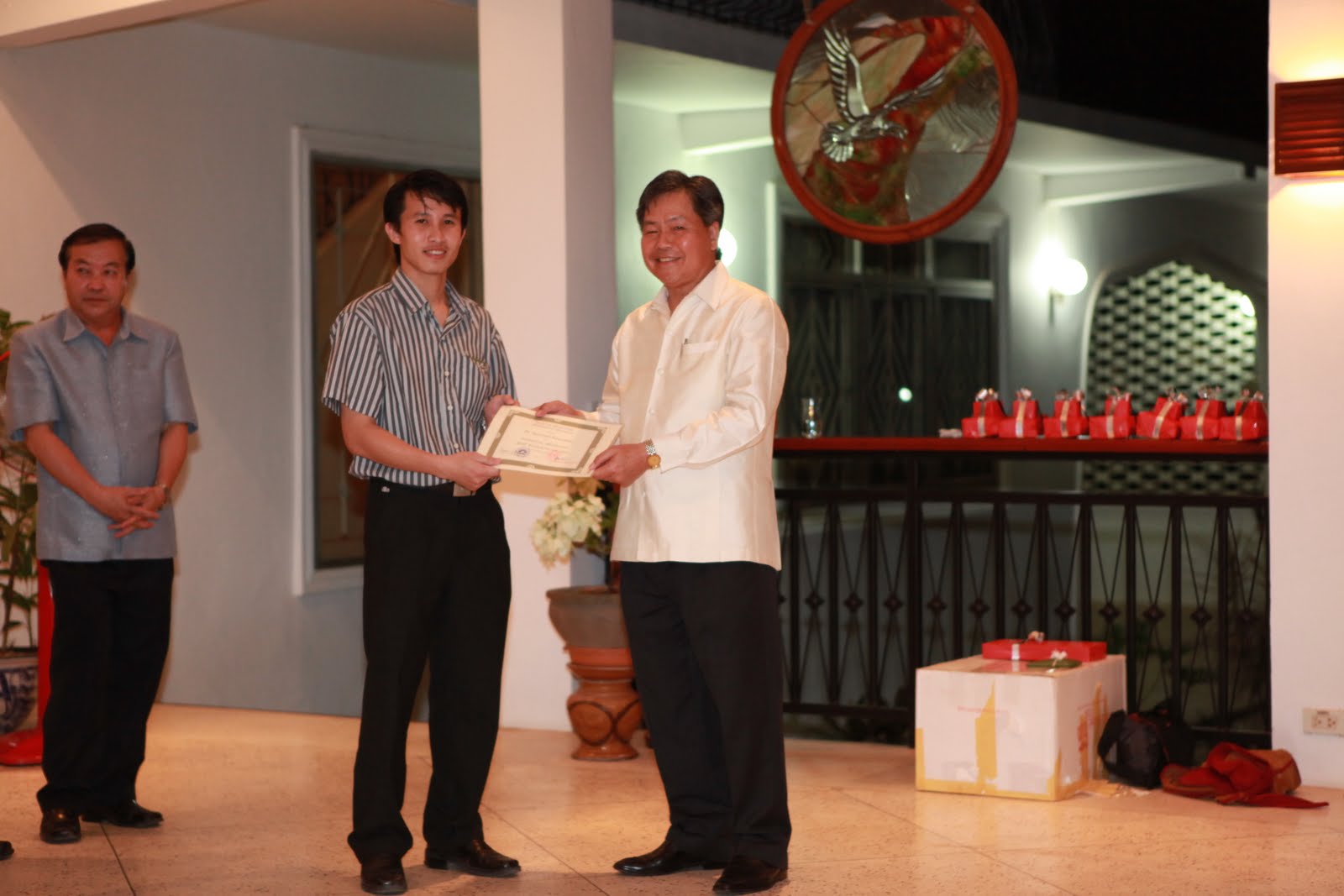
Chief resident Saysavath accepts the best resident award for the 2nd year class.
Finally, in the end of the formal ceremony, we announced the IM graduates. They got a certificate, flowers, and a glucometer as a parting gift. In years past we’ve given them text books, but I think the glucometer is a practical gift that will get used - even by the residents who don’t read English well enough to really make use of a text - so I’m pleased with it. Last year, the presents didn’t get here until after the ceremony, and we ended up giving them at the University ceremony for peds and at CME for IM, so it was also nice to have them to give on the actual night of the ceremony. This is what I said: “We would like to honor and congratulate the Internal medicine graduates of 2010. I have only known them for 9 short months, but I feel confident that each and every one of these doctors will go on to be a teacher and leader in the hospitals in which they practice. Four of them will be returning to provincial or district hospitals this year, and three of them will be the first specialty-trained internists in the hospital when they arrive.” Dr. Bounkong, Dr. Vang Chu, and Dr. Bouachanh presented the certificates and presents to the residents as I read their names, so they were literally each surrounded by their incredible, supportive teachers who are great role models for them as the enter independent practice again.

Dr. Chirapha surrounded by her teachers.
The Ambassador briefly closed the official part of the event, and we proceeded to a flurry of snacking and picture taking. I hope the above description captures some of why it was such a nice event for me. At 8, we cleared out of the Ambassadors house and the peds residents went for karaoke. There, I got to see a very different - less serious, less shy - side of them, which was nice. Plus there were some very inappropriate videos with the English Karaoke songs, which was, well, not so nice, but pretty hilarious.

Ambassador and all IM grads
Subscribe to:
Posts (Atom)
