When you move from a medical culture like America’s to a markedly different one (like Laos) you notice stark differences initially, but then you readjust your expectations and things seem normal here that would be totally bizarre at home. I was reminded of this 2 weeks ago. I had seen a confusing patient with the resident at Setta - and 80+ year old woman who had come in with a severe, unilateral temporal headache that had been present for 2 months. She had photophobia and tearing but also had some swelling and redness. She had no fever, though or other infectious symptoms. She had been seen at another hospital, had a head CT, and told she had brain cancer. “Great! Brain Cancer!” I thought. Of course brain cancer is never great, but a mass lesion in that area might explain her confusing array of symptoms. She had some weight loss as well, so malignancy was plausible. And in an 80+ year old, not super surprising or tragic - she has outlived her life expectancy by more than 20 years. Plus, a mass could also be parasites or abscess, and treatable.
Only one problem existed with this theory - we had the CT (non-contrast) and we couldn’t see any mass. No clearly defined mass lesion, no significant unilateral swelling or loss of contours of the fissures, no midline shift. Could it be temporal arteritis? Certainly, though the ESR was near normal, making this far less likely. Also, it hadn’t improved with steroids. This makes other autoimmune/rheumatological conditions lower on my list as well. Could it be an optic nerve / retinal problem? Could it be glaucoma - the time course was wrong, and the external eye exam didn’t quite fit, but then she wasn’t really fitting any clinical syndrome convincingly. After two trips to the opthamology department, it was determined that both her external ocular structures and retina were normal. A chest x-ray showed masses on either side of the mediastinum that looked more like tumor than infection or anything else, and an abdominal ultrasound showed a mass in the liver. Oh, and she still had no pulmonary or infectious symptoms. Basically, we had no idea what was going on with this patient, but malignancy was still highest on our list having ruled out a number of other things.
One day, after she’d been in the hospital for several days, I was on my way out of the room when I was stopped by her daughter and asked (In excellent english) if I could take a few minutes to explain what was going on with her mother. I was taken aback. I hadn’t been approached with a question from a family member since leaving America. It just doesn’t happen here. I often have to encourage the residents to stay and explain the diagnosis and plan to the family after we discuss a patient, because otherwise they just write the orders with little explanation. They do counsel patients about chronic disease, etc, but generally, the patients trust the doctors and don’t request explanations of what is going on. This is mostly bad; patients don’t know what has been done before because no one explains it to them, and they are probably more prone to non-compliance if they get side effects, because no one has explained why their treatment is important. However, I realize I have adjusted to this culture.
Her daughter was from Phoenix, where she had lived for the past 25 years, and had been called home because her mom was sick. She was coming from the American medical culture where patients now demand explanations from their doctors. I explained that I serve mostly a teaching / consultant role for my residents, and I do not make any direct patient care decisions, only recommendations that the staff physicians actually directly supervising the residents can accept or reject, so the residents and Lao staff would actually be the final decision makers regarding treatment and testing. I explained that we think her mom has lung cancer with a paraneoplastic syndrome (Cancer associated) or a mass lesion that we can’t see on the non-contrast CT. We could get more info with a head CT with contrast, and a chest CT, but we still wouldn’t be able to make a definitive diagnosis. For that, they would have to go to Thailand where they could get a biopsy and pathology results on one of the masses. However, that still wouldn’t confirm the cause of the headache, which was her only real symptom, and would be expensive. It might result in offers of chemotherapy which the family would then have to decide about. We were pretty sure it wasn’t infectious at this point, and she was getting steroids for theoretical tumor edema, but in doses that should treat temporal arteritis or other rheumatological diseases. My understanding is that the medication options for pain in Thailand aren’t much better than ours here. Of course, there was a period of shock - there are no oncologists in Lao? Nope. There isn’t anyone who could do a biopsy here? Nope, no IR doctors, only general surgeons, and I sure as heck wouldn’t let anyone near this frail, elderly lady for an open biopsy to confirm something we can’t treat. (I seriously doubt the surgeons would have done it even if we’d asked.)
The patient’s daughter absorbed this information. Despite being much more aggressive than a Lao patient or family member, she was relatively reasonable - she agreed that diagnostic testing for something we couldn’t treat was not worth pursuing. Neither doctors nor patients are very comfortable with uncertainty in America. I was feeling uncomfortable about how few answers I could give her, so I was impressed that she didn’t demand a better (or at least more definitive) answer. Then she asked me how long her mom might have.
Doctors everywhere hate being asked this question. Unless your patient clearly is going to die within the next few hours, it’s hard to answer. Even if we have a diagnosis of a specific type of cancer, for example, all we can do is give statistics - most people live about this long - but humans are individuals, and averages are averages - some people will live much much longer, and others might seem fine today and have a serious complication and die tomorrow. And then, of course, any of us could die tomorrow - in a traffic accident on the way to work or from some unknown, asymptomatic but serious medical condition. Everyone know someone who doctors said only had a few weeks or months to live and who exceeded their predicted longevity by multiple times the estimate, making the doctors look foolish for predicting in the first place.
I understand why she wanted to know - she had taken all her vacation/leave time to come and spend with her Mom. Was this the right time to be here? Should she try to go home and come back when her mom was really ill so she could be present for the funeral as well? If she went home, the cost of coming back (>2000$ if your ticket is purchased well in advance) and the transit time (at least 30 hrs each way) would make coming back urgently nearly impossible, especially if all her leave time was used up. I understood the question, but I still resented it. How could I make a prediction about how long this woman would live, not even knowing for sure (or for a strong most-likely) what she had?
So I gave her my standard answer - one that I learned from an experienced Irish hospice doctor. “Of course, we never really know, and doctors are terrible at predicting this. However, generally, if she’s been well and deteriorating slowly over months, she probably has months to live. If you see her getting worse over weeks, she probably has weeks to short months to live, and if she is getting worse day by day, then she has days or short weeks.” I thought given that her mom looked pretty good day by day, that it was unlikely that she would die while the daughter was visiting, but she could be on the verge of a rapid deterioration, so I couldn’t make any guarantees.
Over the next week we tried to get her mom’s symptoms more under control. The steroids helped a little, but not dramatically. IV morphine or pethedine worked briefly, for about 3 hours, but this is not a good solution for a patient who should be working towards going home to spend quality time with her family. Our only oral narcotic here is tramadol - not a strong drug, and one which has a strict dosing limit due to seizure risk. Could we give IV or subQ or IM meds at home? They could have the village nurse come by 3 or even 4 times/day, but we had no way to know if this person would be familiar with IV or sub-Q drug administration, morphine dosing, dose changes etc, so it seemed like a bad idea. (Morphine is only used in the hospital, so it’s unlikely that the neighborhood nurse would be comfortable using it to manage pain.) Not to mention the morphine was only lasting 3 hours, and there is no extended release formula here. I tried to encourage scheduled tylenol and tramadol, and we added amitriptyline, which should help if there was a nerve component of the pain, which the symptoms suggested. We switched the steroids to oral. I had another long talk with the daughter explaining what each medication was for, how much she could take, and how frequently she could take it. I did more medication counseling in that one session that I have done (or seen done) in my entire time in Lao.
The truck wasn’t starting at the end of last week, so I didn’t get back to Setta to see how things were going. I’m not particularly optimistic, since scheduling pain meds is another thing that doesn’t really exist in Lao culture, and since we’re working with such poor choices to start out with. This case did inspire me to put together a lecture on pain and symptom management using medicines available here, which I hope I can give early in May when the new residents are here. (I offered to give it next week but they would rather have exam review, reasonably.)
I think there is a happy medium between the Lao patient / caregiver - almost never questioning or understanding their medications and diagnosis - and the American one - demanding answers (and often tests or treatments). Both cultures often end up with patients who are “non-compliant.” Lao patients who aren’t warned about side effects of important treatments may stop them independently and not return for an alternative. American patients perceive a side effect from a medication and search the internet to confirm that this is possible, stop the med and then blame their doctor for not warning them, even if the side effect has only a few case reports associated with it. Lao patients rely on doctors to order the right tests and treatments without any questioning, while American ones often demand unnecessary testing or treatment that then leads to further anxiety, more money spent on confirmatory tests, and / or side effects. Lao patients should be less trusting and demand more info. American patients should be more trusting - demanding information and explanations, but being willing to accept them when provided, and to work with their doctor to find an alternative.
I also think that returning to patient care in America, this may be my biggest aspect of culture shock - not the availability of tests we don’t have here, the tremendous expenditure of resources we don’t have here, or the absence of diseases that are common here - but the way I communicate with my patients.
Sunday, April 3, 2011

Sunday, March 27, 2011
Internal Medicine Continuing Medical Education
I am home from the 2 day IM CME conference. This is the 8th annual IM CME in Laos, and a number of improvements have been made over the years. For example, this year’s conference is on Friday and Saturday. They used to be held during the middle of the week, so that no one’s weekend was infringed on (even if they had travel days on either end), but we now acknowledge that it’s cool to learn on the weekend too. There was also minimal debate in the planning stages about whether boxed lunches would be OK - in the past much attention has been given to the quality of the buffet, but recently the quality of the lectures has taken precedence. The conference is still funded in part by pharmaceutical companies, but to be fair a lot of American CME is too.
I arrived just after the official start time, 8:30, and we actually started only 10 or 15 minutes later. The opening ceremony involved several of the head doctors in IM plus some ministers giving speeches. I had a moment of sheer terror when the WHO representative was asked to speak and I realized that I didn’t know if I was going to be asked to contribute to this. (Fortunately, I wasn’t.) In America, this would be a brief welcome formality, but in Lao the opening and closing ceremonies are important parts of the conference. So important that there are usually multiple camera men, and today, 2 videographers. I have to be very careful not to make faces during the opening ceremonies, because the videographers seem to particularly enjoy recording the one Falang in the room.
At the end of the opening ceremony, the Minister of something related to health gave a long speech that involved frequent use of the Lao word for child, and I watched the other dignitaries and attendees expressions of alarm and then amusement as we all realized he had no idea what kind of conference he was at. Bor Pben Yang, at least he knew it was about doctors and patients.
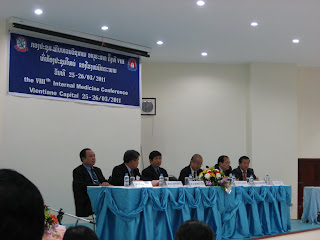
The dignitaries at the opening ceremony.
The first talk was a series of studies on patient satisfaction on one of the inpatient and outpatient wards at Mahosot. Interestingly, despite what would be considered sub-standard facilities (one one of the nicest, newest wards in Lao), 100% of the inpatients and more than 60% of outpatients thought the quality was “Good.” The other options were moderate or poor. Generally, positive answers were in the 85-100% range on all the subsets of the surveys, which were conducted twice several years apart. I don’t suppose there’s any way to figure out whether the patients really are that satisfied, they fear if they answer negatively their care will be affected, or they are just being polite non-complainers. I can’t imagine finding a group of American patients who would answer a similar survey the same way, however.
At the first coffee break, I tried a banana-leaf wrapped snack. I was skeptical, because several times in the past week the banana leaf has been filled with pork, sticky rice, and bean paste which I don’t actually like that much, but eat because it’s usually offered as part of some ritual event. This was sweetened coconut sticky rice, egg paste, and a pudding that i think was made of tapioca, though, and it was delicious. The rest of the morning was Thai doctors and the Lao endocrine fellow introducing them and the topics. It is nice to see Vasana, one of the graduates of the first residency class and now a HF sponsored fellowship grad, in a leadership/teaching role now.
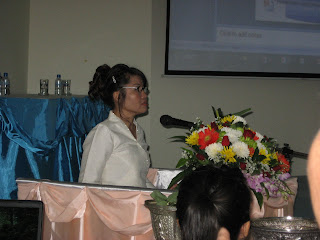
Dr. Vasana introducing topics and her Thai colleagues. Isn't she beautiful?
I ate lunch in the VIP room, with the Lao senior teachers. Alounxay, a recent residency graduate and staff on the Cardio ward, served the most senior teachers lunch - as in, opened their boxed lunches and set things out for them - and then made coffee and tea for everyone as they finished their food. That’s a job you won’t find any American staff doctors doing. . . cultural differences. The box lunches were pretty good - pork and beans and white rice with a few slices of fried mekong fish or fried rice and soup - so I’m glad they saved money on a buffet.
After lunch, I went downstairs to peruse the pharma shopping area. It was interesting, especially when I realized the book stand was run by one of our residents - a second year who is not super motivated on the wards. The residents had mentioned something about his driving to Thailand for books in the past, which I thought was odd, but didn’t question further. I guess he’s running an import business now. He was doing brisk business with residents, staff, and medical students. I can’t really begrudge this - he is giving access to resources that they otherwise might find harder to get - and I think his mark up was only a dollar or two per book. Maybe he should have become a businessman, not a doctor. I bought a copy of the mass general handbook of internal medicine “Pocket Medicine” - it’s smaller than the real thing, has a beautiful pink cover, and was 6$. American MSRP - 60$. I probably should have owned one in residency, but better late than never, eh?
Afternoon was mostly Thai doctors - Movement disorders, chronic kidney disease, spondyloarthropathy - before the coffee break. At the end of each session, awards were presented to all the speakers - wrapped presents in boxes for the Thai visitors and envelopes for the Lao speakers. One of the senior doctors, or if present dignitaries, is called to the front of the room where a lovely young woman holds a silver bowl with the present or envelope in it. The presenter takes it out and hands it to the speaker while the audience claps rhythmically. Then they hold the pose of giving/receiving until the pictures are taken.
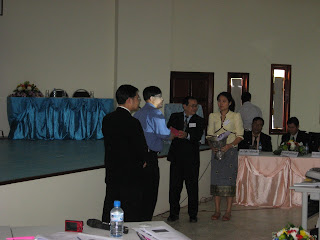
Presenting thank you presents.
After the coffee break, we had a really great presentation from a Lao MD/epidemiologist about causes of fever in 2 distant provinces - one far north and one far south - that was impressive in reminding me of the quality of research that’s being done here with limited resources. And how much it can help them with treatment, like choosing antibiotics that the common local pathogens are susceptible. Brent would be please to see how frequently this means Doxycycline rather than ofloxicin, azithro, or ceftriaxone. Then we had some case presentations, one of ITP treated with cyclophosphamide which prompted a lot of discussion and I’m pretty sure there’s no evidence for, but since I didn’t completely understand the presentation, I kept my mouth shut. (I had just given a talk on thrombocytopenia thursday to the residents, so I’m a little worried they are getting mixed messages, but I think the discussion was heated enough to let them know that’s certainly not a well-accepted first line treatment.)
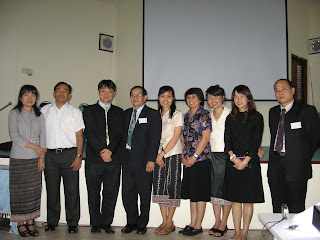
Thai visiting doctors and their current and former fellows and a few of the senior Lao doctors who have made fellowship possible by building the program.
The second day of CME featured: a Lao Nephrology fellow who will be returning from Bangkok soon talking about Rhabdomyolysis - (seems particularly relevant given all the earthquakes recently including one on the Lao/Myanmar border), our senior GI physician talking about GI cancers, another Thai physician discussing the interaction between PPIs and Plavix and the development of H Pylori resistance in Thailand and the interaction between PPI metabolism and H pylori eradication, several case presentations, and discussions of dialysis access and bronchoscopy in Laos. It all seemed useful and relevant, not to simple or too complicated to be useful here. And the PPI metabolism was new to me too - interesting! The first coffee break featured wafer-like, crispy cookies and small green jelly/coconut/mysterious centered treats wrapped in saran wrap, as well as the usual eclairs and cake. Lunch was fried rice and soup or pork and beans and breaded chicken with white rice. I opted for the fried rice. The second coffee break was fruit and very sturdy jello-like heart shaped pudding treats both days. Oh, and powdered soy milk in hot water - I liked the hot powdered milk drink in tanzania, and I found this tasty too (of course it has sugar added), although after a day of sitting and listening to lectures with breaks for food, I certainly didn’t need the calories. I tried to replicate the powdered milk drink in america, but was unsuccessful. There’s something about the texture of the milk powder that makes ours not work.
So overall, although I don’t fully understand most of the content, CME was positive. It was organized entirely by the Lao doctors, seemed relevant, and certainly showcased some HF grads in leadership roles (in addition to the lecturers, many of the people instrumental in planning are our former residents.) I wore 2 beautiful new sins an got many compliments including the ultimate one - “If you changed your hair color, you would be like a Lao woman.” (I challenge you to find a more gracious and complementary group of people than the Lao, so I know it’s not personal, but it’s still nice.) The residents looked engaged in the lectures, the residency grads and even a couple residents asked questions, a good sign that they are both paying attention and learning, and not afraid to speak up. Pharma paid for part of it, but didn’t seem to have any impact on the lectures themselves, and was not given time to speak, just space downstairs to sell the attendees stuff (and give them pens and hand outs, of course.)

The beautiful ladies of IM - Residents Payvanh, Khamvay, Libby, Velouvanh (Fellow at KKU) and Phouthasone. Phouthasone was unhappy about being in the sun. Notice my beautiful woven silk Sam-Neua style sin; This is what gets the compliments, not actually me.:)
I arrived just after the official start time, 8:30, and we actually started only 10 or 15 minutes later. The opening ceremony involved several of the head doctors in IM plus some ministers giving speeches. I had a moment of sheer terror when the WHO representative was asked to speak and I realized that I didn’t know if I was going to be asked to contribute to this. (Fortunately, I wasn’t.) In America, this would be a brief welcome formality, but in Lao the opening and closing ceremonies are important parts of the conference. So important that there are usually multiple camera men, and today, 2 videographers. I have to be very careful not to make faces during the opening ceremonies, because the videographers seem to particularly enjoy recording the one Falang in the room.
At the end of the opening ceremony, the Minister of something related to health gave a long speech that involved frequent use of the Lao word for child, and I watched the other dignitaries and attendees expressions of alarm and then amusement as we all realized he had no idea what kind of conference he was at. Bor Pben Yang, at least he knew it was about doctors and patients.

The dignitaries at the opening ceremony.
The first talk was a series of studies on patient satisfaction on one of the inpatient and outpatient wards at Mahosot. Interestingly, despite what would be considered sub-standard facilities (one one of the nicest, newest wards in Lao), 100% of the inpatients and more than 60% of outpatients thought the quality was “Good.” The other options were moderate or poor. Generally, positive answers were in the 85-100% range on all the subsets of the surveys, which were conducted twice several years apart. I don’t suppose there’s any way to figure out whether the patients really are that satisfied, they fear if they answer negatively their care will be affected, or they are just being polite non-complainers. I can’t imagine finding a group of American patients who would answer a similar survey the same way, however.
At the first coffee break, I tried a banana-leaf wrapped snack. I was skeptical, because several times in the past week the banana leaf has been filled with pork, sticky rice, and bean paste which I don’t actually like that much, but eat because it’s usually offered as part of some ritual event. This was sweetened coconut sticky rice, egg paste, and a pudding that i think was made of tapioca, though, and it was delicious. The rest of the morning was Thai doctors and the Lao endocrine fellow introducing them and the topics. It is nice to see Vasana, one of the graduates of the first residency class and now a HF sponsored fellowship grad, in a leadership/teaching role now.

Dr. Vasana introducing topics and her Thai colleagues. Isn't she beautiful?
I ate lunch in the VIP room, with the Lao senior teachers. Alounxay, a recent residency graduate and staff on the Cardio ward, served the most senior teachers lunch - as in, opened their boxed lunches and set things out for them - and then made coffee and tea for everyone as they finished their food. That’s a job you won’t find any American staff doctors doing. . . cultural differences. The box lunches were pretty good - pork and beans and white rice with a few slices of fried mekong fish or fried rice and soup - so I’m glad they saved money on a buffet.
After lunch, I went downstairs to peruse the pharma shopping area. It was interesting, especially when I realized the book stand was run by one of our residents - a second year who is not super motivated on the wards. The residents had mentioned something about his driving to Thailand for books in the past, which I thought was odd, but didn’t question further. I guess he’s running an import business now. He was doing brisk business with residents, staff, and medical students. I can’t really begrudge this - he is giving access to resources that they otherwise might find harder to get - and I think his mark up was only a dollar or two per book. Maybe he should have become a businessman, not a doctor. I bought a copy of the mass general handbook of internal medicine “Pocket Medicine” - it’s smaller than the real thing, has a beautiful pink cover, and was 6$. American MSRP - 60$. I probably should have owned one in residency, but better late than never, eh?
Afternoon was mostly Thai doctors - Movement disorders, chronic kidney disease, spondyloarthropathy - before the coffee break. At the end of each session, awards were presented to all the speakers - wrapped presents in boxes for the Thai visitors and envelopes for the Lao speakers. One of the senior doctors, or if present dignitaries, is called to the front of the room where a lovely young woman holds a silver bowl with the present or envelope in it. The presenter takes it out and hands it to the speaker while the audience claps rhythmically. Then they hold the pose of giving/receiving until the pictures are taken.

Presenting thank you presents.
After the coffee break, we had a really great presentation from a Lao MD/epidemiologist about causes of fever in 2 distant provinces - one far north and one far south - that was impressive in reminding me of the quality of research that’s being done here with limited resources. And how much it can help them with treatment, like choosing antibiotics that the common local pathogens are susceptible. Brent would be please to see how frequently this means Doxycycline rather than ofloxicin, azithro, or ceftriaxone. Then we had some case presentations, one of ITP treated with cyclophosphamide which prompted a lot of discussion and I’m pretty sure there’s no evidence for, but since I didn’t completely understand the presentation, I kept my mouth shut. (I had just given a talk on thrombocytopenia thursday to the residents, so I’m a little worried they are getting mixed messages, but I think the discussion was heated enough to let them know that’s certainly not a well-accepted first line treatment.)

Thai visiting doctors and their current and former fellows and a few of the senior Lao doctors who have made fellowship possible by building the program.
The second day of CME featured: a Lao Nephrology fellow who will be returning from Bangkok soon talking about Rhabdomyolysis - (seems particularly relevant given all the earthquakes recently including one on the Lao/Myanmar border), our senior GI physician talking about GI cancers, another Thai physician discussing the interaction between PPIs and Plavix and the development of H Pylori resistance in Thailand and the interaction between PPI metabolism and H pylori eradication, several case presentations, and discussions of dialysis access and bronchoscopy in Laos. It all seemed useful and relevant, not to simple or too complicated to be useful here. And the PPI metabolism was new to me too - interesting! The first coffee break featured wafer-like, crispy cookies and small green jelly/coconut/mysterious centered treats wrapped in saran wrap, as well as the usual eclairs and cake. Lunch was fried rice and soup or pork and beans and breaded chicken with white rice. I opted for the fried rice. The second coffee break was fruit and very sturdy jello-like heart shaped pudding treats both days. Oh, and powdered soy milk in hot water - I liked the hot powdered milk drink in tanzania, and I found this tasty too (of course it has sugar added), although after a day of sitting and listening to lectures with breaks for food, I certainly didn’t need the calories. I tried to replicate the powdered milk drink in america, but was unsuccessful. There’s something about the texture of the milk powder that makes ours not work.
So overall, although I don’t fully understand most of the content, CME was positive. It was organized entirely by the Lao doctors, seemed relevant, and certainly showcased some HF grads in leadership roles (in addition to the lecturers, many of the people instrumental in planning are our former residents.) I wore 2 beautiful new sins an got many compliments including the ultimate one - “If you changed your hair color, you would be like a Lao woman.” (I challenge you to find a more gracious and complementary group of people than the Lao, so I know it’s not personal, but it’s still nice.) The residents looked engaged in the lectures, the residency grads and even a couple residents asked questions, a good sign that they are both paying attention and learning, and not afraid to speak up. Pharma paid for part of it, but didn’t seem to have any impact on the lectures themselves, and was not given time to speak, just space downstairs to sell the attendees stuff (and give them pens and hand outs, of course.)
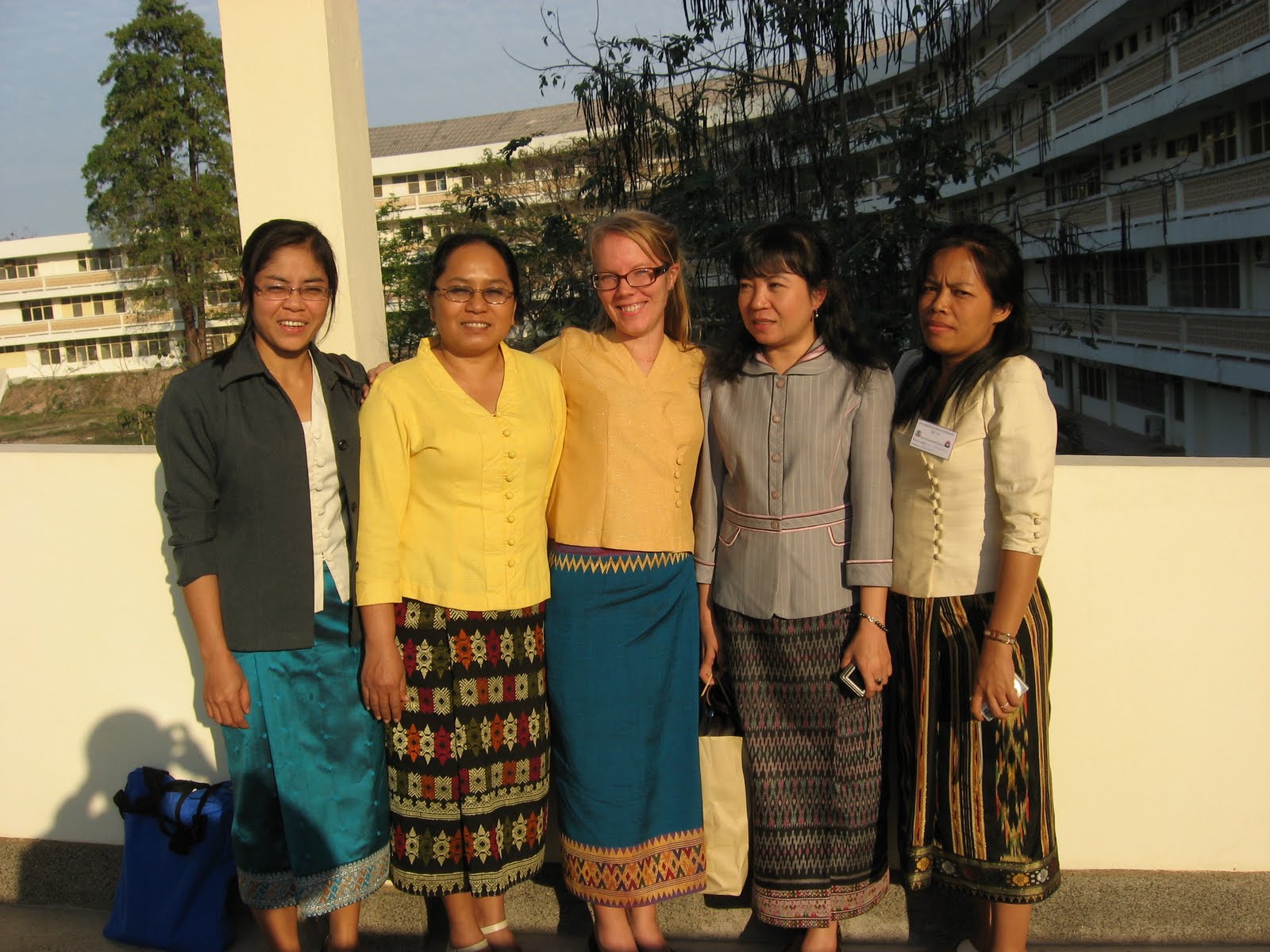
The beautiful ladies of IM - Residents Payvanh, Khamvay, Libby, Velouvanh (Fellow at KKU) and Phouthasone. Phouthasone was unhappy about being in the sun. Notice my beautiful woven silk Sam-Neua style sin; This is what gets the compliments, not actually me.:)
Monday, March 7, 2011
Hits and Misses
Wednesday, after I had seen patients with all 3 residents at Setta, the intern asked me if I wanted to see one more quick case. Sure, why not? I usually stay until it’s clear they are finished with me, unless I have an appointment or meeting at lunch. The ‘quick’ case was a 22 year old woman who had been transferred from another hospital after a wrist abscess was lanced the preceding day. Before being admitted there, she had had a transient episode of loss of vision (without change in consciousness, dizziness, lightheadedness, palpations, etc.) Within a few hours of the lancing, she had sudden, complete loss of vision. The intern tells me this story as between 5 and 10 eager medical students crowd around the bed. I check her eyes - she has pupillary reflexes, but the are sluggish. We do not have an opthalmoscope, but even if we did, she has photophobia and I’m not good enough with one to see anything in a patient who’s not extra cooperative. She has tenderness of her sinuses above and below the eyes, but no swelling, redness, or warmth. She also has a particularly tender area under her jaw on the left, and maybe a slightly big L tonsil but nothing too exciting inside her mouth, and supposedly no tooth pain recently. I listen to her heart and lungs. She’s a bit tachy, but I don’t hear anything else unusual, of course, she is moaning occasionally, so it’s not the easiest cardiac exam. (She's not morbidly obese, though, so it's not the hardest either.:) ) I usually start my exam with the patient’s hands, because it’s less personal and confrontational than the face, but with a crowd of 10 observing, my routine is off. I will later learn that this was a mistake. . .
I ask the residents what the wrist abscess looked like. It was red, warm, and swollen and drained puss when it was lanced. She only had fever for one day before coming to the hospital, according to the family. They haven’t actually seen it though, because no one has unwrapped it since her arrival at this hospital. Maybe the surgeons will look at it this afternoon. (She is actually on the surgery ward, the medicine team was just consulting.) I try to model good wound-observing practices, so we unwrap it. It’s surprisingly clean and benign looking - she writhes in pain every time we move the hand, but it’s not red or warm, and no pus comes out when I remove the pieces of what appears to be rubber glove that had been used to pack it. I’m beginning to think that she’s not a particularly stoic 22 year old. I re-bandage the wound. We talk about what could have possibly caused sudden, bilateral, complete, loss of vision in this 22 year old. We talk about how sudden loss of vision is an emergency (not a quick case.) I am worried about a retropharyngeal abscess with swelling affecting the optic chiasm, or some kind of spread to the sinuses with swelling, because I can’t figure out how else to put the clinical picture together. Either way, I’m pretty certain that she needs more than just cloxacillin, so I suggest we change to ceftriaxone and metronidazole, given the potential tooth/mouth involvement. Ceftraxone will cover meningitis if this is some kind of crazy manifestation of systemic spread from the wrist abscess. I also suggest we need a CT of her head somewhat urgently, and maybe and LP.
Thursday, I am told she is getting better (she is still in the surgery room) but has not had a CT. One of the french program interns suggests that this might be a psychogenic problem, as she tested a blink reflex and found it present, though the patient claimed not to see anything. Still, without a CT (and really, probably and MRI) we couldn’t rule out a physical cause, and I was worried about the tenderness I had found, so I again asked them to push for this. I did not see her, as I did have a lunch appointment and was just barely going to be on time.
Friday, she had been moved to one of our rooms. I had David, an Australian Oncologist here with his wife, Margie who is taking over the Peds coordinator job with me. Her vision was better, maybe even normal, and she was getting ceftriaxone and metronidazole. She still hadn’t had a CT. When I had gotten home Wednesday, I started to worry about eosinophilic meningitis - it can cause a lot of swelling and intraparenchymal hemorrhage - and severe headache, which she now had. Would a contrast head CT be bad, or terrible, in that case? No peripheral eosinophil on the CBC though, so we could put that worry lower on the list. She still had a lot of tenderness under her jaw as well. I again asked about getting a CT - preferably before the weekend started. And I gently chided the residents when I saw that the bandage I had put on on Wednesday was still there, just as I had left it. . . We headed on, but were called back to the bed. Someone had noticed lesions on her hands and feet. We went back to discover that she had classic Osler’s nodes on her right hand - the one without the abscess - and splinter hemorrhages and janeway lesions on her feet. Endocarditis would explain the multiple site of infectious involvement well - I listened to her heart again - now her heart rate was normal and I heard a soft systolic murmur. Was it new, or was my exam just harder on Wednesday? Had we missed these skin findings for 3 days? Or were these new despite antibiotics? We asked the family - they had been there since before she came to the hospital. Part of me was relieved, because it means she wasn’t failing treatment, but another part was mortified that we had all missed this evidence for 3 days. So we changed the plan - EKG, echo at Mahosot that afternoon, and talking to the family about a possible need to go to Thailand for valve replacement if she had a large lesion. We would add gentamycin if she got worse again. And someone would discretely ask her and her husband about “risk factors” (IE, not in the room with 7 other patients, 5-10 doctors/med students, and her whole family.) So that is how I missed, and then (probably) found, my first classic case of bacterial endocarditis. Needless to say, David was also impressed with the incredible pathology you can see here. I am hopeful and afraid about what I will find Wednesday when I return to Setta. (Today I had to take a visiting nephrologist out to Mittaphab for introductions, and tomorrow is Women’s day, a holiday, so the residents will do short rounds then go home.)
I ask the residents what the wrist abscess looked like. It was red, warm, and swollen and drained puss when it was lanced. She only had fever for one day before coming to the hospital, according to the family. They haven’t actually seen it though, because no one has unwrapped it since her arrival at this hospital. Maybe the surgeons will look at it this afternoon. (She is actually on the surgery ward, the medicine team was just consulting.) I try to model good wound-observing practices, so we unwrap it. It’s surprisingly clean and benign looking - she writhes in pain every time we move the hand, but it’s not red or warm, and no pus comes out when I remove the pieces of what appears to be rubber glove that had been used to pack it. I’m beginning to think that she’s not a particularly stoic 22 year old. I re-bandage the wound. We talk about what could have possibly caused sudden, bilateral, complete, loss of vision in this 22 year old. We talk about how sudden loss of vision is an emergency (not a quick case.) I am worried about a retropharyngeal abscess with swelling affecting the optic chiasm, or some kind of spread to the sinuses with swelling, because I can’t figure out how else to put the clinical picture together. Either way, I’m pretty certain that she needs more than just cloxacillin, so I suggest we change to ceftriaxone and metronidazole, given the potential tooth/mouth involvement. Ceftraxone will cover meningitis if this is some kind of crazy manifestation of systemic spread from the wrist abscess. I also suggest we need a CT of her head somewhat urgently, and maybe and LP.
Thursday, I am told she is getting better (she is still in the surgery room) but has not had a CT. One of the french program interns suggests that this might be a psychogenic problem, as she tested a blink reflex and found it present, though the patient claimed not to see anything. Still, without a CT (and really, probably and MRI) we couldn’t rule out a physical cause, and I was worried about the tenderness I had found, so I again asked them to push for this. I did not see her, as I did have a lunch appointment and was just barely going to be on time.
Friday, she had been moved to one of our rooms. I had David, an Australian Oncologist here with his wife, Margie who is taking over the Peds coordinator job with me. Her vision was better, maybe even normal, and she was getting ceftriaxone and metronidazole. She still hadn’t had a CT. When I had gotten home Wednesday, I started to worry about eosinophilic meningitis - it can cause a lot of swelling and intraparenchymal hemorrhage - and severe headache, which she now had. Would a contrast head CT be bad, or terrible, in that case? No peripheral eosinophil on the CBC though, so we could put that worry lower on the list. She still had a lot of tenderness under her jaw as well. I again asked about getting a CT - preferably before the weekend started. And I gently chided the residents when I saw that the bandage I had put on on Wednesday was still there, just as I had left it. . . We headed on, but were called back to the bed. Someone had noticed lesions on her hands and feet. We went back to discover that she had classic Osler’s nodes on her right hand - the one without the abscess - and splinter hemorrhages and janeway lesions on her feet. Endocarditis would explain the multiple site of infectious involvement well - I listened to her heart again - now her heart rate was normal and I heard a soft systolic murmur. Was it new, or was my exam just harder on Wednesday? Had we missed these skin findings for 3 days? Or were these new despite antibiotics? We asked the family - they had been there since before she came to the hospital. Part of me was relieved, because it means she wasn’t failing treatment, but another part was mortified that we had all missed this evidence for 3 days. So we changed the plan - EKG, echo at Mahosot that afternoon, and talking to the family about a possible need to go to Thailand for valve replacement if she had a large lesion. We would add gentamycin if she got worse again. And someone would discretely ask her and her husband about “risk factors” (IE, not in the room with 7 other patients, 5-10 doctors/med students, and her whole family.) So that is how I missed, and then (probably) found, my first classic case of bacterial endocarditis. Needless to say, David was also impressed with the incredible pathology you can see here. I am hopeful and afraid about what I will find Wednesday when I return to Setta. (Today I had to take a visiting nephrologist out to Mittaphab for introductions, and tomorrow is Women’s day, a holiday, so the residents will do short rounds then go home.)
Thursday, February 17, 2011
Amazing Day
The past couple days, I have been lucky to be able to attend the Oxford Tropica Network annual meeting. It is usually closed, but Paul did some finagling and local NGOs were allowed to send a representative. I don’t understand a lot of the research presented, but it is really cool to see how hard some really smart people are working on malaria, dengue, TB, and other diseases that disproportionately affect poor countries. Last night after a dinner for one of the Lao teachers, who has been promoted to the Ministry of Health, I was able to see them jamming together as well at their annual musical review. Scientists and musicians - a talented bunch of people.
This morning I went to the last session of the meeting, as I had a lunch meeting but not the truck, and no way to reliably get back from Setta in time. I’m glad I did (though I missed seeing the residents again this week) because it was again interesting. Talks on antibiotic resistance, new drugs for malaria etc were interesting. But the best was a talk on a neonatal unit in Thailand - basically a hut - but where good training in identifying at-risk babies and treating them quickly and correctly is saving many lives - of preterm and term infants - and all for 200$/month for the sickest. It was really interesting. I also really enjoyed the last talk - about giant crocodiles in a remote part of Papua New Guinea. Mostly because it reminded me of the book Dingley loaned me on crocks and how scary they are. Which made me miss the pub quiz.
Lunch was at our office, signing a “MOU” Memorandum of Understanding with an Australian / Chinese mining executive to pay for pediatric CME for the next 5 years. He told us about how they are helping the Lao government learn about sustainable, environmentally friendly mining practices - they took them to a reclaimed mine site in Indonesia that is now a stunning national park - and will visit Tasmania, which has some examples of bad mining practices and their long lasting effects. It was really nice to know that there are some companies that are trying to use sustainable, environmentally appropriate business practices, and even in a place like Laos where with some well placed bribes and pay-offs to the government, they could certainly get away with doing whatever they wanted and leaving the mess for the Lao people. As a child of the American West, it’s easy to assume no one has learned the lessons from our mine messes.
Then this evening I went with Yannick (our computer repair specialist), Dr. Leatherman, and some conference attendees to the Lao-Taipei soccer match. It started before we thought it did, and it was a long drive, so by the time we arrived it was half-time. (Or whatever we call that in soccer.) The second half was interesting - there were 8 or 9 pauses while players were carried off the field on stretchers - all of them to get up on their own power within a minute and most to cheerfully return to play - so it was all theatrics. The Brits we were with reported that the quality of play was not great, but it was still fun to watch. The crowd dynamics were much the same as an American sporting event - chanting go go go! counting when the players were down, and one crazy guy with a flag running up and down encouraging and leading cheering. After the 7 additional minutes added on to make up for the stretcher-related delays, the game was still tied, but Taipei won the previous night, so unfortunately Lao lost the series.
Dinner at La Terrace with Cindy (former IM coordinator) joining us late - one last camembert salad and pasta binge before I go off to the hinterlands - and tiramisu for desert, and then home to finish some e-mails and pack. Now, at 2 AM I will go to bed, for about 4 hours of sleep. At 6:30, we take a tuk tuk to the bus station, where we get a bus to Xieng Kuang to visit a pediatric grad there. 2 of my IM residents currently are from Xieng Kuang, so I’m interested to see it. Then I will go on alone to Sam Neua, where I will visit another former IM grad. I hope to also have time to see the Vieng Xay caves, where the Pathet Lao lived during the revolution.
Commence radio silence! (likely no safe internets where I am going, and I know you guys don’t want me spamming you after my passwords are stolen)
This morning I went to the last session of the meeting, as I had a lunch meeting but not the truck, and no way to reliably get back from Setta in time. I’m glad I did (though I missed seeing the residents again this week) because it was again interesting. Talks on antibiotic resistance, new drugs for malaria etc were interesting. But the best was a talk on a neonatal unit in Thailand - basically a hut - but where good training in identifying at-risk babies and treating them quickly and correctly is saving many lives - of preterm and term infants - and all for 200$/month for the sickest. It was really interesting. I also really enjoyed the last talk - about giant crocodiles in a remote part of Papua New Guinea. Mostly because it reminded me of the book Dingley loaned me on crocks and how scary they are. Which made me miss the pub quiz.
Lunch was at our office, signing a “MOU” Memorandum of Understanding with an Australian / Chinese mining executive to pay for pediatric CME for the next 5 years. He told us about how they are helping the Lao government learn about sustainable, environmentally friendly mining practices - they took them to a reclaimed mine site in Indonesia that is now a stunning national park - and will visit Tasmania, which has some examples of bad mining practices and their long lasting effects. It was really nice to know that there are some companies that are trying to use sustainable, environmentally appropriate business practices, and even in a place like Laos where with some well placed bribes and pay-offs to the government, they could certainly get away with doing whatever they wanted and leaving the mess for the Lao people. As a child of the American West, it’s easy to assume no one has learned the lessons from our mine messes.
Then this evening I went with Yannick (our computer repair specialist), Dr. Leatherman, and some conference attendees to the Lao-Taipei soccer match. It started before we thought it did, and it was a long drive, so by the time we arrived it was half-time. (Or whatever we call that in soccer.) The second half was interesting - there were 8 or 9 pauses while players were carried off the field on stretchers - all of them to get up on their own power within a minute and most to cheerfully return to play - so it was all theatrics. The Brits we were with reported that the quality of play was not great, but it was still fun to watch. The crowd dynamics were much the same as an American sporting event - chanting go go go! counting when the players were down, and one crazy guy with a flag running up and down encouraging and leading cheering. After the 7 additional minutes added on to make up for the stretcher-related delays, the game was still tied, but Taipei won the previous night, so unfortunately Lao lost the series.
Dinner at La Terrace with Cindy (former IM coordinator) joining us late - one last camembert salad and pasta binge before I go off to the hinterlands - and tiramisu for desert, and then home to finish some e-mails and pack. Now, at 2 AM I will go to bed, for about 4 hours of sleep. At 6:30, we take a tuk tuk to the bus station, where we get a bus to Xieng Kuang to visit a pediatric grad there. 2 of my IM residents currently are from Xieng Kuang, so I’m interested to see it. Then I will go on alone to Sam Neua, where I will visit another former IM grad. I hope to also have time to see the Vieng Xay caves, where the Pathet Lao lived during the revolution.
Commence radio silence! (likely no safe internets where I am going, and I know you guys don’t want me spamming you after my passwords are stolen)
Monday, February 14, 2011
My Funny Valentine’s Day
I’m going to try blogging shorter snippets for a while and see how that goes.
Today I rounded at Setta for the first time in 9 or 10 days, because of scheduling conflicts in my or the resident’s schedules. It was nice to be back with them. When I arrived, of course we discussed Valentines day. There were some english logistics questions around exchanging gifts, and then of course whether I had plans to celebrate. When I told them I did not, the senior resident instructed the intern to take me out dancing “all night long” he blushed and very apologetically explained that he was on duty, so he would not be able to take me dancing. It was cute. (Actually, I had a full schedule this evening, but none of it was Valentines related.) Then we got on to the patient care, where I was able to help the residents thing through a musculoskeletal problem a bit more (thought they had a pretty good differential diagnosis, and they were on the right track of investigation for the most part.) The next patient, with an alarmingly high white blood cell count of 44 and anemia, I encouraged them to get a smear (morphology here) on, and the third they were again pretty much on the right track, with maybe a few small adjustments. Khamvay, the other 3rd year resident, is a short, shy woman who actually does decent patient presentations in English, but spends a great deal of time apologizing for not having perfect English. It is a real pleasure to work with her because she is so genuinely interested and learning and doing the best thing for her patients.
This afternoon, I was luck to be able to attend part of the Oxford Tropical Network annual conference, which is in Vientiane for the first time. The OTN is a network of labs doing research in tropical disease and supported in large part by the Welcome trust, and this is their annual global meeting to make sure everyone is up to date on the research and progress taking place elsewhere. My favorite session was the “Speed dating for scientists” - 16 2 minute talks (one power point slide/presenter) with 2 minutes for questions and 1 minute in between. You could tell we were all pretty type A, rule driven, people when one woman clicked on to a second slide. There was an audible gasp of disapproval from at least 3/4 of the audience. (Including me.) However, we uncomfortably sat through that slide and the third one that followed. Miraculously, this session ended up taking less than the scheduled time, though some presenters went over their allotted 2 minutes of explanation. The highlight was Cindy, a former HF IM coordinator who gave a great, brief but coherent talk about her Malaria research on the Thai-Burma border. She managed to explain why the research was important, how it was done, and what the results were, all coherently in such a short time. I hope I grow up to be like her. . .
After the meeting finished, we all headed over to the Lane Xane hotel where we had Lao food for dinner, and a Lao music show including a man who did an imitation of several birds and then a dying pig (including miming killing the pig), followed by skits/musical numbers by lab groups from Thailand, Vietnam, Cambodia, and Kenya. And then more Lao dancing. It was a good (if odd) way to spend Valentines Day; with a conference room full of people who have devoted their lives to tropical disease, though most of them could be earning more money or accumulating more prestige doing other types of research.
Today I rounded at Setta for the first time in 9 or 10 days, because of scheduling conflicts in my or the resident’s schedules. It was nice to be back with them. When I arrived, of course we discussed Valentines day. There were some english logistics questions around exchanging gifts, and then of course whether I had plans to celebrate. When I told them I did not, the senior resident instructed the intern to take me out dancing “all night long” he blushed and very apologetically explained that he was on duty, so he would not be able to take me dancing. It was cute. (Actually, I had a full schedule this evening, but none of it was Valentines related.) Then we got on to the patient care, where I was able to help the residents thing through a musculoskeletal problem a bit more (thought they had a pretty good differential diagnosis, and they were on the right track of investigation for the most part.) The next patient, with an alarmingly high white blood cell count of 44 and anemia, I encouraged them to get a smear (morphology here) on, and the third they were again pretty much on the right track, with maybe a few small adjustments. Khamvay, the other 3rd year resident, is a short, shy woman who actually does decent patient presentations in English, but spends a great deal of time apologizing for not having perfect English. It is a real pleasure to work with her because she is so genuinely interested and learning and doing the best thing for her patients.
This afternoon, I was luck to be able to attend part of the Oxford Tropical Network annual conference, which is in Vientiane for the first time. The OTN is a network of labs doing research in tropical disease and supported in large part by the Welcome trust, and this is their annual global meeting to make sure everyone is up to date on the research and progress taking place elsewhere. My favorite session was the “Speed dating for scientists” - 16 2 minute talks (one power point slide/presenter) with 2 minutes for questions and 1 minute in between. You could tell we were all pretty type A, rule driven, people when one woman clicked on to a second slide. There was an audible gasp of disapproval from at least 3/4 of the audience. (Including me.) However, we uncomfortably sat through that slide and the third one that followed. Miraculously, this session ended up taking less than the scheduled time, though some presenters went over their allotted 2 minutes of explanation. The highlight was Cindy, a former HF IM coordinator who gave a great, brief but coherent talk about her Malaria research on the Thai-Burma border. She managed to explain why the research was important, how it was done, and what the results were, all coherently in such a short time. I hope I grow up to be like her. . .
After the meeting finished, we all headed over to the Lane Xane hotel where we had Lao food for dinner, and a Lao music show including a man who did an imitation of several birds and then a dying pig (including miming killing the pig), followed by skits/musical numbers by lab groups from Thailand, Vietnam, Cambodia, and Kenya. And then more Lao dancing. It was a good (if odd) way to spend Valentines Day; with a conference room full of people who have devoted their lives to tropical disease, though most of them could be earning more money or accumulating more prestige doing other types of research.
Sunday, February 13, 2011
Funny conversations from the past few weeks
When asked how their new english teachers were (two Australian medical students who volunteered)
Resident: Nayang has palpitations.
Libby: Oh really?
R: Yes, because the new English teachers are very beautiful. He has sinus tachycardia.
Next week: L: Nayang, do you have tachycardia again?
Nayang: No, I premedicated with propranolol.
After a second new english teacher:
L: How do you like your new english teacher?
R: She is big and strong, like a man (Makes body building pose with arms)
L: Please don’t tell her that. . .
Thai Doctor, explaining how the university has only one staff dermatologist: “We say that dermatologists are a mystery. We train them and then they disappear.”
Resident: Nayang has palpitations.
Libby: Oh really?
R: Yes, because the new English teachers are very beautiful. He has sinus tachycardia.
Next week: L: Nayang, do you have tachycardia again?
Nayang: No, I premedicated with propranolol.
After a second new english teacher:
L: How do you like your new english teacher?
R: She is big and strong, like a man (Makes body building pose with arms)
L: Please don’t tell her that. . .
Thai Doctor, explaining how the university has only one staff dermatologist: “We say that dermatologists are a mystery. We train them and then they disappear.”
Saturday, January 22, 2011
A win and a loss
My non-medical readers may want to skip this post. I will post a non-medical one soon, I promise.
Just before new years, the residents asked me to see a patient who had been admitted to the hospital for hiccoughs. When I saw him, the story was a bit more complicated, and included a motor vehicle accident with head trauma 10 years ago, and had been told that he had a hematoma but then had no follow up. He had a left sided daily headache for 2-3 years, pain around (but not inside) the left ear for several days, bleeding from the left ear for one day, and one day of subjective fever within the week prior to admission. At the end of the encounter, they mentioned that he had Hepatitis B and had been treated with interferon for 15 weeks several years ago. His headache was variable, not always in the morning, and didn’t fit migraine or cluster headache patterns either. It had improved with paracetamol, and his hiccoughs (his original presenting complaint) had been present for a week prior to admission, and had improved but not completely resolved over several days with metoclopramide. (He came on Friday and I saw him on Monday or Tuesday.) I think the residents had already decided to do a head CT, and I encouraged them with that plan, explaining that Hiccoughs can come from the brain/nerves or the diaphragm, and I was hopeful that his were from the diaphragm, but his story was worrisome that they might be from the brain.
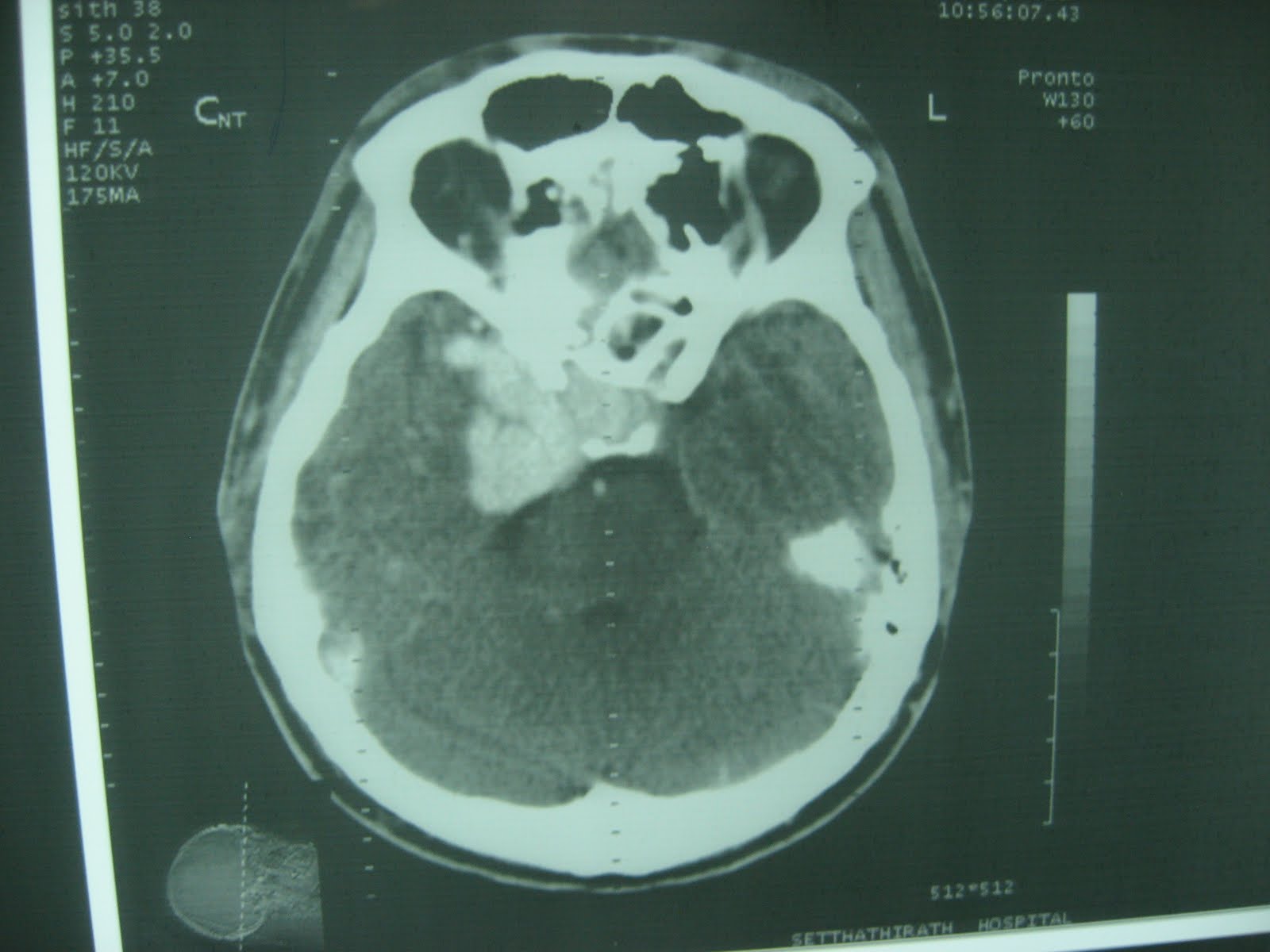
The next day, I was asked to look at his head CT. He had multiple lesions, including an area on the right side that looked like an old stroke or hematoma - mostly empty space where there should have been brain - an 2 spots that light up homogeneously with contrast - one near the left ear, and one on the right, at the very front of the brain near the pituitary gland and optic nerves. And it looked like maybe he had an old fracture in his right sinuses that had not completely healed. The enhancing lesions looked most like tumor - they were very regular - but I was praying for infection (or something else we could treat.) Either way, it was clear he needed an MRI and a neurologist, so the residents sent him home with plans to see Lao’s only neurologist (and a HF internal medicine residency grad) after his MRI in Thailand. A week and a half or so later, he returned to Setta with his MRI read. 11 pages of images in a 5x6 grid. The residents asked me to interpret it for them, because there was no read.
By the 6th or 7th page I was pretty discouraged. I couldn’t tell what kind of lesion the biggest, most worrisome one was, at the R front of the brain. It didn’t look like an abscess or a tumor to me, but I’m also not really trained to read brain MRIs. I’m not a neuro-radiologist, a neurosurgeon, or a neurologist, and while I occasionally look at brain MRIs, I usually do so with a detailed explanation of the results in front of me. I’d like to think I could see acute ischemia or a tumor or parasites on an MRI, but subtle differentiations are certainly beyond me. Fortunately for me, page 9 revealed a possible answer. The malformation lit up with IV contrast too - A LOT - like a blood vessel, not a tumor. Page 11 was the MRA and it clearly showed lots of blood flowing to the area and contrast filling the veins much quicker on the R. Maybe it wasn’t tumor but a crazy big aneurism or AVM? Would that be good or bad for my patient in a country with one neurologist and limited neurosurgeons, maybe none who specialize in vascular problems? I decided it was better than tumor, and explained my theory to the residents with multiple disclaimers about my lack of qualification to interpret MRIs, and they agreed to send the images on to the neurologist. The next day we got the official read from Thailand - he did, in fact, have a large abnormal vascular malformation in the R parasellar region. The neurologist tells me he and the surgeons will discus whether it can be repaired in Lao or he needs to go to Thailand. (And hopefully someone has figured out what the abnormality is on the Left side of the brain -that one wasn’t in the read we got.) But I left the hospital that day feeling proud of my deductive reasoning skills, if not my MRI reading ones. And while the patient isn’t “fixed” yet, he did have appropriate diagnostic testing in a timely fashion, and is being directed to the people who can decide when and how to fix him. :) That’s often as close as we get to a win in Laos.
 At around the same time, a 15 year old girl was admitted to the inpatient medicine wards. It’s ok for my residents to take care of kids sometimes, because when they go home to their districts they may be the only competent doctor, and they will certainly be expected to care for everyone who shows up in the ER when they’re on call. However, I really do not feel qualified supervising them in the care of pediatric patients, particularly here in Lao; not only am I not trained in peds in america, I know nothing about the diseases that are more common here, or specific to SE asia, in children. However, the residents reported that they had asked the pediatricians if they’d like to take over the care of the patient and they weren’t interested. And she was looking pretty sick. She had had more than 3 months of abdominal pain, diarrhea, and weight loss. She now had anasarca and had had an albumin that was too low to measure (less than 2.7) on a check several months ago and again on admission. My resident really wanted it to be nephrotic syndrome (which is pretty common in SE asia) but she had multiple UAs that showed no protein. He was worried that it might be Capillaria philippinensis. This did not make a little light bulb appear over my head. Maybe we talked about it in global health class, but if we did I wasn’t remembering it. However, she did have Opisthorchis, a parasite that you get from eating raw fish, in her stool, and we determined that she had not been treated for this during her previous stay in the hospital. (No one had asked this, or reviewed the chart to see if treatment was prescribed.) So we agreed that we would repeat the few labs that hadn’t been ordered in the ER and treat the parasite we knew she had.
I went home and read about Capillaria philippinensis. It turns out that you get it the same way - eating raw fish - and it is one of the rare parasites that will actually kill you without treatment. It causes chronic diarrhea, abdominal pain, and protein loosing enteropathy. (All of the symptoms our patient had.) And it can be hard to find on stool exams. And almost all patients who have it have other parasites as well. And there have been cases in Lao. All of this was adding up to make me very worried about this patient. I e-mailed our beloved ID doc who agreed that the story was worrisome but suggested we also consider beri-beri (thiamine deficiency.) Another condition I have never actually seen in America. I reported this back to the residents. We discussed how she didn’t have the parasites on another stool exam, but we knew she had one parasite, which made others more likely. We discussed how clinically, the picture was compatible, and how these particular parasites can be hard to find on stool exam. We discussed how not treating capillariasis is deadly. We discussed the risk / benefit of possibly giving anti-parasite drugs she doesn’t need (side effects/toxicities) vs. the risk of not treating the infection (death.) The residents reported that they agreed with me but the teachers said they couldn’t give albendazole, the medicine for capillariasis. They did give some thiamine.
Over the next week, her anasarca improved and her fatigue improved a bit. She looked more like a chronically ill patient, but not one on the verge of death, the way she had the first day or two. She started eating a little, sitting up, and interacting with the doctors. Maybe she had just had thiamine deficiency, but probably not, because thiamine deficiency doesn’t cause abdominal pain, and it usually does cause other symptoms / exam findings that she did not have. I had the same discussion about likelihood of infection (Unknown, but certainly non-zero), and risk/benefit of treatment vs not treating several more times with the residents, and one time with the IM teachers and ID team there. They all sort of nodded their heads, but every day she still hadn’t been put on albendazole. This monday, I came in to the hospital and she was gone. She was discharged over the weekend, having never been given albendazole. The residents reported they would have liked to give it, but the teachers kept saying no. I can only hope that if she gets worse again (which she will do if she has untreated infection with this particular parasite) she comes back to Setta, either to the IM ward where I can try again, or to the peds ward where the docs can at least look at all the recent notes saying ?capillariasis and consider it as a diagnosis. But I feel like we failed a young woman with a lot of potential life left ahead of her, and that is discouraging.
Just before new years, the residents asked me to see a patient who had been admitted to the hospital for hiccoughs. When I saw him, the story was a bit more complicated, and included a motor vehicle accident with head trauma 10 years ago, and had been told that he had a hematoma but then had no follow up. He had a left sided daily headache for 2-3 years, pain around (but not inside) the left ear for several days, bleeding from the left ear for one day, and one day of subjective fever within the week prior to admission. At the end of the encounter, they mentioned that he had Hepatitis B and had been treated with interferon for 15 weeks several years ago. His headache was variable, not always in the morning, and didn’t fit migraine or cluster headache patterns either. It had improved with paracetamol, and his hiccoughs (his original presenting complaint) had been present for a week prior to admission, and had improved but not completely resolved over several days with metoclopramide. (He came on Friday and I saw him on Monday or Tuesday.) I think the residents had already decided to do a head CT, and I encouraged them with that plan, explaining that Hiccoughs can come from the brain/nerves or the diaphragm, and I was hopeful that his were from the diaphragm, but his story was worrisome that they might be from the brain.
The next day, I was asked to look at his head CT. He had multiple lesions, including an area on the right side that looked like an old stroke or hematoma - mostly empty space where there should have been brain - an 2 spots that light up homogeneously with contrast - one near the left ear, and one on the right, at the very front of the brain near the pituitary gland and optic nerves. And it looked like maybe he had an old fracture in his right sinuses that had not completely healed. The enhancing lesions looked most like tumor - they were very regular - but I was praying for infection (or something else we could treat.) Either way, it was clear he needed an MRI and a neurologist, so the residents sent him home with plans to see Lao’s only neurologist (and a HF internal medicine residency grad) after his MRI in Thailand. A week and a half or so later, he returned to Setta with his MRI read. 11 pages of images in a 5x6 grid. The residents asked me to interpret it for them, because there was no read.
By the 6th or 7th page I was pretty discouraged. I couldn’t tell what kind of lesion the biggest, most worrisome one was, at the R front of the brain. It didn’t look like an abscess or a tumor to me, but I’m also not really trained to read brain MRIs. I’m not a neuro-radiologist, a neurosurgeon, or a neurologist, and while I occasionally look at brain MRIs, I usually do so with a detailed explanation of the results in front of me. I’d like to think I could see acute ischemia or a tumor or parasites on an MRI, but subtle differentiations are certainly beyond me. Fortunately for me, page 9 revealed a possible answer. The malformation lit up with IV contrast too - A LOT - like a blood vessel, not a tumor. Page 11 was the MRA and it clearly showed lots of blood flowing to the area and contrast filling the veins much quicker on the R. Maybe it wasn’t tumor but a crazy big aneurism or AVM? Would that be good or bad for my patient in a country with one neurologist and limited neurosurgeons, maybe none who specialize in vascular problems? I decided it was better than tumor, and explained my theory to the residents with multiple disclaimers about my lack of qualification to interpret MRIs, and they agreed to send the images on to the neurologist. The next day we got the official read from Thailand - he did, in fact, have a large abnormal vascular malformation in the R parasellar region. The neurologist tells me he and the surgeons will discus whether it can be repaired in Lao or he needs to go to Thailand. (And hopefully someone has figured out what the abnormality is on the Left side of the brain -that one wasn’t in the read we got.) But I left the hospital that day feeling proud of my deductive reasoning skills, if not my MRI reading ones. And while the patient isn’t “fixed” yet, he did have appropriate diagnostic testing in a timely fashion, and is being directed to the people who can decide when and how to fix him. :) That’s often as close as we get to a win in Laos.
 At around the same time, a 15 year old girl was admitted to the inpatient medicine wards. It’s ok for my residents to take care of kids sometimes, because when they go home to their districts they may be the only competent doctor, and they will certainly be expected to care for everyone who shows up in the ER when they’re on call. However, I really do not feel qualified supervising them in the care of pediatric patients, particularly here in Lao; not only am I not trained in peds in america, I know nothing about the diseases that are more common here, or specific to SE asia, in children. However, the residents reported that they had asked the pediatricians if they’d like to take over the care of the patient and they weren’t interested. And she was looking pretty sick. She had had more than 3 months of abdominal pain, diarrhea, and weight loss. She now had anasarca and had had an albumin that was too low to measure (less than 2.7) on a check several months ago and again on admission. My resident really wanted it to be nephrotic syndrome (which is pretty common in SE asia) but she had multiple UAs that showed no protein. He was worried that it might be Capillaria philippinensis. This did not make a little light bulb appear over my head. Maybe we talked about it in global health class, but if we did I wasn’t remembering it. However, she did have Opisthorchis, a parasite that you get from eating raw fish, in her stool, and we determined that she had not been treated for this during her previous stay in the hospital. (No one had asked this, or reviewed the chart to see if treatment was prescribed.) So we agreed that we would repeat the few labs that hadn’t been ordered in the ER and treat the parasite we knew she had.
I went home and read about Capillaria philippinensis. It turns out that you get it the same way - eating raw fish - and it is one of the rare parasites that will actually kill you without treatment. It causes chronic diarrhea, abdominal pain, and protein loosing enteropathy. (All of the symptoms our patient had.) And it can be hard to find on stool exams. And almost all patients who have it have other parasites as well. And there have been cases in Lao. All of this was adding up to make me very worried about this patient. I e-mailed our beloved ID doc who agreed that the story was worrisome but suggested we also consider beri-beri (thiamine deficiency.) Another condition I have never actually seen in America. I reported this back to the residents. We discussed how she didn’t have the parasites on another stool exam, but we knew she had one parasite, which made others more likely. We discussed how clinically, the picture was compatible, and how these particular parasites can be hard to find on stool exam. We discussed how not treating capillariasis is deadly. We discussed the risk / benefit of possibly giving anti-parasite drugs she doesn’t need (side effects/toxicities) vs. the risk of not treating the infection (death.) The residents reported that they agreed with me but the teachers said they couldn’t give albendazole, the medicine for capillariasis. They did give some thiamine.
Over the next week, her anasarca improved and her fatigue improved a bit. She looked more like a chronically ill patient, but not one on the verge of death, the way she had the first day or two. She started eating a little, sitting up, and interacting with the doctors. Maybe she had just had thiamine deficiency, but probably not, because thiamine deficiency doesn’t cause abdominal pain, and it usually does cause other symptoms / exam findings that she did not have. I had the same discussion about likelihood of infection (Unknown, but certainly non-zero), and risk/benefit of treatment vs not treating several more times with the residents, and one time with the IM teachers and ID team there. They all sort of nodded their heads, but every day she still hadn’t been put on albendazole. This monday, I came in to the hospital and she was gone. She was discharged over the weekend, having never been given albendazole. The residents reported they would have liked to give it, but the teachers kept saying no. I can only hope that if she gets worse again (which she will do if she has untreated infection with this particular parasite) she comes back to Setta, either to the IM ward where I can try again, or to the peds ward where the docs can at least look at all the recent notes saying ?capillariasis and consider it as a diagnosis. But I feel like we failed a young woman with a lot of potential life left ahead of her, and that is discouraging.
Subscribe to:
Posts (Atom)
