Tuesday, October 19, 2010

Lao Lao Liaw Laew

These four words mean: a person or thing in/from Laos, whiskey / alcohol, turn, and and then / already. I think I am understanding more Lao, but speaking is hard, and the more I learn, sometime the more confused I feel. Our teacher is very patient with us trying to figure out the differences between words that are clearly different to her.

I have had a visitor, Dr. Leila from Mung Sing, a former Health frontiers pediatrics co-ordinator who now lives in far northern Lao and helps children there. It has been interesting to hear all her stories of living in Lao for the past 7 years, but has also been time consuming, so I have not had much time to blog. (Or reflect on the last week and a half.) However, she has had some incredible experiences, particularly in looking for victims of Noma (a malnutrition / immune compromise related disease in which portions of the face of children essentially rot away - google image Noma if you have a strong stomach). They are located in the poorest areas of Lao (and therefore the hardest to get too. When Leila found the first victim, it was thought to be a disease which occurred only in Africa, though historically it had happened worldwide 200-300 years ago. She has now found 22 victims, and arranged for reconstructive surgery, which not only improves their appearance, but often restores their ability to eat solid foods communicate better, etc. Now she is traveling around the country again to follow up on the outcomes of the patients.

While Leila was away, I went to the COPE ( http://www.copelaos.org/ ) concert Saturday night. It was raining, but this didn’t really significantly diminish my enjoyment of the music, as it wasn’t cold. I saw two bands perform - a sort of Lao ska band who were quite good except when they allowed a female friend (girlfriend of a band member?) to sing with them - then we got a truly off rendition of “Knockin’ on Heaven’s Door.” The second band was “U Luv Us” - a band composed of foreigners who sing pop-esq ballads and faster songs in Lao. Their music is pretty good, and they are totally hilarious to watch with their faux hawks and heart shaped sunglasses and smoke machine. There were two Lao girls standing right behind us that kept screaming with glee when they started/ended a song etc, which only added to the experience. Luckily, no one fainted since we were outside in the rain and mud. Unfortunately, I was too short to get a good look at the hip-hop dancing troop that performed between the bands, but I think hip-hop dancing troops are quite similar world wide, so it’s probably ok. This suspicion was confirmed by the fact that one of them was wearing a Michael Jordan jersey. Dinner before hand was at the Taj Mahal - Lassi’s, samosas, nan, rice, daal, and chicken Korma for two, all for less than 9 dollars. Delicious!

COPE is a great organization that provides rehab, prosthetics, mobility devices, etc for victims of cluster bombs (Thanks, America!) and other disfiguring, disabling accidents. They also have a blind school and a deaf school on their campus. (There is no ADA here, so blind, deaf, or otherwise disabled children are often refused entry to schools.) They have a visitor center that has some information on cluster bombing and it’s prolonged consequences, as well as profiles of some of their successes. The conference to ban cluster bombs will be in Vientiane in November, which is appropriate as Laos is one of the most heavily bombed country in the world. Of course America has not yet ratified this ban. . . Anyone planning to visit me here in Vientiane can expect to visit the COPE visitor center as well.
Sunday I went to the Buddha park. The Buddha park is as statue park about 25 KM (or 45 -60 min) outside Vientiane, past the friendship bridge. It is filled with statues of Buddha and Hindu deities which were commissioned by a man who was out walking in the mountains when he fell through a sink hole landing in the lap of a Guru. This experience inspired him to make or commission giant concrete statues of Buddhist and Hindu deities, which were made by people who had no formal training in art or sculpting. In this context, the quality is actually surprisingly high. The statues are all packed pretty close to each other, which makes them hard to appreciate individually sometimes, but easier to see as a body of work and to think about the inter-relatedness of the myths etc. It was drizzling off an on, which hampered my enjoyment (and photographs) somewhat, but it was a nice way to spend an afternoon. On the way home I stopped and bought oranges and bananas at a local market all in Lao! My visitor from America arrived home from Vang Vieng Sunday evening, and I got to hear about his trip at dinner. Then Leila arrived from Khamua and Bolecomsai, where she was following up on Noma patients, and scarfed down some spaghetti (I’m not the only one that misses pasta!) and we walked home from downtown together.

On the work front, things are good. The “most talkative” (his own description) chief resident has returned from two months in Khon Kaen, Thailand, and the other 3rd year chief is away at Khon Kaen, so Phanivone has been ruling with an iron fist. Not really, but last weekend he called me at 7:40 AM on Sunday because the printer in the resident room was not working, and they wanted me to bring a new toner cartridge to the hospital. (I did not.) Turns out that the printing emergency was an organizational chart which assigns all the residents duties in teaching (eg: rheumatology, cardio, endocrine) and in more mundane tasks (budget, accounting, cleaning the resident room). The task and resident responsible were printed, and then they were all pasted to a poster-board, and once they add the resident’s pictures they will hang it. They love adding passport photos to things here - that makes it official. I will take a picture once they’ve got it complete. I don’t know if I’ll ever be able to tell whether people are doing their assigned job, or how the assignments were made (I suspect it was not a democratic process). The good news is, they were able to solve the toner emergency without me by shaking the ink cartridge. Phanivone has translated two or three of my lectures now and I can tell he is adding in things (because I’m hearing english medical words I didn’t say) but I suppose as long as they are accurate things, that’s ok. They seem to usually be things I was going to say later in a more detailed section of the talk. The residents are very patient with me - they do not complain when lecture goes over the 1.5 hr time, and even manage to still look interested and clap at the end. However, I must do better at limiting what I try to cover.

We had KKU grand rounds on Friday. The speaker was an Electrophysiological cardiologist trained at Duke. I remembered to check the gas tank this time, so there were no embarrassing trips to the gas station. The topic was update in the management of arrythmias, and I think it was better received in Thai than the recent french lectures on the same topic. In Lao, we do not have a cath lab, so there are no EP ablations (Or stenting for Acute MI, for that matter), but in Thailand they can do all of those things, and a pacemaker is only 1000$! (Though the Thai have socialized medicine, so they pay 1 dollar for each hospitalization) This doesn’t really help the Lao, because for most of them 1000$ might as well be a billion dollars - there’s an equal chance of them seeing that much money - but I think they are more likely to get cath labs, pacemakers, etc, if they keep hearing about it from their neighbors.

Saturday, October 9, 2010

Excellencies, Ladies and Gentleman

Wow, it has been a busy week. Last night I went to a concert celebrating the 15th anniversary of the re-establishment of friendship between the Republic of Korea (South Korea) and Laos. In the introduction and concluding speeches, they addressed us as “Excellencies, Ladies and Gentleman.” I’m pretty sure that the excellencies were only the diplomats in attendance, but it was still funny. The concert was pretty cool. It was sponsored by a “Beautiful Mind” organization of South Korea which aims to promote friendship and peace through music, and to support disabled or underprivileged children in learning music. They played some classical music in the first half, then they had a pianist with cerebral palsy play after an inspirational video about his struggle to gain dexterity in his fingers. The second half was traditional Korean instruments, which was really cool. My favorite was the Haeguem, an upright stringed instrument played with a bow, because the woman playing it moved her shoulders and back when she moved the bow, so it almost looked like the instrument was playing her. They also had traditional drums, a long stringed instrument played with the fingers, and korean flute. For the finale, they played Edelweiss, a russian folk song, a korean folk song, and then a much loved Lao song about the Dok Champa (Frangipani flower) with the korean traditional instruments and piano, violin, and cello. Supposedly, there are only a few classical concerts each year in Vientiane, so I’m glad I made it to this one. Plus, it was inside the Lao cultural hall, which I hadn’t been inside yet, so that was an interesting bonus. Concert etiquette is very different here - people were arriving, leaving, and stepping out for phone calls throughout the concert, and they had the performers use microphones (which I don’t think they would have needed to do for a space that size) but it was free, so I really can’t complain. Afterward, we had dinner at as small Japanese restaurant, and then drinks at the Jazzy room, a bar up a small wooden staircase that had posters of famous American jazz musicians hanging.

On Thursday, my first visitor arrived. Dr. S is an internist doing primary care in America, who has come to volunteer and teach for 3.5 weeks. He originally trained in Hong Kong, but has been practicing in the resource-rich setting of American medicine for the past 10+ years, and I think this is his first trip to the developing world, so he had quite a culture shock on rounds yesterday. For example, on Thursday I saw a patient with likely periodic hypokalemic paralysis (A very rare disorder of suddenly low potassium, often overnight, leading to muscle weakness.) On Thursday we had gotten his potassium lab back and it was 1.54, (ridiculously low, for my non-medical readers) so the residents planned to give oral and IV potassium and recheck the level. Friday morning. In America, this would be completely unacceptable, but here even if there is a lab tech who would run the lab at 4 or 5 PM after replacement, there is no doc to follow up on the result, as there is no formal cross-cover sign out. And his weakness was improved, so hopefully his potassium level was improved as well. Our visitor was shocked that the residents had not checked the level again, whereas having spent 2 months in Africa, once daily labs (at the most) are what I expected when I arrived here. (Bonus: I got to see real live U waves on EKG with this case, for the first time. Not small ones either. I have a copy of the EKG.)

Thursday I finally visited the temple with the little Buddhas. A monk who spoke a little english explained to me that the Stupa collapsed and they found all the little Buddhas. Since Stupas are filled with Buddhist relics or symbolic objects, I guess that finding the little Buddhas was not surprising. It is still pretty cool, though, because they are old. The little Buddhas had been placed on a table and baskets in the main temple which had been closed off, and a small altar set up in front of the table, where people are coming to make offerings of marigolds, incense, candles, and money. I will try to post pictures on Facebook. Thursday evening, at english class I was presented with a coconut pastry and a pineapple pastry for national teacher’s day. At my IM lecture (“GI anatomy”) I was presented with red wine and informed that not only was it national teachers day, but they wanted to keep my cholesterol low. I guess residents come up with the same excuses for drinking red wine worldwide. . . having used this to justify more than one glass of red wine over the past 3 years, I had to chuckle. Though I don’t think I ever combined red wine and a lecture in my day.

Now I am off the market to buy a couple more sin’s (Lao skirts) as I have been told that the residents will get bored of my first 4 soon. I have two medium blue, a purple, and a light blue now, all with horizontal stripes, so I think I’ll look for something pink or purple with vertical stripes.

Tuesday, October 5, 2010

Bor Pben Nyang

It has been a busy couple weeks here. And I have a cold. So I will apologize for not posting more frequently. Hopefully you, dear readers (Mom) will say “Bor Pben Yang” which literally means “no ask why” but is used to mean “no worries” or “it’s ok.”

Christine has gone home to Minneapolis after her trip to China. She got back to Lao Thursday afternoon and it was a whirlwind weekend of packing, saying good bye, and last minute information sharing. She was kind enough to lecture Thursday night on urinalysis and urine sediment while I got the microscopes set up. (They have recently returned from Bangkok where we sent them for cleaning.) Unfortunately, as I unwrapped them, I discovered that one was broken in transport, so we only have one working microscope right now. Frustrating, especially since Christine spent a lot of time in the last several months figuring out how to get them to bangkok and back safely. Thursday I also started feeling sick, and had a fever and myalgias by Thursday night, so it’s lucky Christine was planning to lecture. Friday night we had a going away dinner for Christine at “Moon the Night” a restaurant on the Mekong, and then went to a see a friend’s band “ULuvUs” play. The band is composed of all falang (foreigners) but sings songs in Lao (with some english phrases) and has quite a following of falang and Lao. Apparently, they have even made it fairly high on the charts in Thailand. Erwin, our friend, is Australian and plays the Keytar and keyboards. The music was pretty standard pop - but they had some good tunes and it was cool to hear them sing in Lao.

Saturday we had resident games as a going away event for Christine. We played soccer, did the limbo, played basketball, jumped rope, and finally had medicine vs pediatrics tug of war. Medicine won for the second year in a row, despite having Joey, our english teacher, anchoring their team. To be fair, they are mostly girls. I played soccer for the first time since elementary school, (which is to say quite badly) and the residents were all very kind and did not make fun of my lack of skills. We had a lot of fun, and it was good to be reminded of how much fun a group of adults can have with just a soccer ball, a mop, and a rope. Unfortunately, running around for 3 hours after being up late was not good for my cold, so I spent the afternoon in bed rather than watching the second Australian Grand Finals. Fortunately, Collingwood, Chris’s team, won by a large margin, so everyone in our group was happy with the day. Sunday we had a last breakfast and lunch at Kung’s (last for Christine) and I helped her pack her bike up. In the evening, we crammed a few last things into her 5 suitcases, weighed them. (I need to learn not to weigh my suitcases on bathroom scales. They are never accurate and just lead to more anxiety) Amy, Chris, and I drove her to the airport, where her total luggage weighed in at 133 kg (5 cases and a bike in a box) which is actually not a bad accumulation of stuff for the past 2 years, I think. Some of the residents met us at the airport with a bouquet of roses for a final good bye. It was sad to see her go, and I hope she is happy once she settles into her new job back in Minnesota.

I still have not made it to the temple near our house where the small Buddhas were found. But I have arranged lecturers for most of GI month (October) which took several visits to Mahosot last week. I will start with GI anatomy Thursday, and one of our fellows will teach GI bleeding tomorrow. Today’s lecture was cancelled because of a symposium by the IFMT (Institute Francophone Medicine Tropical) - I hear they have good teaching mostly in Lao at this, so that’s ok.

Today Tanja and I bought our tickets to Luang Prabang for the weekend before Halloween. We will ride the bus (8-9 hours on a “VIP” bus, with air conditioning) there on Friday, to see the country side, tourist on Saturday and Sunday, and fly home (1 hour) on Monday. I will take my zofran with me. Luan Prabang is one of the main tourist destinations in Laos - it is known for it’s old temples and scenic parading monks - and the weekend we are there will also be the end of “buddhist lent”, so they will be floating banana leaf boats down the river for good luck in the next year, too. We will miss the boat races in Vientiane, but I think we will be able to see more of the banana leaf boats, and it was the only weekend in October or November that I could take Friday and Monday for travel. So that’s something to look forward to, and I may soon have my multi-entry visa, so I can also think about a trip to Thailand.

Saturday, September 25, 2010

Wat Miracle?

Apparently, at one of the wats near our house, there was some construction going on and something collapsed revealing tens of small Buddha statues, that are presumably old, since no one knew they were there. This is likely not an actual miracle, as someone probably buried them at some point, accidentally or purposefully, but it is the closest I’ve lived physically to any sort of religious happening. Tomorrow, I plan to go visit and try to see these Buddhas, as I hear they are quite attractive. (Oh, and get used to the Wat puns, I anticipate they will keep coming.)

I learned about the small Buddhas from my first independently-acquired friend in Vientiane. I have not lacked for social engagements or opportunities since getting here to Vientiane, but all of them have been with people that Christine or Chris and Amy are friends with, and you never know whether you’re being invited to stuff because people want you to come, or if they feel obligated. And I sense that there is some degree of visitor / short term guest fatigue that sets in amongst the people who have been here for several years. I don’t know if it would bother me, but I can see how many people would just get tired of meeting and getting to know new people at some point. So I am happy to have independently found a friend, because I was feeling a bit frustrated / worried. Although, when I think about it objectively, how many non-med school classmates and non-relative friends did I have a month after moving to Minnesota? The answer is zero, but I think I feel more pressured here because I am probably only here for a year so I need to get started. :)

Tanja is a Swiss doctor visiting Vientiane for 3 months to finish the 2 years and 3 months of work abroad she needs to do to qualify as a specialist in tropical medicine in Switzerland. Yes, MN friends, that is 2.25 years abroad. We are lucky with our 2 month requirement from ASTMH. She is also a pretty cool person. Her first year abroad was in the Congo with MSF. I told her I was impressed and I didn’t think I’d be brave enough to go to the Congo, and she replied that she really felt quite safe there. She was re-building an old Belgian hospital that had been destroyed in the civil war, doing clinical care, and training local MDs. The area was accessible only by bush plane or extended (many days) over-land journey. It sounds like it was an incredible experience, though in some ways very frustrating because of very limited resources. She was evacuated once, but she thinks MSF was maybe too aggressive about taking people out of potentially dangerous situations. That’s reassuring, I guess. Her second year abroad was in French Guyana where she had great resources and equipment, but struggled with the poorly trained and un-motivated to learn doctors. I think this supports my theory that patients and doctors are unsatisfied to some degree with their medical care system worldwide, no matter where it is. It’s not much comfort, but sometimes when you’re really frustrated with your situation at home, it’s a little. Her first impressions (after 2 weeks) is that the Lao doctors are really eager to learn and provide good care with limited resources. I think this is true in my experience as well, and since she’s on a ward with several of ‘my’ residents, I’m happy to hear she is impressed. And to be fair, the ID ward she is on has limited diagnostic resources, but Paul, the lab director and ID specialist seems to have picked those resources very well to tailor to accurate diagnosis and timely treatment of the problems they see most often here.

The Australian rules Football Grand Finals was very fun - somehow heckling is so much more enjoyable with crazy Australian slang and accents. And it’s a game that can actually be pretty edge-of-your-seat exciting, and worth heckling. This game in particular - it was tied at least twice in the last quarter with the last (and tying) goal being kicked in the last 2 minutes of play. There is no overtime, so we get to watch _another_ grand finals match next Saturday. From my perspective this is awesome, though of course the people who were rooting for a favorite team are pretty disappointed. Next weeks game probably won’t be as close or exciting, but we can hope. We are not sure if Chris will actually come home this week - he may stay if he can get a ticket for next Sunday’s match. We will miss him at resident’s games next Saturday morning, but will understand if he stays in Australia.

Friday, September 24, 2010

The letter R

There is no R sound in Lao. My understanding is that they used to have an R, but they got rid of it. It seems kind of harsh to me to just get rid of a letter all together, but they must have had their reasons. . . Thai has an R, though, so my residents and english students know how to say R, they just often forget to. And it does make some words more fun - curriculum, for example, sounds much more musical as culiculum. My Lao is very slowly improving. I know most of the question words now, usually understand numbers if repeated slowly, and am starting to recognize words here and there on the wards. There are still tonal differences that I will probably never be able to fully hear, much less replicate, and differences in the length of consonants that I struggle with. (For example if you say you are very tired incorrectly, you are saying that you have a lot of pubic hair, and if you say “I’m going to eat pork for dinner” but linger too long on the word pork, you’ve said that you are going to eat your friend for dinner.) The good thing is that there are no tenses to memorize and verbs are not conjugated depending on who they refer to. I’ve been struggling to teach irregular verbs to my english students, so I’m glad I don’t have to learn them in another language too.

Last Friday I watched one quarter of the Australian football semifinals. Australian football turns out to be way cooler than american football - it requires actual athletic skill; both cardiovascular fitness and coordination to kick and run with the ball. And it is not interrupted every 30 seconds for some esoteric rule. I hope to watch the grand finals with Amy tomorrow - Chris is leaving tonight at 9 and flying home for the game, because his team is playing and he won a free ticket in the lottery. He has never seen them win a grand final (though he has been to two grand final games) and his whole family are die hard fans and members of the athletic club the game is being played at. Given that his team won the semi-finals game by a margin of 60 points, (and only because they relaxed somewhat for the last quarter, which they started with a lead of about 80 points) I am hopeful that he will get to watch them win this year. And also that he gets there on time - he only has 3 hours from the time his plane is scheduled to land until the game starts!

I never thought, after all those months on the medicine firms at the U, that I would wish I could have more patients who got ERCPs. But I do. This week, I have seen 3 patients that have common bile duct stones and none have had anything done about it. The surgeons said they would operate on the first one, but then they waited over last weekend and monday he was septic so they transferred him back to medicine. As the intern was writing orders to start antibiotics for ascending cholangitis, his family was trying to decide whether they should take him home now, because it would be hard to get him home if he died in the hospital, or to let him stay and start antibiotics. On one hand, he did have elevated AFP levels and likely cirrhosis, so he might die in the next months - year anyway, but on the other, he had a very treatable problem which would likely be fatal if he doesn’t get IV antibiotics and ultimately have the stone removed. I really wished that he had gotten his surgery on friday. The second patient came with a month of right upper quadrant pain, not one but 2 ultrasounds confirming a CBD stone and dilation, and had been refused surgery because he was septic 2 weeks ago at his second presentation. He was treated for ascending cholangitis and discharged to home with plans for an elective cholecystectomy in a few weeks. He came back, still on antibiotics, no longer febrile, and with ongoing pain and was refused surgery because he had elevated liver function tests. Gee, I wonder if that could be due to the bile backing up into his liver and irritating it? A third ultrasound confirmed that the stone was still there, causing trouble. My resident and I agreed that if after being offered a second chance to surgerize him at Setta he was not accepted he would be sent to Mahosot, where there is a GI specialist that can do some ERCP, and/or maybe (Hopefully?) has a good relationship with a surgeon. The third was a similar story - a woman with a CBD stone and fever, who was initially refused surgery due to sepsis, and then the surgeons wanted to send her home for a couple weeks before operating. I didn’t anticipate running into the age-old medicine vs. surgery debate here as quickly and throughly as I have, and I feel somewhat adrift as to what to do. At home, I would try to talk to the surgeons personally, (Or have my staff call their staff) but here I’m pretty sure that would be inappropriate, plus I don’t speak Lao, so I actually can’t talk to them. And there is clearly a pattern of decision making emerging, so I don’t want to ask my residents to confront or try to explain to them, knowing that they probably need to preserve good relationships with their surgery colleagues for the benefit of future patients. So I’m pretty much left encouraging the patients to go to the “GI hospital” if they get discharged and have recurrence of symptoms (which they almost certainly will) and praying that some of those stones magically work their way out on there own. I’m not an optimist, or good at not being in control, so these are not great options for me.

Sunday, September 12, 2010

Wat?

Buddhist temples are called wats. They are all over Vientiane. Literally, like every 3 blocks. I’ve only been in a couple, but if I wanted to go to one a week for the next year, I feel confident that I would not have to go back anywhere. The day I arrived, Christine took me to a wat near our house and showed me some monkeys she can hear at night. (I haven’t heard them, or haven’t recognized them as monkey sounds.) They were pretty cute, but unfortunately, I was so tired and disoriented from the 29 hour journey, that I have no idea which of the 3 wats within a 2 block walk of our house (one north, one south, and one east) they live in. In fact, I’ve found that while Christine showed me many useful places (the department store, the DVD store, and the book store amongst others) that afternoon, I have been unable to return to an of them without getting directions again. It was still a nice tour, though, and a good way to stay awake until sunset, so I didn’t have major jet lag. (I slept till 5AM the day after I arrived, which was a new record for sleeping in according to Christine)
(The monkey!)

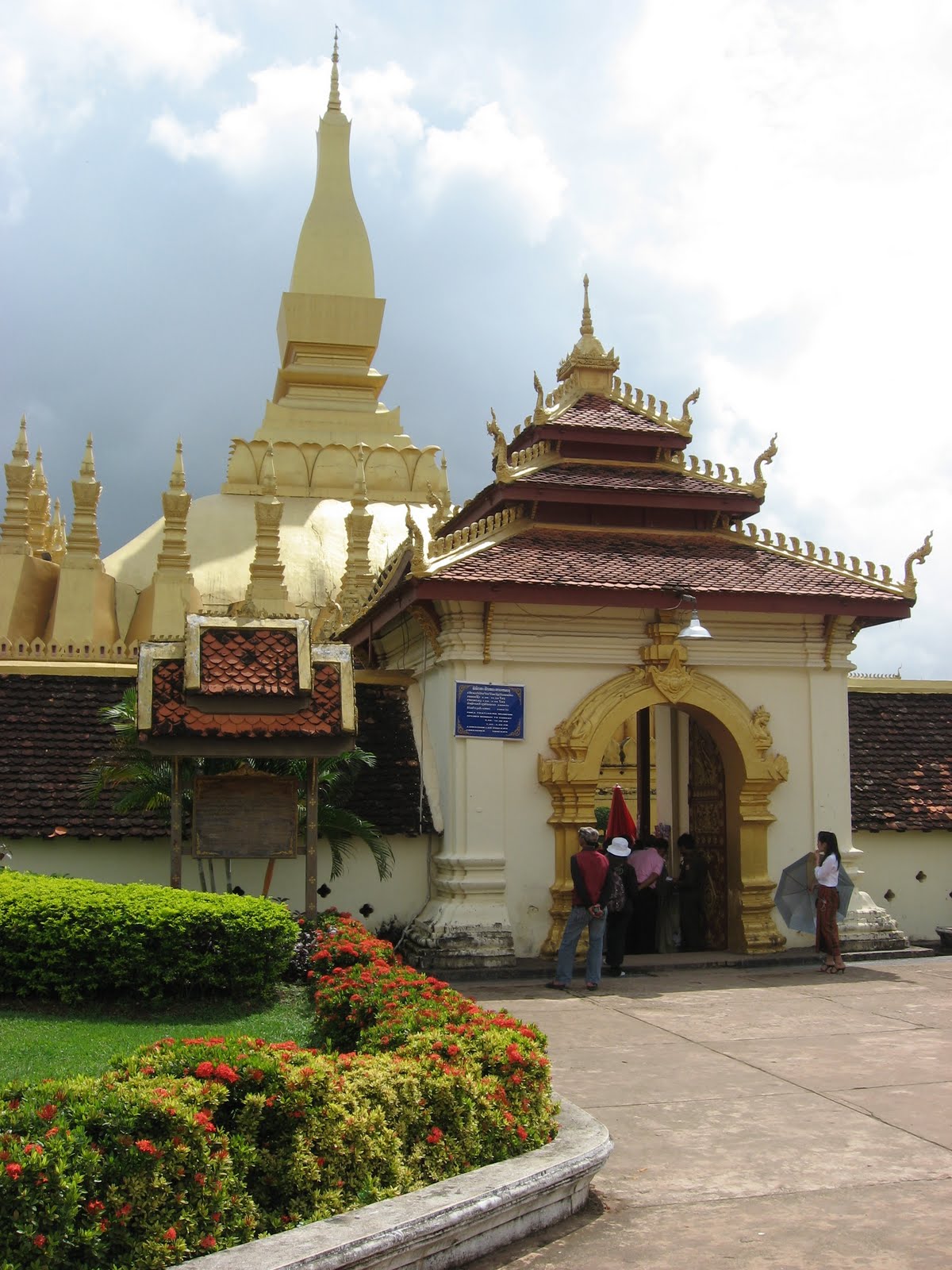
Yesterday, I visited the That Luang, (Stupa Yellow) which is the national emblem of Lao and has a Wat on either side of it. The that is a tower that rises 45 meters and is painted gold. It is actually a temple as well, and the distances and heights are symbolic in Buddhism, as are the numbers of things (a certain type of stones, lotus petals on top of the walls, etc. There are also 4 prayer halls, one facing north, south, east and west. I got there at about midmorning and it was threatening to rain so there were lots of interesting lighting and cloud changes during my visit. My favorite part was the Naga, or giant snake, which seems to be a common theme, and aside from flat walls, there was pretty not many things that didn’t have a naga - stairs, roofs, etc.
(The That Luang)

Just as I was leaving the That Luang (which cost 5000 kip, or 62 cents to get into) it started to sprinkle, and it looked like soon it would be down-pouring. So I popped across the street to the wat to the south of the monument, where I took of my shoes and sat in the main temple building under the roof for 15 or 20 minutes while it rained. This wat had a high, steeply arched roof with wide overhangs, but only one side had a wall. So it was kind of like sitting in the rain, without getting wet. The wat compound had many other buildings - smaller, enclosed temples, a giant Budda statue on the second floor of an open walled pavilion-like structure below, several other pavilions with many buddha lined up sitting and standing, and some enclosed buildings that must be housing for the monks. (In fact, one of our residents is living at a temple, so I know there is housing in the compound.) Inside the main wat, there are beautiful paintings on the ceiling, which presumably depict stories from the life of Buddha. I will have to read more about that, so I can understand them better. In the middle of the one enclosed wall is and alter, and to one side is a sort of pulpit, though this one appeared to be used for storage currently. At least 2 other groups of falang joined me to wait out the rain, and we all sat in silent reflection, which was nice. After if stopped raining, I spent some time wandering around the temple complex and then over to the wat to the north of the That Luang. That one is enclosed, more like a traditional church or temple that I would think of, and I did not try the doors. There were some young hooligans setting off fireworks in a pop bottle, so I spent less time at the second compound.

On the way back to the bike parking, I detoured past a monument at the other end of the parking lot. It was a white pillar with friezes around the bottom, and a big bouquet of roses form the president of India (who I later learned is in town.) The friezes seemed to depict the history of Lao, including pre-industrial times, the civil war, and the new, communist state of harmony. It was pretty cool, but it was looking like rain again, so I got back on my bike and pedaled down the hill to the Swedish baking company, which serves the best pizza in town. I really need to get on their delivery map. I went past the market on the way home, succeeded in buying 2 pair of shoes, and felt like I had accomplished quite a bit.

Saturday, September 11, 2010

Free Right Turn

I still can’t decide if I approve or disapprove of “Free Right Turn.” It’s actually kind of nice when you’re turning right, but it can be pretty annoying when you’re going straight. This week was my first real week alone. Last week Christine let me manage things alone, but she was still here to answer questions. Now, she is gone. Things went well Monday through Thursday morning.

(If you’re a non-doctor an annoyed by doctorly discussions, skip the next 2 paragraphs.)

Monday through Thursday mornings, I went out to Setta and rounded with the two residents out there. They are both quite good, and I am lucky they both have decent English skills, so they can present in English. I still saw some disturbing patients. I saw at least 2 young women that were septic by vitals criteria (including pretty severe tachypnea), one on no antibiotics and the other on 2 antibiotics for 4 days (clearly, not the right ones.) One went to the ICU and the other was better the next day after being treated for Rickettsia. The ICU is apparently not a good place to go, (It is not staffed by Medicine residency grads) and last I checked, no one knew what had happened to that patient. The part that was disturbing, though, was that there is really not a sense of urgency. I look at a 27 year old woman with a fever and respiratory rate of 35 and want something to happen right away (blood cultures, antibiotics, etc.) The Lao doctors may have the right plan, but not in the appropriate timeline. To be fair to our residents, I think it is an endemic problem, and even if they really tried hard to do things quickly, I think the staff supervising them, the nurses, the radiologists, pharmacists, etc would make it impossible. Still, it’s frustrating to see young, previously healthy patients with treatable problems not being treated. I also saw a 2 week old hemorrhagic stroke. The patient had sudden onset of R sided HA 2 weeks ago, which as constant, and some L sided weakness on exam. We saw him wednesday and the resident got a CT (with and w/o contrast!) which showed fairly extensive R sided intraparenchymal bleed. I realized I’ve never diagnosed a hemorrhagic stroke because in America, people get stat CTs in the ED and go to neurosurgery if they have a bleed. The residents were planning to refer him to Mittaphab where they have neurosurgeons, but they weren’t sure he was going to go on Thursday. Fortunately, his exam was stable.

Tuesday I went for case review and topic review (prepared by the residents.) They reported there was a visiting Cardiologist, so this had been cancelled. I went to see what the cardiologist was teaching on. The topics were good - HTN, Ischemia, anticoagulants, anti-arrythmics. (They start digoxin here for clinical heart failure, regardless of EF, without any monitoring. Luckily, most patients probably don’t stay on it longs since they’re paying for their own meds.) The lectures were in french with Lao translation. Tuesday happened to be anticoagulation, and while the info presented seemed to be factually accurate (Turns out medical french isn’t that different from medical English, so I could understand quite a bit from reading the slides); I am not sure how relevant it was to practice here. There was discussion of the various parinuxes and irudins, none of which are available here. There was discussion of indications for warfarin, which I know the residents already know because last week they asked me how they could dose it for a-fib without INR monitoring. Oh, right, there’s no INR monitoring. Not really necessary to teach about warfarin in depth then, eh? Maybe the other days were better, though. I did my english teaching as usual, but my thursday lecture was cancelled - there was poor attendance and the residents who did come were looking a bit glazed from the 3 hours of cardiology lecture each of the 4 previous afternoons. I can’t say I blame them.

Friday was Khon Kaen Grand rounds. We were fortunate to have a lovely young geriatrician from Thailand come and talk to the residents about delirium and dementia in the elderly. I don’t think there is any structured geriatrics teaching in Lao. (Indeed, there are no geriatricians yet.) So it was a good exposure for them. Unfortunately, it was also a lot of organization for me. I had to get the handouts printed before Friday, drive to the border Friday morning, then drive back and take the visiting MD to Mahosot to round, then host lunch (Ning cooked) and then bring her to the lecture room. Of course I forgot to check the gas tank (I fill it so infrequently on Gordon it didn’t even occur to me to look) and noticed just as we were getting back to town from the border that it was on E. So we didn’t have very much time to round, and the poor Thai doctor got an exciting trip to the Shell station as part of her visit. Then I forgot the handouts when we went to the lecture hall, so had to come back and get them. Fortunately, she was very patient with my deficient hosting skills, and hopefully by next month I will be more settled and capable.

I had my first Lao lesson Monday. My teacher seems very good, but unfortunately the Friday lesson was cancelled. I shall practice my flash cards this weekend. I went out for Indian food Friday night with Amy and Chris. It was delicious, and 68,000 kip (<10 dollars) for all three of us. I lowered the seat on Christine’s mountain bike so I can ride it, and aside from some difficulty adjusting to a man’s frame, that is going well. I rode up the river 15 minutes earlier this week, and then to the That Luang today. After having a basket incident that required repair, I have returned to the one speed bike for around town errands - it has a basket which is more convenient and I am really not sure how Christine was getting on the mountain bike in her sin (Lao skirt) but I am not confident enough to try yet. The one speed seems to be the perfect speed for in town riding anyway. I have worn 3 of my 4 new Sin and gotten positive comments on them from the Lao. “Teacher, you are very beautiful today, you look like Lao.” I’m not sure whether to be frustrated by the reluctance to acknowledge foreign or different things as potentially beautiful, or impressed by the lack of eager and universal conformity to western (and quickly becoming global, sadly) ideals of beauty.