Tuesday, May 31, 2011

Strange

In addition to providing a culturally- contextual ear to chat to, my recent American visitors - Kim and Kate, and then Kristiana, an ER doc from Chicago, have made me think more concretely about here vs home and my time here. People from home often ask me what is different or strange here, and I often have trouble coming up with anything. My life here is radically different from my life in the US, but it’s normal for here, and some how my mind has quite effectively partitioned. I note things that you would never see, hear, or experience in the US, and I chuckle or think “what a shame” or think “I should take a picture”, but I rarely feel shocked or disturbed.

Example: Cats wandering the corridors of the hospital, sneaking under the chairs as I teach lecture in the resident room, or, once, a tiny kitten crouched in the middle of a wide wheelchair. In America, this would be incredibly rare, but it’s normal here, and while I recognize that there is a public health risk, I also like cats and know that they probably kill mice and roaches that would otherwise be infesting the hospital. (The week after Phi Mai, there was a constant stream of roaches from the nurses room at Setta. Someone must have left a lot of food in there, and the cats can’t get in. THAT did disgust me a little, along with just being impressive.)


Cat napping on a transport stretcher at Mahosot hospital - photo credit to Kim.

Example: a man I saw last week with an absent femoral pulse and blue, cold leg. He had been started on a heparin drip without any imaging, and the team was hoping to get an ultrasound that afternoon, but it was in no way perceived as a medical emergency the way it would have been in the US. Did I encourage my residents to talk to the ultrasound tech about what they were looking for and why, and get the scan ASAP? Yes. Did I freak out the way I might have at home? No.

Example: I see a man with a giant, peripherally calcified mass that appears to arise from his pleura and has completely displaced most of the left lower lobe of his lung. You do not see x-rays like this in America. Chronic cough gets an X-ray sooner than this. What is it? Tumor? Could be. . . Infection? Could be. . . but it’s something crazy either way. I’ll probably never know. I hope they find a way to biopsy, but I know that they probably won’t, and it doesn’t really bother me that I will likely never know what it was.


Incredible Lung mass CT - the x-ray is even more impressive.

However, at some point in the last 2 weeks I realized I have been here for 9 months, and have just over 5 months left of my stay. I’m no longer hovering around the halfway mark of my visit, I’m well into the second half. That does seem strange. It is crazy that I’ll be home in significantly less time that the time I’ve already been here. A small part of me is tempted to volunteer to stay on through the spring - we still haven’t found anyone to take over my job when I leave - but I know I need to get home and start preparing for the next stage in my life, and I also know I need the money I can make working at home. This volunteer job has been wonderful - I love my residents, the Lao staff doctors and teachers, teaching has been incredibly rewarding (see previous post), my schedule is much nicer than that of residency, and I am healthier than I’ve been in a long time physically. But it hasn’t been great for the metaphorical pocket book. I’m not accruing interest on my student loans, but I’m not paying them off. And I haven’t made any super close friends here, so I think it will be nice to get back to a familiar social circle as well.

But there’s so much I haven’t done. . . I haven’t learned nearly as much Lao language as I would like to, and have lost most of my motivation to do so. I still haven’t really been to Bangkok, which I’m not excited about, but I know is an experience I’m supposed to have while in SE Asia. I haven’t been to Muang Sing and Luang Nam Tha, Chang Mai, Siem Reip, back to Luang Prabang, or even to the Patu Xai and Korp Jai Der in Vientiane. I know that some of these things will probably not end up happening before I leave. I start feeling that bitter-sweet moving feeling, though my ticket home isn’t till December. I start to buying souvenirs for people at home. (People other than me - if you have a specific request, probably now is the time to get it in.) And I start to realize that I will really really miss many of the things about life here in Vientiane, and I think the transition home will be much harder than the transition here was.


Free Right Turn - something I thought was crazy when I got here, and have become totally adjusted to. If I don't get at ticket for turning right on a red within a year of coming home it will be a miracle.

Saturday, May 28, 2011

Cinco De Mayo (Late)

It’s been a while since my last post. I am going to blame my latest visitors - Kim and Kate, two pediatric residents from Case Western who stayed here at the office house with me. They were smart, easygoing, and fun, and so my dinner out schedule has been pretty full. There’s something about communicating with a fellow American that is much easier than even another native english speaker from elsewhere. Maybe it’s that we all have the same starting context - growing up in the middle of the country in middle class families, or that we speak the same version of English, or just sharing the larger context of American culture. (Some will argue that America is acultural - I disagree - we may not always like our culture, but we do have one.) Whatever it is, I immediately felt like I didn’t have to censor myself with Kim and Kate (and with my last visitor from San Diego as well) in a way that I still do have to with my Australian colleagues that I’ve now known for months or other people that I’ve spent many hour socially with since arriving here. That can be draining. So it was nice to have 3 weeks of totally ‘normal’ conversations and interactions. Plus, they invited me to Vang Vieng and I finally got to go tubing!


Kim and Kate in a cave in Vang Vieng

May 5th was the IM final exam. The teachers set up a 10 station OSCE. (Objective Structured Clinical Exam - practice patients or clinical scenarios that the residents have 10 minutes to assess and answer some questions.) I was impressed that the Lao teachers care enough about their residents progress to organize this time-and man-power intensive evaluation. My last OSCE was during residency orientation on ‘challenging patients’ but after that, there was no formal evaluation of clinical skills during my residency training. (Though I was perhaps a bit more closely supervised on a day-to-day basis on many of my rotations than my Lao residents are on many of theirs.) Another part of me was glad that I didn’t have the stress of an OSCE added to residency - nor any sort of multiple choice testing that actually ‘counted’ towards completion of residency.


Two of 10 OSCE stations in progress

I had 2 very nice moments on May 5th. The first was when I learned that one of the graduating residents had gotten a perfect score on the EKG OSCE station. She is a quite, shy, unconfident resident from one of the most distant, poorest provinces, and she came to residency knowing a lot less than some of the other residents. She has learned a lot, but there have still been questions from the medicine teachers about whether she has learned enough to graduate. And sometimes some of the more confident residents give her a hard time, which I really dislike. I think they think that she is slow to answer questions partly just because she is so shy and unconfident - but when I actually take time to listen to her go all the way through a patient presentation she usually has a decent assessment, differential diagnosis, and plan. I suspect the teachers just get impatient with her and then she probably gets flustered and doesn’t do well. And she is very deferential - she probably doesn’t feel comfortable telling her superiors what she wants to do and is instead happy to have them tell her what to do. So anyway, I have been a bit worried that there will be a fight to have her graduate, and then she got a perfect score on the EKG station (which I think I could not have done.) Only 3 or 4 other residents did this - and none of the residents from the cardio ward who were supposedly teaching the others EKG the day before the test did it. So that will be some leverage if there is a discussion about whether to graduate her. Plus, it is just great to see her quiet, deliberate, methodical work outshine the bolder, more confident approach of some of her classmates.


The second half, waiting for their test to start.

The second was when one of the interns glowingly thanked me for helping to prepare “this competition” (the test.) He was very pleased with the test because it had made him aware of how much he needs to learn. He said he doesn’t care how he does on “the competition”, but he is afraid of not knowing enough and hurting a patient, and so he is grateful for the opportunity to assess his knowledge and maybe realize that he needs to study more or differently. Can you imagine an American resident (or medical student) thanking someone after a test in the same way? I think not - we are too prideful to appreciate (at least out loud) an opportunity to realize how little we know.


The first group in the hospital cafeteria after the OSCE

After the test, I helped the resident arrange review on some of the subjects they found most challenging, and I gave another EKG lecture and started using some of Dr. Wong’s practice EKGs that I brought with me. They were hesitant at first, but they got into reading them pretty quickly, and I think if we do a few more afternoons, they may even be willing to then self-study or quiz each other.

Last, but far from least, I finally have new residents! They started on may 12th, almost 4 weeks late, and I only have 6 (which is fine), and only one from the provinces (not so great), but they are all lovely, and eager to learn. I am very glad to have not failed completely in getting a new class of residents. May was spent doing orientation for them (the Lao teachers teach orientation, since many of the residents have minimal english skills at the start) and filling in other things for the 2nd and 3rd years - review and some pain and symptom management talks (my soap-box, but also something they need to know in a place where they can’t treat cancer and some other diseases, and something they don’t do fabulously currently.) It was nice to be back to lecturing after having most of April for test review and much of March taught by a visiting lecturer. June will be Neuro month, so I will spend the weekend preparing lectures on after-stroke cares, delirium, or dementia. Or maybe I’ll start all 3 and see which one will be the simplest to start with next week.


Me and many lao kids in the swimming hole in Vang Vieng.

Wednesday, May 4, 2011

Nationality, Ethnicity, and Home

Several things have made me think more about the above these past couple weeks. We have a medical student visiting from America. Her parents emigrated to the US during the secret war and she was born and raised there. I’ve been introducing her as “ethnically Lao” - she has two Lao parents, and she’s American, but clearly she has Lao ancestry. Actually, I think one parent’s family would have considered themselves ethnically Chinese, not ethnically Lao, while they were in Laos. (Though several generations of them may have lived in Lao.) So is she ethnically Chinese? Really, she is just as American as me - English was her first Language, and she misses pizza just as much as I do. (But cheese not quite so much. :) ) There’s a temptation to introduce her as Lao so that people here will embrace her - and she does speak some Lao and understand a lot, so she has an advantage there. But at some point I realized this also isn’t fair to her. She’s American - and introducing her as Lao may set up expectations she can’t live up too.

I’ve been hoping she would finish residency and then find some way to come back and help Lao - maybe just short visits, or maybe a longer commitment. Having HF as a connection could help her forge relationships where she could make a lasting difference. But then one evening last week I realized that it’s quite possible she doesn’t feel Lao at all, or feel any connection or obligation to this place. Her parents left a country that was in the middle of a war where they were poor and are now successful and happy in a new home, where they’ve had and raised children. Her family had to leave this place to be happy, and America is the place where she had the opportunities that have allowed her to return here. Maybe she’s just here because her family wanted to come, or out of simple curiosity. But maybe she has no more reason to feel a connection, or want to help here, than someone like me would. (She’s a lovely person, and assures me this is not true and she is interested in helping here in the long run. But the point is, there’s really no reason to assume she would be.)

At the dentist yesterday, the dentist asked me where I was from. “America” Where are you from before that “Um, I’ve always been an American?” No, he wanted to know what my ethnic background - it’s a longer, but in some ways more simple answer. I’m 1/4th German, 1/4 Norwegian, and 1/2 mixed British Empire. One branch of the family can be traced back to the Mayflower, and Dad’s side has been in America so long it can pretty much just be called American. I’ve never felt Norwegian, German, or British - I’m American. I would even say that I’m “ethnically American.” And I’m generally proud to be an American. I don’t agree with everything our government does, or with many of my fellow citizens, but traveling and living abroad always reminds me that there is no other place in the world that I would rather call home. We’re not a perfect nation (no one is) but it’s a good place to be from.

Over the course of my life, I’ve had many friends and colleagues who had different perspectives on this. In primary and secondary school, I had black friends who’s families had also been American for many generations - but who probably had a very different perspective on what that history meant. Certainly being an African American has been much harder than being a white American for much of our history. I also had friends who’s parents had emigrated from Mexico and spoke little English and friends who’s families had lived in the south west for many generations but still spoke Spanish as their primary language. Indeed, the first (and for many years only) settlers in Colorado were Spanish speakers. However, both these groups might be perceived as ‘un-American’ by many of my countrymen.

In medical school and residency, I’ve had friends who considered themselves American, but who were constantly asked where they were from because they didn’t look look or sound exactly like our concept of “American.” Their whole families lived in America, they had done much of their schooling in America, they had American citizenship, some were born in America, but they had tan/brown skin and black hair (and sometimes a slight accent) so they must be “from” somewhere else. I know they got tired of this question - America is their home, probably the only place they’d ever want to live - so why are they perceived as foreign by so many? I also had friends in residency who were from elsewhere and had come to America for training they couldn’t get at home. Some were counting the days till they could go home, and others would be happy to spend the rest of their careers in America. (All of the foreign medical grads I worked with were more knowledgeable, smarter, and harder working than the average American medical grad, so we should be happy to have them should they choose to stay.) After all - that is the American dream - you (or your parents) come here, work hard, contribute, have opportunities you might not have at home (at costs you wouldn’t have at home), and become a successful member of American society. One we constantly ask “where are you really from?” (Oh, wait, that’s not part of the American dream, is it?)

However, I must admit, that a small part of me wished I could claim some other country as my native land yesterday at the dentist. The images I saw on BBC over the weekend of drunk Americans celebrating the death of Osama Bin Laden in front of the White House have stuck with me. Don’t get me wrong, I’m not upset that the US killed Bin Laden. Generally, I am anti-death penalty and I think vengeance in place of justice costs us a lot in American society - morally, and in the actual cost of killing people in the course of ‘justice.’ But I’m also a realist, and in this particular case, I can’t see what capturing him would have done but waste time and money. He was never going to cooperate with a trial, or recant his evil teachings. It seems very unlikely that he was going to have a last minute revelation and see the world as governed by a god of peace - Islamic, Christian, Jewish, Hindi, Buddhist, or otherwise. He might have used a trial / incarceration as an ongoing platform from which to spread a message of hate. And his guilt in instigating terrorist attacks is not questioned, or really questionable - he proudly takes responsibility for them. I am sure he had no intention of being captured, and would not have complied with incarceration, likely ultimately trying to commit suicide, but probably trying to take some captors with him.

So in this case I think the practical choice was, in fact, to go ahead and kill him immediately, and I think this was also just. However, that is certainly not a choice or situation I see worthy of celebration. Relief, yes. Sadness for all the people he has killed over the years, for whom his death does nothing, yes (young Muslims he indoctrinated into suicide missions included.) Joy, no. No one won in this battle, but hopefully some people stopped loosing.

I also keep remembering a young man who was particularly jubilant stating “It’s finally over, after 10 years!” Umm. . . what is over exactly? We still have thousands of troops in Iraq and Afghanistan. All the people Bin Laden trained and the network he set up are still alive, functional, and probably more pissed off than ever. If he didn’t have a plan in place for this very possibility, and a successor chosen, I’ll be surprised. I hope that this can be another step to Afghanistan and Iraq having stable, independent, democratic governments, but it certainly isn’t the last. And I hope it leads to a decreased American presence in Afghanistan and Iraq, but I doubt it will change things immediately or dramatically. These images - celebrating the death of a human being, thinking that killing one many will solve big problems for our nation - bother me because they are wrong - morally, and also just incorrect. But also because this is now the image that is projected to the rest of the world. And that makes a small part of me wish I could claim to be something else. Oh, I’m from America, but I’m. . .

Nationhood/Personhood/Ethnicity seems like it should be simpler in a place like Laos - only 6 million people, relatively stable population. However, Lao citizens identify themselves as being from many different communities or groups. There are people who are Chinese or Vietnamese ethnically, though their families may have been in Lao for generations, they still identify as being from somewhere else. There are the lowland Lao - ethnically Lao, and with the traditions that foreigners perceive as “Lao”. And there are the highland Lao and other tribal/ethnic groups. Many have their own languages - last week one of my residents had to translate from Hmong to Lao (for the other Lao doctors) and Hmong to English (for me) to present a patient . I don’t even know how many actual languages are spoken in Lao. And they certainly have their own values and traditions, some of which may be perceived as very odd by lowland Lao.

I guess who you are and where you are ‘from’ can be complicated anywhere. It can be complicated in America, where you may have been born elsewhere but see America as the land that nurtured you. Or you may have been born in America but raised in a community that was really ethnically and culturally much more aligned with some other nation. Or you could be born in rural Laos and never go more than 100 km from your village, but identify yourself as Hmong or Acca - and see Laos as a contrived politically defined state, not a group you belong to. I suppose I am very lucky that I identify myself as American, and for the most part, no one questions that idea. But it means I have to be even more careful about assumptions I may make about other people.

Tuesday, April 26, 2011

Number Crunchers

When I was little, I think my mom really wanted me to grow up to be an engineer or mathematician. She pretty much taught me all the math I learned up until trigonometry, and I’m not sure why she stopped there. I didn’t mind math; type A people usually have a good relationship with it - we follow the rules and get the right answer - it’s simple, and rewarding. However, I was never passionate about it, and I never really understood calculus, despite multiple (some halfhearted) attempts to teach me. I could try blame the illness of my high school calculus teacher and subsequent string of subs and then a new teacher who had never taught calculus. But really, I don’t think I ever cared enough to try and learn it. I’m not really a math person. However, I did emerge from a family and education system that insisted I have not only the ability to memorize tables etc, but a basic understanding of math, at least up through geometry.

A couple weeks back we had a patient on the ward who was on prednisone for cancer symptoms, but really dexamethasone was better in that patient's particular situation. We could just give her the standard dose from America, but people are small here, and she was on a lower than standard dose of prednisone for an America-sized patient. Also, steroids tend to come in only tablets of very small doses here, so if you suggest a large dose, you’re recommendation may be ignored simply because it’s too many pills to take. So to decide on a dose I pulled out a handy pocket reference of equivalent steroid doses. 5mg prednisone = 0.75 mg Dexamethasone. She was on 40 mg of prednisone. In my head, (though it took longer than it should have) I calculated that she should get 6 mg dexamethasone daily. The residents whipped out their cell phone calculators. This gave me time to verify my result on paper, though it seemed like a simple enough calculation. After several minutes, we all agreed. Then a resident called the pharmacy and reported that they had 0.5 mg tabs. 6 tabs twice a day, eh? The resident wrote 3 tabs twice a day. It took several minutes and a return to the cell phone calculator to convince them otherwise.

My residents are smart, hardworking people. When they think critically, they ask insightful questions, and they learn quickly. The longer I am in Laos, however, the more I realize that they have been completely let down by the education system. The above example is one of the standard math knowledge/understanding, not of an abnormally low one. They can’t do simple multiplication or division in their heads. They can’t estimate - they are often off by an order of magnitude or more if asked to estimate something with a more complicated formula. (Like calculating a GFR or an accurate sodium in a patient with significant hyperglycemia.) I’ve never seen one do long division or multiplication on a piece of paper either. And Bryan, who lives in Muang Sing and supports and after-school math/computer tutorial there, reports that he recently found a child cheating using a multiplication table on their computer exercises. These are voluntary after school tutoring sessions - in fact, the kids have to sign up on a waiting list to get in - so there should be no pressure to cheat. However, if you really don’t understand multiplication, and rather have simply been told to memorize it, (Maybe by a teacher who doesn’t understand it either) I guess you might.

How do you take someone who has (through never having been exposed to adequate teaching) maybe never learned simple math, biology, chemistry, or physics, and make them a great doctor? Or a great professional in any field that requires critical thinking about science or math? If you don’t understand basic biology and chemistry, and also math, and some grasp on physics - dimensions, properties of liquids, etc - then how can you understand the pathophysiology of disease? And how can you critically think about treatment? You can’t - you have to rely on algorithmic thinking and protocols. (In American medicine we are recognizing the value of algorithms, protocols, and checklists, but these need to be based on an adequate assessment of the patient and understanding of disease process.) So it’s that much more impressive, then, that my residents know and are learning to make these assessments and critical thinking. If you don’t have a basic understanding of physics, then you need to learn about properties of liquids (blood) in tubes of varying diameters (blood vessels) before you can understand shock, and how septic and cardiogenic shock differ. They are learning these things on their own while we’re trying to teach more complicated concepts. And I think it’s incredible how well they are doing.

It’s also a great illustration of the vital importance of getting at least an adequate primary and secondary eduction - so today I thank all of my friends and readers who are teachers. Sometimes we take your hard work for granted, as if these concepts are so simple that any normal human could almost figure them out on their own. But when we actually think about it, someone taught us all of that information we access and use every day (without conscious awareness we are doing it.) And someone encouraged, or even forced, us to think critically about it and learn how to make a plan to solve a problem. So to my Mom, who taught me almost all the math I remember, and to all the people who taught me biology, chemistry, and physics, and to an education system that required me to learn critical thinking and creative problem solving: Thank you! And to my Lao residents and colleagues who somehow manage to be great doctors and learn despite an often incomplete foundation on which to build: thank you for persevering and working harder to learn things I take for granted.

Tuesday, April 19, 2011

On the Eve of my 30th Birthday

I spent last week in Southern Lao, reading, relaxing, seeing tons of beautiful waterfalls, the rare (and endangered) Mekong River dolphin, and Wat Phu, a thousand year old Khmer temple. The last couple days were spent just enjoying Phi Mai Lao - Lao New Year. It’s always a little bit hard to travel by yourself. As people who have traveled with me can attest, I LOVE having my picture taken in front of stuff. I’m never going to get the perfect picture of a sight with my lack of photography skills and basic camera, so I should go ahead and buy a book or download a professional one if I want one. It’s not vanity; what I want is a picture proving I was there, and reminding myself what it was like to be there - how big were things? Was it super hot? Was I more interested in the plants or people than the location? - etc. It’s hard to get that picture on your own. I’m an expert at the old 10-second delay shot propped on something (usually my backpack) and I’m improving on my holding my camera up myself shots (though my arm’s aren’t super long, so this is hard). Of course you can always ask a fellow traveler to take the photo for you, but you can’t really direct them the way you would a friend, and if you want a picture with several things, that gets awkward quickly.


Libby taking a picture of herself at a waterfall.

Eating is another hard part of traveling alone. I have a great imagination and vivid internal dialogue, but I still get kind of bored/lonely when I’ve eaten 3 meals alone for several days. There’s always the read a book option - read the guidebook for you next destination, or something else you brought along. This is good, but often requires odd arrangements of condiments to keep the book open, and it’s distracting from both the book and the meal. There’s really nothing like sharing a good meal with a good conversation partner.


My hammock in the four thousand islands - the correct place to read a book

That said though, I had a great time. I imagine it would be hard to find a better place to be a solo woman traveler. Lao people are generally super friendly, honest, polite, and there is absolutely no overt sexism. It’s also a small place, without a lot of business travelers or white people who live there full time, so it’s easy to ID your fellow tourists and engage with them. Even local people who try to ‘take advantage’ of tourists never more than double the price they’d charge a Lao person. And in a country where the average income is less than a dollar a day, I can hardly be angry at them for charging a bit more from the white people who have clearly spent hundreds or thousands of dollars to be here. (I know young people like to travel in SE Asia because it’s cheap, but it does frustrate me when I see someone haggling or complaining about a markup 12.5 cents, or even a few dollars. That is a lot of money to the sales person and if 2 dollars is going to break your budget as a traveler, you probably shouldn’t be this far from home. Especially when I _regularly_ see patients leave the hospital with easily, and inexpensively treatable conditions because they can’t afford to be treated.) So if I had to pick a place to travel alone, this is a great one. And I’d rather see interesting things alone than stay at home.


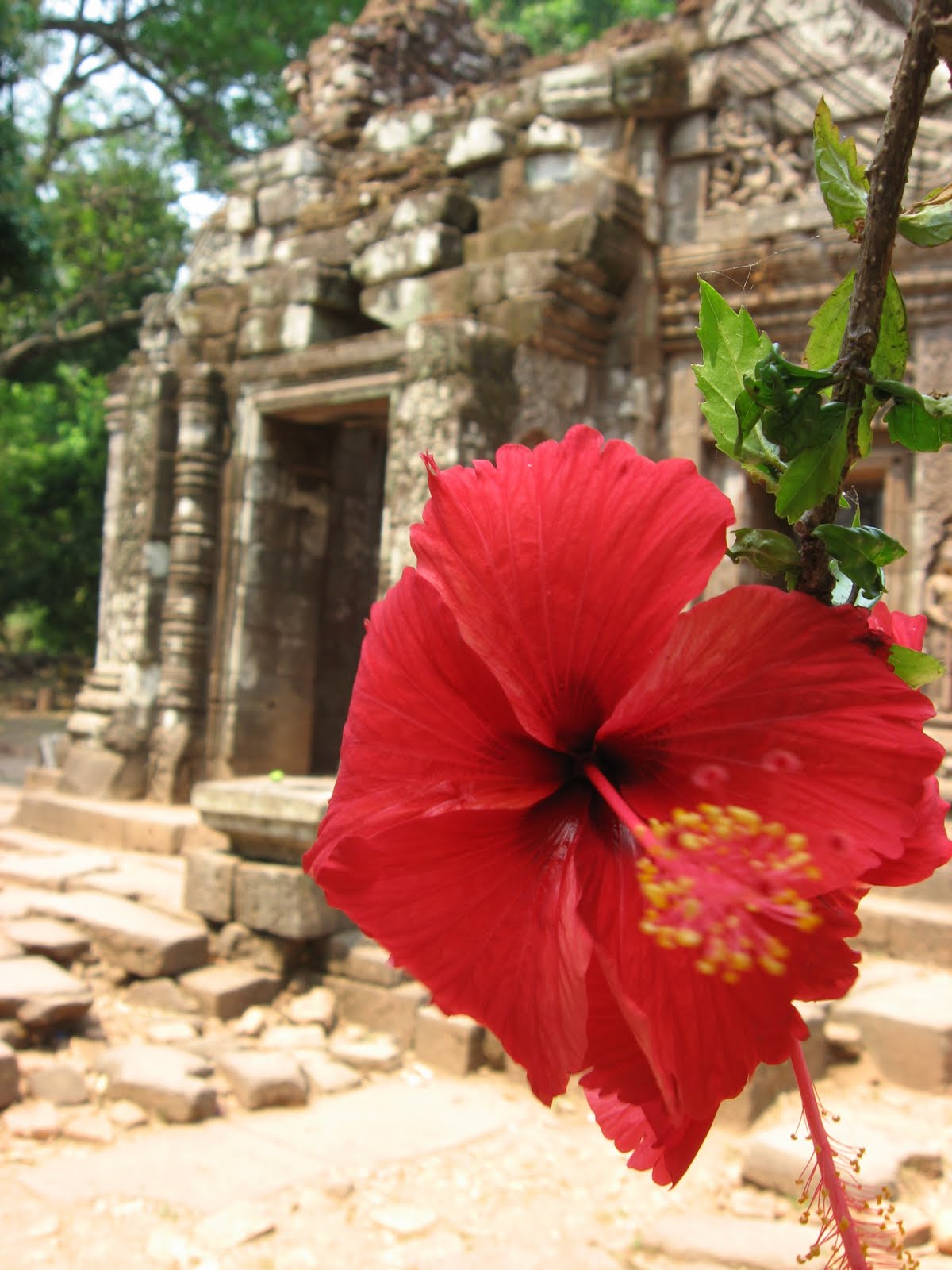
Wat Phu, Champassak, Laos

As an aside - Phi Mai Lao may be my new favorite holiday. It’s like a cross between the world’s most innocent and sincere wet t-shirt contest and the world’s biggest water fight. It was 3 days of people at the side of the road throwing water (or hosing down) people in trucks, on motorbikes, on bicycles, or walking. People in trucks reciprocate with their own buckets of water, and people riding pillion on motorcycles and bicycles and people walking shooting each other with water guns. As we drove through town one afternoon, half the town was gathered in their front driveways with music playing, the hose and buckets out, the girls dancing and swinging the hose around in the air above their heads, dousing and washing each other, the guys taking the lookout for (and drenching of) passers by more seriously. The other half the town was in the back of pickup trucks in groups of 5-10 with buckets and water guns, and on their motorbikes. The best part is: they all slow down as they approach one another so they can be sure they have a good opportunity to drench and be drenched. Even passing motorists not engaged in the festivities would, for the most part, cheerfully slow down to have the hose held over them for a few moments. And when I say drench, I mean drench. I stood outside with the girls who worked at the hotel for 45 minutes, and when it became clear that I was joining them the first thing they did was hold the hose over my head and rotate me for a minute. Oh, and it’s 90-100+ outside, so even if someone dumps a bucket of ice water over you, you’re still not ever really cold.


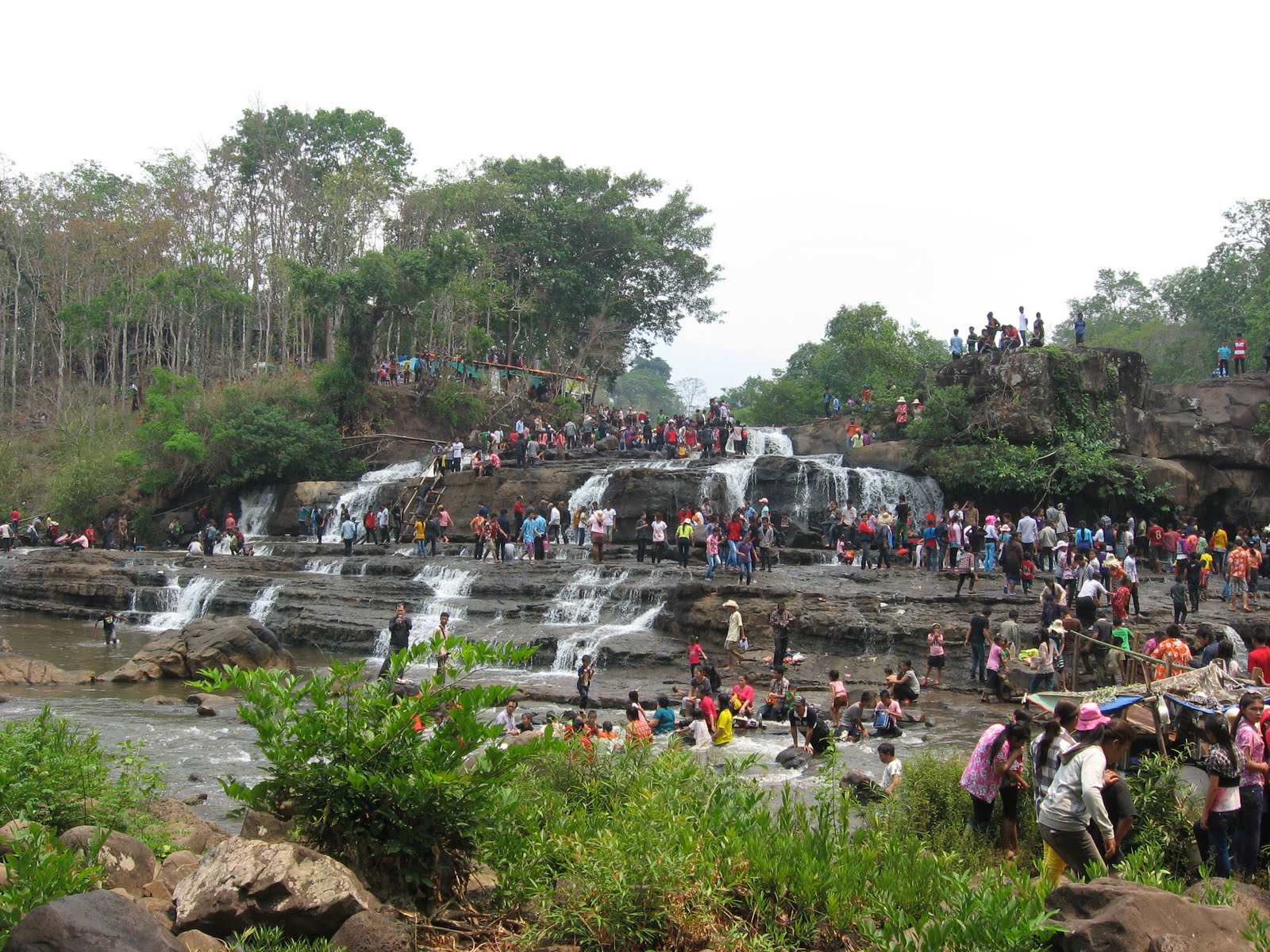
Hundreds of Lao people frolic in Tat Lo, Salavan. The water felt great, and they loved splashing the falang.

Two weeks ago my Mom sent me a link to the obituary of Carla Madison. Carla moved in across the alley from my family when I was in elementary school. She was 54 and a Denver City Council member when she died of metastatic colon cancer. We weren’t close friends, or even still neighbors, but I know she will be missed greatly in Denver. She was a massage therapist when she moved in, and she was so good she would be the one called when a famous band was in town. (I seem to recall a weekend spent working on the Rolling Stones, but maybe my childhood memories have exaggerated that.) She always had a crazy new shade of red hair, she had a home-made evil monkey chandelier in her dining room, had gargoyles installed on her front steps, and she couldn’t stop adopting stray dogs. I remember being kind of scared and in awe of Carla - she was pretty cool but also a bit mysterious and maybe her life was a bit dangerous in addition to being exciting. (I actually doubt it was, but that was my impression in elementary school.) When I learned in medical school that she had metastatic colon cancer, it was my first experience being uncomfortable knowing more about a diagnosis than I could share with parents/friends, and not knowing if someone I was in no way a caregiver for understood what a diagnosis meant. This continues to be an awkward situation when it occurs, and probably always will be. I know that Carla understood her cancer for a long while before she died, though, I saw her last summer during a visit and she was pretty open about it. I wasn’t surprised - she was a smart woman who stuck up for herself and made her own assessment of things, so of course she would have asked the right questions and wanted to understand. I don’t know, but I would guess that she was also at peace with her life and death, although it was clearly terribly unfair. (My impression is that) Carla was a person who lived life fully, completely, without being reckless, but experiencing, giving, and receiving as much as she could. She lived more in 54 years than many people do in a full lifetime. As I approach 30, I hope that my friends would be able to say the same of me - whether I die next week or at 90. Working in medicine makes you aware of the preciousness of life, and makes you want to preserve your own, but you also realize how crazy, terrible things happen to people all the time, so you don’t want to put off or pass up opportunities when they present themselves.


Kayaking to see the dolphins. I think Carla would approve.

Work has been frustrating the last few weeks. I am trying to negotiate resident selection for the next class in a political climate I don’t fully understand, and a language I understand maybe a third of. (For the record, understanding 1/3 words is absolutely not enough to understand the nuances of a conversation between native speakers. General gist, maybe.) The residents were supposed to start today and we still don’t have a final list. And they have to move from all over the country. There are at least 2, if not 3 factions with drastically different ideas of who should be chosen. Time I spend calling, e-mailing, and attending meetings about this is often time away from clinical work, which is the really fun part of this volunteer job. Then I spent quite a bit of time making the schedule for next year work, including trying to make sure people didn’t have vacation too early, etc. Of course, almost none of the residents are happy with it and many want changes. It’s not a simple process to make sure that 21 people each have the correct rotations and all the wards have the correct number of residents from each year working on every ward each month. (Hats off to Julie Cole, who did this for 30+ people per class in my residency program, by the way. I have a whole new level of sympathy for her, and I’m glad I never requested changes to my schedule once it was made. Of course, she did a good job.)


My best attending English students. Poor suckers, I barely understand the language myself.

Even at my most frustrated/confused about work, or at my loneliest while traveling alone, I haven’t regretted the decision to be here now. I haven’t even come close. This has been a great year for me. I’ve solidified clinical skills and critical thinking skills that I had at residency graduation, but was accustomed to having a supervising doctor to confirm or correct. I’ve learned about disease I had heard of only in passing (Meliodosis) or not at all (Capillariasis). I’ve worked normal-length weeks, and I’m exercising regularly. I hope my time here has also been valuable for my residents - I think they are learning, and they aren’t complaining about my teaching, but then again people here generally don’t complain. I think the part of my day that I value the most - clinical rounds with the residents - is also the part they benefit from the most. Prompting them to get the whole story, make a differential diagnosis, and then think critically about what we should test, treat, and think about for later is not something their Lao supervising doctors always have time to do.


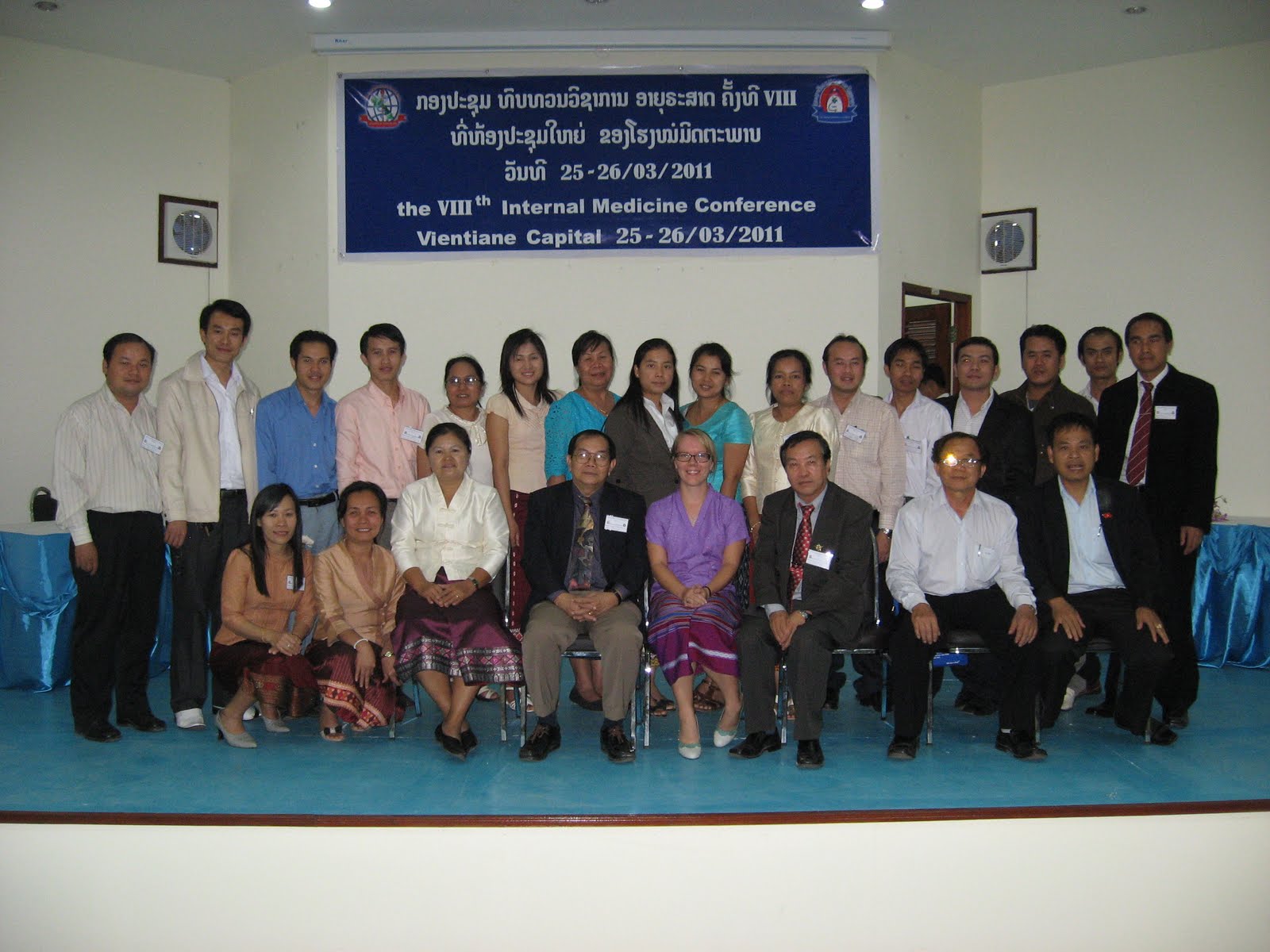
Residents and staff at the end of CME. Why I am here.

A friendly old hippie from San Francisco who I met at the Pakse Hotel had 2 pieces of wisdom regarding turning 30; the first was that you should not wake up alone, because it can be a hard day, the second was that whatever you’re doing at 30 will be what you do for the rest of your life. I’m going to bed alone tonight, so unless something crazy happens, I will be waking up alone. I’m OK with that; I do have a birthday card my parents mailed March 26th (So it would arrive in time) to open. And I have a full day planned, so I don’t think I’ll have time for much melancholy. As for the second, I don’t think I’ll be in Lao for the rest of my life (in fact, I hope to be home at this time next year - my next home tentatively being Denver). I do hope that I’ll continue to be involved in global health, teaching, learning, and taking good, compassionate, care of my patients for the rest of my life. I hope I’ll continue to enjoy life and take care of myself as well. So I hope he was right about the second piece of “wisdom.”


Enjoying another sunset over the Meekong - this one from the rooftop bar of the Pakse Hotel with a Margarita! I've never before seen so many fabulous sunsets in one year.

Yesterday I got this message in an e-mail about the schedule from one of the chief residents: “Occasion in your birthday and Laos new year, I wish you have good healths, do not ill or do not fever. Have successful in your life all of your family too. Have a lot of money, but do not forget to share me! Itdermair, and Chief of resident” You couldn’t ask for a nicer sentiment. I wish it back to my Lao residents and colleagues, friends in Lao, and of course all of you, dear readers, who have supported me through these first 30 years. I look forward to sharing the ongoing journey with you!


Jonty, 2, sweeping the yard in his dress. He still knows how to follow his dreams without fear of judgment.

Sunday, April 3, 2011

Communication Culture Shock

When you move from a medical culture like America’s to a markedly different one (like Laos) you notice stark differences initially, but then you readjust your expectations and things seem normal here that would be totally bizarre at home. I was reminded of this 2 weeks ago. I had seen a confusing patient with the resident at Setta - and 80+ year old woman who had come in with a severe, unilateral temporal headache that had been present for 2 months. She had photophobia and tearing but also had some swelling and redness. She had no fever, though or other infectious symptoms. She had been seen at another hospital, had a head CT, and told she had brain cancer. “Great! Brain Cancer!” I thought. Of course brain cancer is never great, but a mass lesion in that area might explain her confusing array of symptoms. She had some weight loss as well, so malignancy was plausible. And in an 80+ year old, not super surprising or tragic - she has outlived her life expectancy by more than 20 years. Plus, a mass could also be parasites or abscess, and treatable.

Only one problem existed with this theory - we had the CT (non-contrast) and we couldn’t see any mass. No clearly defined mass lesion, no significant unilateral swelling or loss of contours of the fissures, no midline shift. Could it be temporal arteritis? Certainly, though the ESR was near normal, making this far less likely. Also, it hadn’t improved with steroids. This makes other autoimmune/rheumatological conditions lower on my list as well. Could it be an optic nerve / retinal problem? Could it be glaucoma - the time course was wrong, and the external eye exam didn’t quite fit, but then she wasn’t really fitting any clinical syndrome convincingly. After two trips to the opthamology department, it was determined that both her external ocular structures and retina were normal. A chest x-ray showed masses on either side of the mediastinum that looked more like tumor than infection or anything else, and an abdominal ultrasound showed a mass in the liver. Oh, and she still had no pulmonary or infectious symptoms. Basically, we had no idea what was going on with this patient, but malignancy was still highest on our list having ruled out a number of other things.

One day, after she’d been in the hospital for several days, I was on my way out of the room when I was stopped by her daughter and asked (In excellent english) if I could take a few minutes to explain what was going on with her mother. I was taken aback. I hadn’t been approached with a question from a family member since leaving America. It just doesn’t happen here. I often have to encourage the residents to stay and explain the diagnosis and plan to the family after we discuss a patient, because otherwise they just write the orders with little explanation. They do counsel patients about chronic disease, etc, but generally, the patients trust the doctors and don’t request explanations of what is going on. This is mostly bad; patients don’t know what has been done before because no one explains it to them, and they are probably more prone to non-compliance if they get side effects, because no one has explained why their treatment is important. However, I realize I have adjusted to this culture.

Her daughter was from Phoenix, where she had lived for the past 25 years, and had been called home because her mom was sick. She was coming from the American medical culture where patients now demand explanations from their doctors. I explained that I serve mostly a teaching / consultant role for my residents, and I do not make any direct patient care decisions, only recommendations that the staff physicians actually directly supervising the residents can accept or reject, so the residents and Lao staff would actually be the final decision makers regarding treatment and testing. I explained that we think her mom has lung cancer with a paraneoplastic syndrome (Cancer associated) or a mass lesion that we can’t see on the non-contrast CT. We could get more info with a head CT with contrast, and a chest CT, but we still wouldn’t be able to make a definitive diagnosis. For that, they would have to go to Thailand where they could get a biopsy and pathology results on one of the masses. However, that still wouldn’t confirm the cause of the headache, which was her only real symptom, and would be expensive. It might result in offers of chemotherapy which the family would then have to decide about. We were pretty sure it wasn’t infectious at this point, and she was getting steroids for theoretical tumor edema, but in doses that should treat temporal arteritis or other rheumatological diseases. My understanding is that the medication options for pain in Thailand aren’t much better than ours here. Of course, there was a period of shock - there are no oncologists in Lao? Nope. There isn’t anyone who could do a biopsy here? Nope, no IR doctors, only general surgeons, and I sure as heck wouldn’t let anyone near this frail, elderly lady for an open biopsy to confirm something we can’t treat. (I seriously doubt the surgeons would have done it even if we’d asked.)

The patient’s daughter absorbed this information. Despite being much more aggressive than a Lao patient or family member, she was relatively reasonable - she agreed that diagnostic testing for something we couldn’t treat was not worth pursuing. Neither doctors nor patients are very comfortable with uncertainty in America. I was feeling uncomfortable about how few answers I could give her, so I was impressed that she didn’t demand a better (or at least more definitive) answer. Then she asked me how long her mom might have.

Doctors everywhere hate being asked this question. Unless your patient clearly is going to die within the next few hours, it’s hard to answer. Even if we have a diagnosis of a specific type of cancer, for example, all we can do is give statistics - most people live about this long - but humans are individuals, and averages are averages - some people will live much much longer, and others might seem fine today and have a serious complication and die tomorrow. And then, of course, any of us could die tomorrow - in a traffic accident on the way to work or from some unknown, asymptomatic but serious medical condition. Everyone know someone who doctors said only had a few weeks or months to live and who exceeded their predicted longevity by multiple times the estimate, making the doctors look foolish for predicting in the first place.

I understand why she wanted to know - she had taken all her vacation/leave time to come and spend with her Mom. Was this the right time to be here? Should she try to go home and come back when her mom was really ill so she could be present for the funeral as well? If she went home, the cost of coming back (>2000$ if your ticket is purchased well in advance) and the transit time (at least 30 hrs each way) would make coming back urgently nearly impossible, especially if all her leave time was used up. I understood the question, but I still resented it. How could I make a prediction about how long this woman would live, not even knowing for sure (or for a strong most-likely) what she had?

So I gave her my standard answer - one that I learned from an experienced Irish hospice doctor. “Of course, we never really know, and doctors are terrible at predicting this. However, generally, if she’s been well and deteriorating slowly over months, she probably has months to live. If you see her getting worse over weeks, she probably has weeks to short months to live, and if she is getting worse day by day, then she has days or short weeks.” I thought given that her mom looked pretty good day by day, that it was unlikely that she would die while the daughter was visiting, but she could be on the verge of a rapid deterioration, so I couldn’t make any guarantees.

Over the next week we tried to get her mom’s symptoms more under control. The steroids helped a little, but not dramatically. IV morphine or pethedine worked briefly, for about 3 hours, but this is not a good solution for a patient who should be working towards going home to spend quality time with her family. Our only oral narcotic here is tramadol - not a strong drug, and one which has a strict dosing limit due to seizure risk. Could we give IV or subQ or IM meds at home? They could have the village nurse come by 3 or even 4 times/day, but we had no way to know if this person would be familiar with IV or sub-Q drug administration, morphine dosing, dose changes etc, so it seemed like a bad idea. (Morphine is only used in the hospital, so it’s unlikely that the neighborhood nurse would be comfortable using it to manage pain.) Not to mention the morphine was only lasting 3 hours, and there is no extended release formula here. I tried to encourage scheduled tylenol and tramadol, and we added amitriptyline, which should help if there was a nerve component of the pain, which the symptoms suggested. We switched the steroids to oral. I had another long talk with the daughter explaining what each medication was for, how much she could take, and how frequently she could take it. I did more medication counseling in that one session that I have done (or seen done) in my entire time in Lao.

The truck wasn’t starting at the end of last week, so I didn’t get back to Setta to see how things were going. I’m not particularly optimistic, since scheduling pain meds is another thing that doesn’t really exist in Lao culture, and since we’re working with such poor choices to start out with. This case did inspire me to put together a lecture on pain and symptom management using medicines available here, which I hope I can give early in May when the new residents are here. (I offered to give it next week but they would rather have exam review, reasonably.)

I think there is a happy medium between the Lao patient / caregiver - almost never questioning or understanding their medications and diagnosis - and the American one - demanding answers (and often tests or treatments). Both cultures often end up with patients who are “non-compliant.” Lao patients who aren’t warned about side effects of important treatments may stop them independently and not return for an alternative. American patients perceive a side effect from a medication and search the internet to confirm that this is possible, stop the med and then blame their doctor for not warning them, even if the side effect has only a few case reports associated with it. Lao patients rely on doctors to order the right tests and treatments without any questioning, while American ones often demand unnecessary testing or treatment that then leads to further anxiety, more money spent on confirmatory tests, and / or side effects. Lao patients should be less trusting and demand more info. American patients should be more trusting - demanding information and explanations, but being willing to accept them when provided, and to work with their doctor to find an alternative.

I also think that returning to patient care in America, this may be my biggest aspect of culture shock - not the availability of tests we don’t have here, the tremendous expenditure of resources we don’t have here, or the absence of diseases that are common here - but the way I communicate with my patients.

Sunday, March 27, 2011

Internal Medicine Continuing Medical Education

I am home from the 2 day IM CME conference. This is the 8th annual IM CME in Laos, and a number of improvements have been made over the years. For example, this year’s conference is on Friday and Saturday. They used to be held during the middle of the week, so that no one’s weekend was infringed on (even if they had travel days on either end), but we now acknowledge that it’s cool to learn on the weekend too. There was also minimal debate in the planning stages about whether boxed lunches would be OK - in the past much attention has been given to the quality of the buffet, but recently the quality of the lectures has taken precedence. The conference is still funded in part by pharmaceutical companies, but to be fair a lot of American CME is too.

I arrived just after the official start time, 8:30, and we actually started only 10 or 15 minutes later. The opening ceremony involved several of the head doctors in IM plus some ministers giving speeches. I had a moment of sheer terror when the WHO representative was asked to speak and I realized that I didn’t know if I was going to be asked to contribute to this. (Fortunately, I wasn’t.) In America, this would be a brief welcome formality, but in Lao the opening and closing ceremonies are important parts of the conference. So important that there are usually multiple camera men, and today, 2 videographers. I have to be very careful not to make faces during the opening ceremonies, because the videographers seem to particularly enjoy recording the one Falang in the room.

At the end of the opening ceremony, the Minister of something related to health gave a long speech that involved frequent use of the Lao word for child, and I watched the other dignitaries and attendees expressions of alarm and then amusement as we all realized he had no idea what kind of conference he was at. Bor Pben Yang, at least he knew it was about doctors and patients.
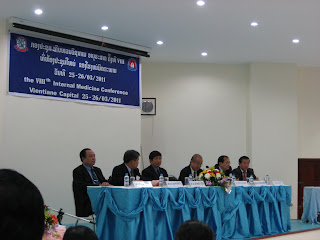


The dignitaries at the opening ceremony.

The first talk was a series of studies on patient satisfaction on one of the inpatient and outpatient wards at Mahosot. Interestingly, despite what would be considered sub-standard facilities (one one of the nicest, newest wards in Lao), 100% of the inpatients and more than 60% of outpatients thought the quality was “Good.” The other options were moderate or poor. Generally, positive answers were in the 85-100% range on all the subsets of the surveys, which were conducted twice several years apart. I don’t suppose there’s any way to figure out whether the patients really are that satisfied, they fear if they answer negatively their care will be affected, or they are just being polite non-complainers. I can’t imagine finding a group of American patients who would answer a similar survey the same way, however.

At the first coffee break, I tried a banana-leaf wrapped snack. I was skeptical, because several times in the past week the banana leaf has been filled with pork, sticky rice, and bean paste which I don’t actually like that much, but eat because it’s usually offered as part of some ritual event. This was sweetened coconut sticky rice, egg paste, and a pudding that i think was made of tapioca, though, and it was delicious. The rest of the morning was Thai doctors and the Lao endocrine fellow introducing them and the topics. It is nice to see Vasana, one of the graduates of the first residency class and now a HF sponsored fellowship grad, in a leadership/teaching role now.
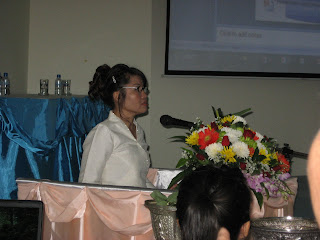

Dr. Vasana introducing topics and her Thai colleagues. Isn't she beautiful?

I ate lunch in the VIP room, with the Lao senior teachers. Alounxay, a recent residency graduate and staff on the Cardio ward, served the most senior teachers lunch - as in, opened their boxed lunches and set things out for them - and then made coffee and tea for everyone as they finished their food. That’s a job you won’t find any American staff doctors doing. . . cultural differences. The box lunches were pretty good - pork and beans and white rice with a few slices of fried mekong fish or fried rice and soup - so I’m glad they saved money on a buffet.

After lunch, I went downstairs to peruse the pharma shopping area. It was interesting, especially when I realized the book stand was run by one of our residents - a second year who is not super motivated on the wards. The residents had mentioned something about his driving to Thailand for books in the past, which I thought was odd, but didn’t question further. I guess he’s running an import business now. He was doing brisk business with residents, staff, and medical students. I can’t really begrudge this - he is giving access to resources that they otherwise might find harder to get - and I think his mark up was only a dollar or two per book. Maybe he should have become a businessman, not a doctor. I bought a copy of the mass general handbook of internal medicine “Pocket Medicine” - it’s smaller than the real thing, has a beautiful pink cover, and was 6$. American MSRP - 60$. I probably should have owned one in residency, but better late than never, eh?

Afternoon was mostly Thai doctors - Movement disorders, chronic kidney disease, spondyloarthropathy - before the coffee break. At the end of each session, awards were presented to all the speakers - wrapped presents in boxes for the Thai visitors and envelopes for the Lao speakers. One of the senior doctors, or if present dignitaries, is called to the front of the room where a lovely young woman holds a silver bowl with the present or envelope in it. The presenter takes it out and hands it to the speaker while the audience claps rhythmically. Then they hold the pose of giving/receiving until the pictures are taken.
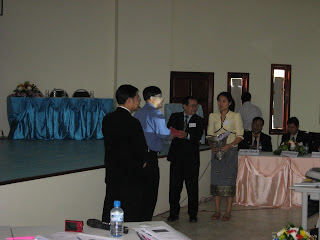

Presenting thank you presents.

After the coffee break, we had a really great presentation from a Lao MD/epidemiologist about causes of fever in 2 distant provinces - one far north and one far south - that was impressive in reminding me of the quality of research that’s being done here with limited resources. And how much it can help them with treatment, like choosing antibiotics that the common local pathogens are susceptible. Brent would be please to see how frequently this means Doxycycline rather than ofloxicin, azithro, or ceftriaxone. Then we had some case presentations, one of ITP treated with cyclophosphamide which prompted a lot of discussion and I’m pretty sure there’s no evidence for, but since I didn’t completely understand the presentation, I kept my mouth shut. (I had just given a talk on thrombocytopenia thursday to the residents, so I’m a little worried they are getting mixed messages, but I think the discussion was heated enough to let them know that’s certainly not a well-accepted first line treatment.)
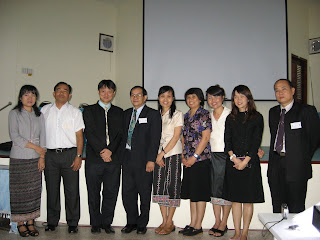

Thai visiting doctors and their current and former fellows and a few of the senior Lao doctors who have made fellowship possible by building the program.

The second day of CME featured: a Lao Nephrology fellow who will be returning from Bangkok soon talking about Rhabdomyolysis - (seems particularly relevant given all the earthquakes recently including one on the Lao/Myanmar border), our senior GI physician talking about GI cancers, another Thai physician discussing the interaction between PPIs and Plavix and the development of H Pylori resistance in Thailand and the interaction between PPI metabolism and H pylori eradication, several case presentations, and discussions of dialysis access and bronchoscopy in Laos. It all seemed useful and relevant, not to simple or too complicated to be useful here. And the PPI metabolism was new to me too - interesting! The first coffee break featured wafer-like, crispy cookies and small green jelly/coconut/mysterious centered treats wrapped in saran wrap, as well as the usual eclairs and cake. Lunch was fried rice and soup or pork and beans and breaded chicken with white rice. I opted for the fried rice. The second coffee break was fruit and very sturdy jello-like heart shaped pudding treats both days. Oh, and powdered soy milk in hot water - I liked the hot powdered milk drink in tanzania, and I found this tasty too (of course it has sugar added), although after a day of sitting and listening to lectures with breaks for food, I certainly didn’t need the calories. I tried to replicate the powdered milk drink in america, but was unsuccessful. There’s something about the texture of the milk powder that makes ours not work.

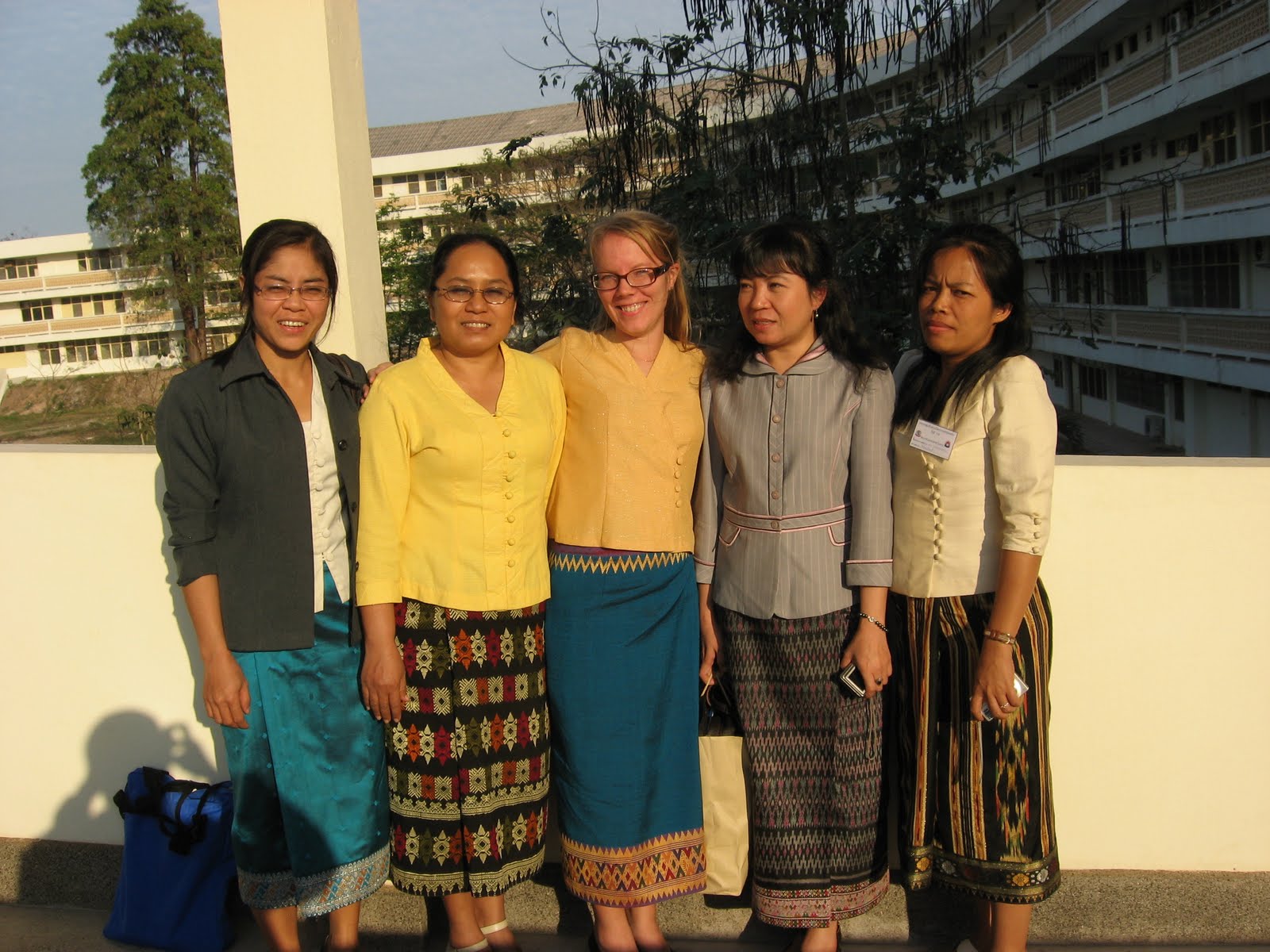
So overall, although I don’t fully understand most of the content, CME was positive. It was organized entirely by the Lao doctors, seemed relevant, and certainly showcased some HF grads in leadership roles (in addition to the lecturers, many of the people instrumental in planning are our former residents.) I wore 2 beautiful new sins an got many compliments including the ultimate one - “If you changed your hair color, you would be like a Lao woman.” (I challenge you to find a more gracious and complementary group of people than the Lao, so I know it’s not personal, but it’s still nice.) The residents looked engaged in the lectures, the residency grads and even a couple residents asked questions, a good sign that they are both paying attention and learning, and not afraid to speak up. Pharma paid for part of it, but didn’t seem to have any impact on the lectures themselves, and was not given time to speak, just space downstairs to sell the attendees stuff (and give them pens and hand outs, of course.)


The beautiful ladies of IM - Residents Payvanh, Khamvay, Libby, Velouvanh (Fellow at KKU) and Phouthasone. Phouthasone was unhappy about being in the sun. Notice my beautiful woven silk Sam-Neua style sin; This is what gets the compliments, not actually me.:)