When asked how their new english teachers were (two Australian medical students who volunteered)
Resident: Nayang has palpitations.
Libby: Oh really?
R: Yes, because the new English teachers are very beautiful. He has sinus tachycardia.
Next week: L: Nayang, do you have tachycardia again?
Nayang: No, I premedicated with propranolol.
After a second new english teacher:
L: How do you like your new english teacher?
R: She is big and strong, like a man (Makes body building pose with arms)
L: Please don’t tell her that. . .
Thai Doctor, explaining how the university has only one staff dermatologist: “We say that dermatologists are a mystery. We train them and then they disappear.”
Sunday, February 13, 2011

Saturday, January 22, 2011
A win and a loss
My non-medical readers may want to skip this post. I will post a non-medical one soon, I promise.
Just before new years, the residents asked me to see a patient who had been admitted to the hospital for hiccoughs. When I saw him, the story was a bit more complicated, and included a motor vehicle accident with head trauma 10 years ago, and had been told that he had a hematoma but then had no follow up. He had a left sided daily headache for 2-3 years, pain around (but not inside) the left ear for several days, bleeding from the left ear for one day, and one day of subjective fever within the week prior to admission. At the end of the encounter, they mentioned that he had Hepatitis B and had been treated with interferon for 15 weeks several years ago. His headache was variable, not always in the morning, and didn’t fit migraine or cluster headache patterns either. It had improved with paracetamol, and his hiccoughs (his original presenting complaint) had been present for a week prior to admission, and had improved but not completely resolved over several days with metoclopramide. (He came on Friday and I saw him on Monday or Tuesday.) I think the residents had already decided to do a head CT, and I encouraged them with that plan, explaining that Hiccoughs can come from the brain/nerves or the diaphragm, and I was hopeful that his were from the diaphragm, but his story was worrisome that they might be from the brain.
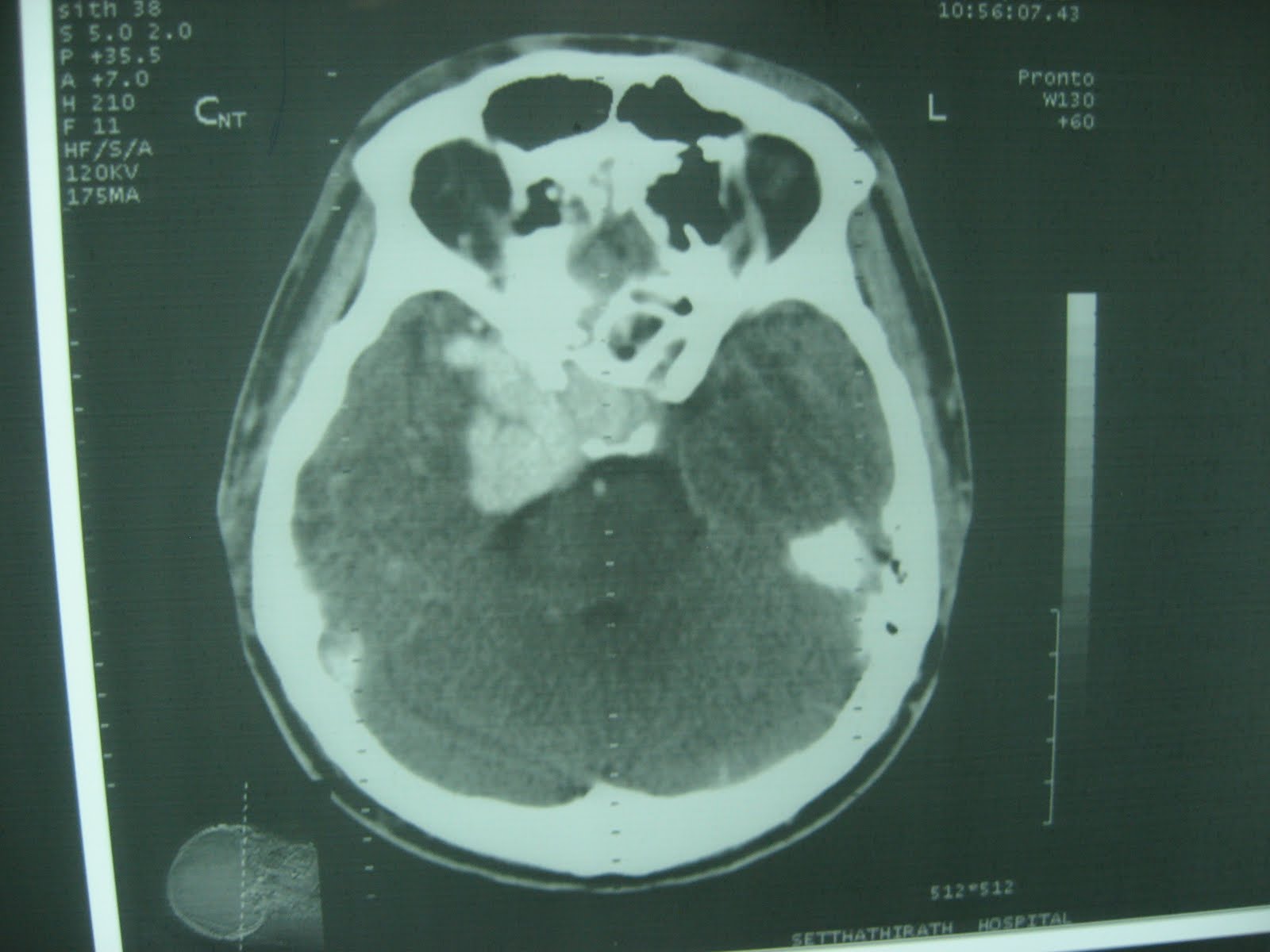
The next day, I was asked to look at his head CT. He had multiple lesions, including an area on the right side that looked like an old stroke or hematoma - mostly empty space where there should have been brain - an 2 spots that light up homogeneously with contrast - one near the left ear, and one on the right, at the very front of the brain near the pituitary gland and optic nerves. And it looked like maybe he had an old fracture in his right sinuses that had not completely healed. The enhancing lesions looked most like tumor - they were very regular - but I was praying for infection (or something else we could treat.) Either way, it was clear he needed an MRI and a neurologist, so the residents sent him home with plans to see Lao’s only neurologist (and a HF internal medicine residency grad) after his MRI in Thailand. A week and a half or so later, he returned to Setta with his MRI read. 11 pages of images in a 5x6 grid. The residents asked me to interpret it for them, because there was no read.
By the 6th or 7th page I was pretty discouraged. I couldn’t tell what kind of lesion the biggest, most worrisome one was, at the R front of the brain. It didn’t look like an abscess or a tumor to me, but I’m also not really trained to read brain MRIs. I’m not a neuro-radiologist, a neurosurgeon, or a neurologist, and while I occasionally look at brain MRIs, I usually do so with a detailed explanation of the results in front of me. I’d like to think I could see acute ischemia or a tumor or parasites on an MRI, but subtle differentiations are certainly beyond me. Fortunately for me, page 9 revealed a possible answer. The malformation lit up with IV contrast too - A LOT - like a blood vessel, not a tumor. Page 11 was the MRA and it clearly showed lots of blood flowing to the area and contrast filling the veins much quicker on the R. Maybe it wasn’t tumor but a crazy big aneurism or AVM? Would that be good or bad for my patient in a country with one neurologist and limited neurosurgeons, maybe none who specialize in vascular problems? I decided it was better than tumor, and explained my theory to the residents with multiple disclaimers about my lack of qualification to interpret MRIs, and they agreed to send the images on to the neurologist. The next day we got the official read from Thailand - he did, in fact, have a large abnormal vascular malformation in the R parasellar region. The neurologist tells me he and the surgeons will discus whether it can be repaired in Lao or he needs to go to Thailand. (And hopefully someone has figured out what the abnormality is on the Left side of the brain -that one wasn’t in the read we got.) But I left the hospital that day feeling proud of my deductive reasoning skills, if not my MRI reading ones. And while the patient isn’t “fixed” yet, he did have appropriate diagnostic testing in a timely fashion, and is being directed to the people who can decide when and how to fix him. :) That’s often as close as we get to a win in Laos.
 At around the same time, a 15 year old girl was admitted to the inpatient medicine wards. It’s ok for my residents to take care of kids sometimes, because when they go home to their districts they may be the only competent doctor, and they will certainly be expected to care for everyone who shows up in the ER when they’re on call. However, I really do not feel qualified supervising them in the care of pediatric patients, particularly here in Lao; not only am I not trained in peds in america, I know nothing about the diseases that are more common here, or specific to SE asia, in children. However, the residents reported that they had asked the pediatricians if they’d like to take over the care of the patient and they weren’t interested. And she was looking pretty sick. She had had more than 3 months of abdominal pain, diarrhea, and weight loss. She now had anasarca and had had an albumin that was too low to measure (less than 2.7) on a check several months ago and again on admission. My resident really wanted it to be nephrotic syndrome (which is pretty common in SE asia) but she had multiple UAs that showed no protein. He was worried that it might be Capillaria philippinensis. This did not make a little light bulb appear over my head. Maybe we talked about it in global health class, but if we did I wasn’t remembering it. However, she did have Opisthorchis, a parasite that you get from eating raw fish, in her stool, and we determined that she had not been treated for this during her previous stay in the hospital. (No one had asked this, or reviewed the chart to see if treatment was prescribed.) So we agreed that we would repeat the few labs that hadn’t been ordered in the ER and treat the parasite we knew she had.
I went home and read about Capillaria philippinensis. It turns out that you get it the same way - eating raw fish - and it is one of the rare parasites that will actually kill you without treatment. It causes chronic diarrhea, abdominal pain, and protein loosing enteropathy. (All of the symptoms our patient had.) And it can be hard to find on stool exams. And almost all patients who have it have other parasites as well. And there have been cases in Lao. All of this was adding up to make me very worried about this patient. I e-mailed our beloved ID doc who agreed that the story was worrisome but suggested we also consider beri-beri (thiamine deficiency.) Another condition I have never actually seen in America. I reported this back to the residents. We discussed how she didn’t have the parasites on another stool exam, but we knew she had one parasite, which made others more likely. We discussed how clinically, the picture was compatible, and how these particular parasites can be hard to find on stool exam. We discussed how not treating capillariasis is deadly. We discussed the risk / benefit of possibly giving anti-parasite drugs she doesn’t need (side effects/toxicities) vs. the risk of not treating the infection (death.) The residents reported that they agreed with me but the teachers said they couldn’t give albendazole, the medicine for capillariasis. They did give some thiamine.
Over the next week, her anasarca improved and her fatigue improved a bit. She looked more like a chronically ill patient, but not one on the verge of death, the way she had the first day or two. She started eating a little, sitting up, and interacting with the doctors. Maybe she had just had thiamine deficiency, but probably not, because thiamine deficiency doesn’t cause abdominal pain, and it usually does cause other symptoms / exam findings that she did not have. I had the same discussion about likelihood of infection (Unknown, but certainly non-zero), and risk/benefit of treatment vs not treating several more times with the residents, and one time with the IM teachers and ID team there. They all sort of nodded their heads, but every day she still hadn’t been put on albendazole. This monday, I came in to the hospital and she was gone. She was discharged over the weekend, having never been given albendazole. The residents reported they would have liked to give it, but the teachers kept saying no. I can only hope that if she gets worse again (which she will do if she has untreated infection with this particular parasite) she comes back to Setta, either to the IM ward where I can try again, or to the peds ward where the docs can at least look at all the recent notes saying ?capillariasis and consider it as a diagnosis. But I feel like we failed a young woman with a lot of potential life left ahead of her, and that is discouraging.
Just before new years, the residents asked me to see a patient who had been admitted to the hospital for hiccoughs. When I saw him, the story was a bit more complicated, and included a motor vehicle accident with head trauma 10 years ago, and had been told that he had a hematoma but then had no follow up. He had a left sided daily headache for 2-3 years, pain around (but not inside) the left ear for several days, bleeding from the left ear for one day, and one day of subjective fever within the week prior to admission. At the end of the encounter, they mentioned that he had Hepatitis B and had been treated with interferon for 15 weeks several years ago. His headache was variable, not always in the morning, and didn’t fit migraine or cluster headache patterns either. It had improved with paracetamol, and his hiccoughs (his original presenting complaint) had been present for a week prior to admission, and had improved but not completely resolved over several days with metoclopramide. (He came on Friday and I saw him on Monday or Tuesday.) I think the residents had already decided to do a head CT, and I encouraged them with that plan, explaining that Hiccoughs can come from the brain/nerves or the diaphragm, and I was hopeful that his were from the diaphragm, but his story was worrisome that they might be from the brain.
The next day, I was asked to look at his head CT. He had multiple lesions, including an area on the right side that looked like an old stroke or hematoma - mostly empty space where there should have been brain - an 2 spots that light up homogeneously with contrast - one near the left ear, and one on the right, at the very front of the brain near the pituitary gland and optic nerves. And it looked like maybe he had an old fracture in his right sinuses that had not completely healed. The enhancing lesions looked most like tumor - they were very regular - but I was praying for infection (or something else we could treat.) Either way, it was clear he needed an MRI and a neurologist, so the residents sent him home with plans to see Lao’s only neurologist (and a HF internal medicine residency grad) after his MRI in Thailand. A week and a half or so later, he returned to Setta with his MRI read. 11 pages of images in a 5x6 grid. The residents asked me to interpret it for them, because there was no read.
By the 6th or 7th page I was pretty discouraged. I couldn’t tell what kind of lesion the biggest, most worrisome one was, at the R front of the brain. It didn’t look like an abscess or a tumor to me, but I’m also not really trained to read brain MRIs. I’m not a neuro-radiologist, a neurosurgeon, or a neurologist, and while I occasionally look at brain MRIs, I usually do so with a detailed explanation of the results in front of me. I’d like to think I could see acute ischemia or a tumor or parasites on an MRI, but subtle differentiations are certainly beyond me. Fortunately for me, page 9 revealed a possible answer. The malformation lit up with IV contrast too - A LOT - like a blood vessel, not a tumor. Page 11 was the MRA and it clearly showed lots of blood flowing to the area and contrast filling the veins much quicker on the R. Maybe it wasn’t tumor but a crazy big aneurism or AVM? Would that be good or bad for my patient in a country with one neurologist and limited neurosurgeons, maybe none who specialize in vascular problems? I decided it was better than tumor, and explained my theory to the residents with multiple disclaimers about my lack of qualification to interpret MRIs, and they agreed to send the images on to the neurologist. The next day we got the official read from Thailand - he did, in fact, have a large abnormal vascular malformation in the R parasellar region. The neurologist tells me he and the surgeons will discus whether it can be repaired in Lao or he needs to go to Thailand. (And hopefully someone has figured out what the abnormality is on the Left side of the brain -that one wasn’t in the read we got.) But I left the hospital that day feeling proud of my deductive reasoning skills, if not my MRI reading ones. And while the patient isn’t “fixed” yet, he did have appropriate diagnostic testing in a timely fashion, and is being directed to the people who can decide when and how to fix him. :) That’s often as close as we get to a win in Laos.
 At around the same time, a 15 year old girl was admitted to the inpatient medicine wards. It’s ok for my residents to take care of kids sometimes, because when they go home to their districts they may be the only competent doctor, and they will certainly be expected to care for everyone who shows up in the ER when they’re on call. However, I really do not feel qualified supervising them in the care of pediatric patients, particularly here in Lao; not only am I not trained in peds in america, I know nothing about the diseases that are more common here, or specific to SE asia, in children. However, the residents reported that they had asked the pediatricians if they’d like to take over the care of the patient and they weren’t interested. And she was looking pretty sick. She had had more than 3 months of abdominal pain, diarrhea, and weight loss. She now had anasarca and had had an albumin that was too low to measure (less than 2.7) on a check several months ago and again on admission. My resident really wanted it to be nephrotic syndrome (which is pretty common in SE asia) but she had multiple UAs that showed no protein. He was worried that it might be Capillaria philippinensis. This did not make a little light bulb appear over my head. Maybe we talked about it in global health class, but if we did I wasn’t remembering it. However, she did have Opisthorchis, a parasite that you get from eating raw fish, in her stool, and we determined that she had not been treated for this during her previous stay in the hospital. (No one had asked this, or reviewed the chart to see if treatment was prescribed.) So we agreed that we would repeat the few labs that hadn’t been ordered in the ER and treat the parasite we knew she had.
 I went home and read about Capillaria philippinensis. It turns out that you get it the same way - eating raw fish - and it is one of the rare parasites that will actually kill you without treatment. It causes chronic diarrhea, abdominal pain, and protein loosing enteropathy. (All of the symptoms our patient had.) And it can be hard to find on stool exams. And almost all patients who have it have other parasites as well. And there have been cases in Lao. All of this was adding up to make me very worried about this patient. I e-mailed our beloved ID doc who agreed that the story was worrisome but suggested we also consider beri-beri (thiamine deficiency.) Another condition I have never actually seen in America. I reported this back to the residents. We discussed how she didn’t have the parasites on another stool exam, but we knew she had one parasite, which made others more likely. We discussed how clinically, the picture was compatible, and how these particular parasites can be hard to find on stool exam. We discussed how not treating capillariasis is deadly. We discussed the risk / benefit of possibly giving anti-parasite drugs she doesn’t need (side effects/toxicities) vs. the risk of not treating the infection (death.) The residents reported that they agreed with me but the teachers said they couldn’t give albendazole, the medicine for capillariasis. They did give some thiamine.
Over the next week, her anasarca improved and her fatigue improved a bit. She looked more like a chronically ill patient, but not one on the verge of death, the way she had the first day or two. She started eating a little, sitting up, and interacting with the doctors. Maybe she had just had thiamine deficiency, but probably not, because thiamine deficiency doesn’t cause abdominal pain, and it usually does cause other symptoms / exam findings that she did not have. I had the same discussion about likelihood of infection (Unknown, but certainly non-zero), and risk/benefit of treatment vs not treating several more times with the residents, and one time with the IM teachers and ID team there. They all sort of nodded their heads, but every day she still hadn’t been put on albendazole. This monday, I came in to the hospital and she was gone. She was discharged over the weekend, having never been given albendazole. The residents reported they would have liked to give it, but the teachers kept saying no. I can only hope that if she gets worse again (which she will do if she has untreated infection with this particular parasite) she comes back to Setta, either to the IM ward where I can try again, or to the peds ward where the docs can at least look at all the recent notes saying ?capillariasis and consider it as a diagnosis. But I feel like we failed a young woman with a lot of potential life left ahead of her, and that is discouraging.
Friday, December 24, 2010
The Journey is the Destination.
I remember wanting a book by this title in high school. I have been on or involved in many journeys recently. The first was my trip to Phuket. I was happy in my last post because I’d managed to find out the bus schedule in Lao for the trip to Udon Thani Thailand, where I was catching a plane to Phuket. What I didn’t do that saturday morning was buy the actual bus ticket, and when I returned at 11 for the 11:30 bus, they were sold out. My plane was at 4:50, so I probably could have taken the 2:30 bus, cutting it close, but I definitely wouldn’t have been able to run an errand in Udon Thani. I was trying to go early to buy train tickets for my parents from Ko Samui to Bangkok, as we had been told the overnight trains sell out up to a week before, especially around Christmas. (Thai is Buddhist, but they celebrate end of the year holidays with the west.) So I took the city bus to the border and then haggled (a little) for a mini bus to Udon Thani.
This van ride was the first time I felt like it was winter here - all the fields and bushes in northern thailand were brown and dry, and looked like a more tropical version of the high plains in winter (no snow, of course) I arrived at the bus station there and people gestured somewhat vaguely in a through the bus station to show me where the train station was. I started walking, and after 2 blocks down a side street, asked again at a restaurant and was told I was on the right track. Soon I arrived at the train station and was able, after one failed attempt, to buy my parents the first class sleeper car train tickets they wanted. My lonely planet said one of the biggest malls in Northern Thailand was a few blocks away, so I set out again from the train station. I found the mall after wandering through a deserted market and a construction site. Unfortunately, no one in Northern Thailand was selling swim suits (I guess it’s winter, and I didn’t have time to search every shop, but I think in an American mall at least the department store would have some.) But I did have a pretzel at Autie Annie’s, so it wasn’t a total loss. Then I got a tuk-tuk through town to the airport, arriving with plenty of time. My flight was on Air Asia, and I had pre-ordered spaghetti bolognese as my dinner on board. I was craving pasta a lot when I purchased the ticket. It was pretty gross - really sweet sauce - but I still ate most of it, because by 5 PM I was fairly hungry, having only had a bowl of corn flakes and then the pretzel.
We flew through some pretty awesome cloud formations and then over the mangrove swamp and beautiful Ao-Phang-Na bay filled with limestone carsts as we landed in Phuket. I got a mini-bus to my hotel, which drove through Patong - the biggest, brightest, seediest tourist town on the island - on the way. It also drove straight up and down some hills that would be considered to steep to build on in America. Meanwhile, my parents were on a much longer journey - from Denver to Phuket via LA and Hong Kong. Their flights were also uneventful, but they were delayed at the Phuket airport trying to get money from the ATM, so they ended up spending more for a taxi to the hotel. (I’ve come to the conclusion that when a Thai ATM is broken, it just tells you that you’ve inserted your card incorrectly, no matter what the actual problem is. ) They were there at the hotel, tired but intact after a 30 hour journey, when I arrived. They had even walked around town some.
 The view from the airplane.


This van ride was the first time I felt like it was winter here - all the fields and bushes in northern thailand were brown and dry, and looked like a more tropical version of the high plains in winter (no snow, of course) I arrived at the bus station there and people gestured somewhat vaguely in a through the bus station to show me where the train station was. I started walking, and after 2 blocks down a side street, asked again at a restaurant and was told I was on the right track. Soon I arrived at the train station and was able, after one failed attempt, to buy my parents the first class sleeper car train tickets they wanted. My lonely planet said one of the biggest malls in Northern Thailand was a few blocks away, so I set out again from the train station. I found the mall after wandering through a deserted market and a construction site. Unfortunately, no one in Northern Thailand was selling swim suits (I guess it’s winter, and I didn’t have time to search every shop, but I think in an American mall at least the department store would have some.) But I did have a pretzel at Autie Annie’s, so it wasn’t a total loss. Then I got a tuk-tuk through town to the airport, arriving with plenty of time. My flight was on Air Asia, and I had pre-ordered spaghetti bolognese as my dinner on board. I was craving pasta a lot when I purchased the ticket. It was pretty gross - really sweet sauce - but I still ate most of it, because by 5 PM I was fairly hungry, having only had a bowl of corn flakes and then the pretzel.
We flew through some pretty awesome cloud formations and then over the mangrove swamp and beautiful Ao-Phang-Na bay filled with limestone carsts as we landed in Phuket. I got a mini-bus to my hotel, which drove through Patong - the biggest, brightest, seediest tourist town on the island - on the way. It also drove straight up and down some hills that would be considered to steep to build on in America. Meanwhile, my parents were on a much longer journey - from Denver to Phuket via LA and Hong Kong. Their flights were also uneventful, but they were delayed at the Phuket airport trying to get money from the ATM, so they ended up spending more for a taxi to the hotel. (I’ve come to the conclusion that when a Thai ATM is broken, it just tells you that you’ve inserted your card incorrectly, no matter what the actual problem is. ) They were there at the hotel, tired but intact after a 30 hour journey, when I arrived. They had even walked around town some.
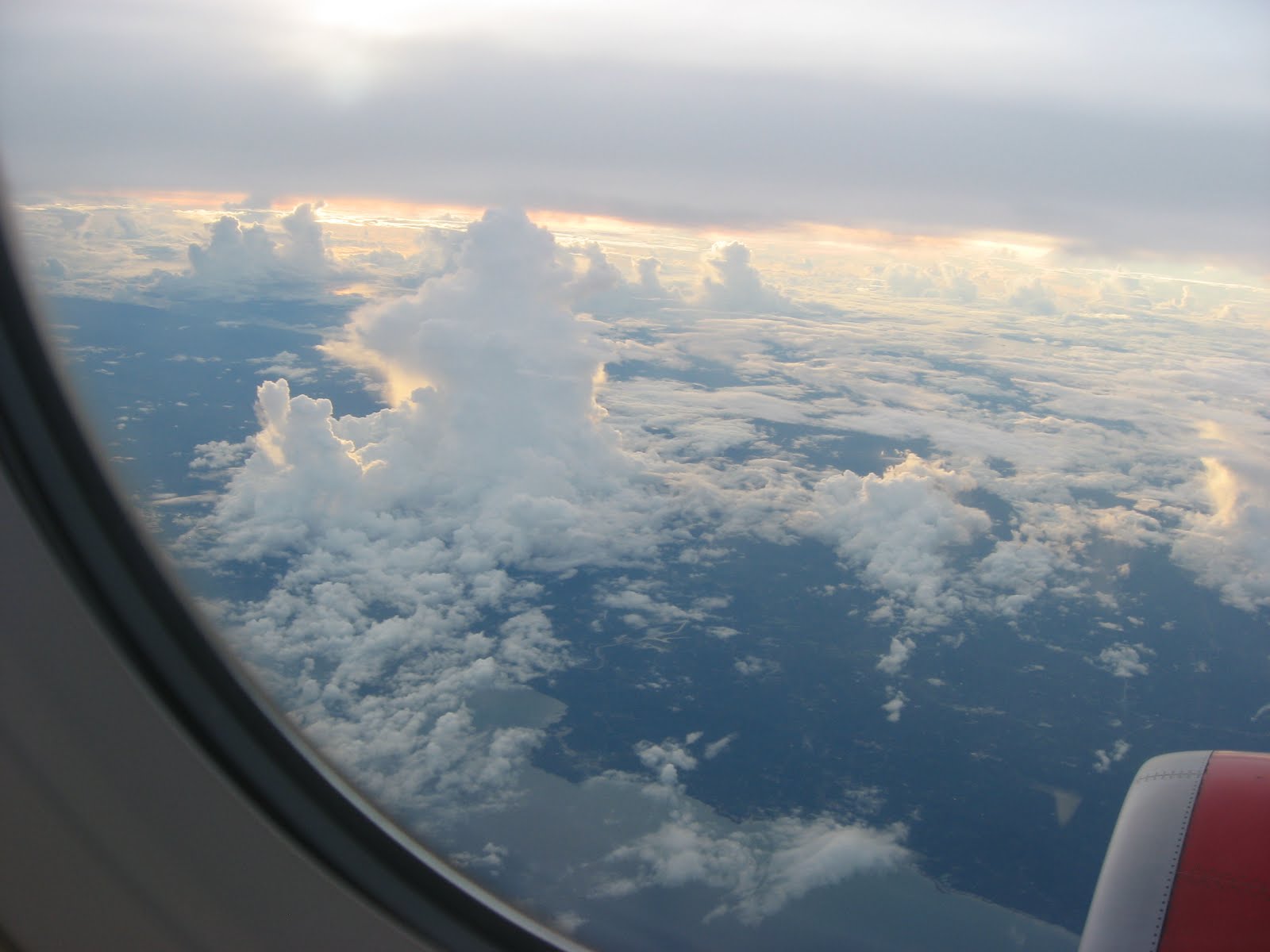 The view from the airplane.
Our next journey was from Puket to Ko Samui. My mom had researched this and knew that we wanted the big bus from Phuket town, not a mini-bus. However, the big bus company phone number did not work initially, and after several attempts with different numbers, when we go through to a person who spoke english, they told us to call another number. One which didn’t work on multiple attempts. So we booked a mini bus at the travel agent on the corner, recommended by the hotel. The mini bus arrived Wednesday morning at 7:50, already pretty much full of French students and their giant backpacks (these people had at least 1.5 times as much luggage as me, each, and I had a lot of extra stuff because my parents had brought a suitcase from home for me. Our terse mini bus driver managed to pile our suitcases atop the large stack behind his seat, and Mom and I climbed back to the 4th and last bench of the bus, where we sat with 2 french students. Dad got to perch next to the luggage, and spent the next 20 minutes trying to get the left half of his left butt cheek on the seat, while worrying that a sharp corner might cause the luggage to collapse onto him. Mom and I encouraged him to move forward to the passenger seat, which was unoccupied. But this was bad advise, because after our gas stop we picked up 3 more passengers. One of the french students had abandoned our row for the passenger seat by this time, so my dad was gestured back to our row. the luggage was rearranged to make about 1.3 seats in the first row by piling some of the suitcases into the aisle between the second and 3rd row of seats.
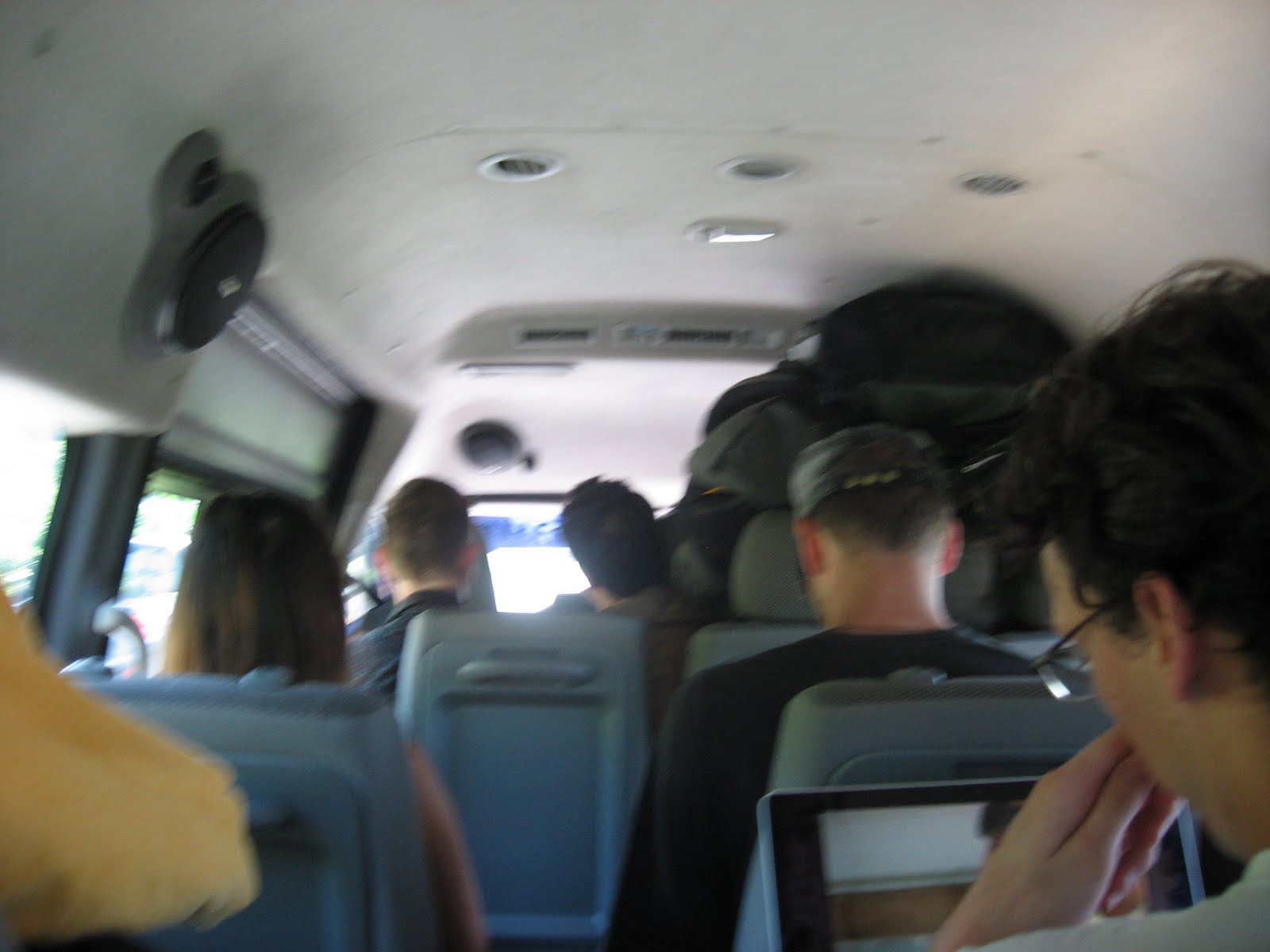
The view from my seat in the Mini Bus. At least with me, my Mom, and Dad in the back,we were able to share and redistribute space and stuff so all of us had the most legroom possible.
At this point, one of the french students protested, and was rudely offered his ticket back and a chance to get out of the bus. One of the new passengers got to sit in the front seat with the french student, and the other two got to share the first row. Somehow, despite their perch, the managed to sleep through the next several hours of the journey. I think they might all have been hungover, but especially the one who slept sprawled across the luggage, with his shirt buttoned incorrectly. Finally, after an early lunch stop at which none of us ate (we weren’t hungry, and with the AC working only somewhat in the last row of the bus, I was worried about motion sickness), we arrived in Surat Thani about 1:30 PM. We were deposited at a storefront with one table and 4 chairs (at this point, our minibus had 14 occupants) along with the contents of a second mini-bus. We waited here until about 3 while the man in the storefront tried to sell us taxis and accommodation on Ko Samui. Finally a songthao (truck taxi - like a pickup truck with benches and a covered back) took us to another place, this one a restaurant, where we were again offered transportation / lodging services while we waited for the big bus. The big bus took us the short (1/2 hr) journey to the ferry and there we waited only a short while (But were again offered booking assistance for hotels and taxis on the other end) until the ferry left at 4.
The ferry had indoor seating upstairs (VIP, 50 baht to sit in it, with a slight smell of gasoline exhaust), indoor seating downstairs (regular, free, and completely filled with gas fumes), and the ability to sit on the deck in front or the walkway to the front (but no benches or chairs). The front quickly filled up, so we ended up downstairs, but made frequent trips to the back deck for fresh air and picture taking. At this point, we were too frustrated with the package transit company to give them any more money to sit in the VIP area.

The deck of the ferry - full of people who don't want to sit dowstairs in the fumes or pay for slightly less fumes. They're all young and on vacation, so they seem to be handling it well.
When we arrived in Ko Samui, we checked out other ferry options, and then got a taxi to our hotel - after calling the hotel and being told ‘their’ taxi was taking someone to the other end of the island. We payed the same price, anyway, and it was 50 bhat less than the kind offer of the man at the storefront enforced rest in Surat Thani. Our hotel was lovely, and we were more than ready to hop in the swimming pool and have some spring rolls and phad thai for dinner.
My last journey was from Ko Samui back to Vientiane. It started with the hotel hostess asking if I could go to the airport at 2 because my parents wanted the taxi to the ferry at 2:20, and she only knows one taxi driver. I told her no, I would walk to the taxi stand (about 3 blocks.) I needed the extra 20 minutes to eat lunch and pack. I got a fair price to the airport at the taxi stand, and we drove through what looked like small country roads to me, finally arriving at a small airport. Check in went smoothly, an I was soon inside security at the Ko Samui Airport. The whole airport is made up of small hut-like buildings, I suppose trying to be authentically island-style, with covered walkways between. It was actually quite picturesque, especially the outdoor shopping mall on the way to the 6 gates. At my gate, I sat and read the Bangkok Post, which was hilarious in that every article was both reporting and editorializing on the news. A fellow traveler tipped me off that I could get my very own copy in the “Courtesy court.” What is a “Courtesy Court?” I thought to myself. Turns out, it is a little hut filled with free food, drinks, and newspapers. Bangkok Airlines really is a boutique airline! I loaded up with croissants, cake, pudding, and newspapers and really enjoyed the rest of my wait for the plane. On board, after riding little golf-cart like trolleys to the plane, we had chicken sandwiches and juice or water during the 45 minute flight to Bangkok.
I knew that I could get to the train station in Bangkok on the new high-speed train that connects to the airport from the city, then by subway, or on an express bus. The subway/train would be cheaper, but the bus would be simpler. But, I made the mistake of asking a fellow Thai traveler how was the best way, and he told me to take a taxi on the express way (400 bhat) because 2 hrs between my plane arrival and the train departure might not be enough to get there on the train/subway. I don’t think he knew the express bus existed. But, that made me anxious while trying to find the bus stop. (It also made me decide not to risk the train/subway connection.) I did find the express bus, and after all that worry, was more than a half hour early for my train. The train station was also NOT confusing (my Thai friend reported I might need a half hour to find things) and I had plenty of time to buy water, juice, milk, and 2 donuts from Mister Donut before getting on the train and sitting for 20 minutes before departure. This was my first time on a sleeper train - I had booked a second class lower bunk with AC. I had been warned that the upper bunks are quite narrow (this is true, plus you have to climb a ladder to get to them) and the cabins are freezing (also true.) An hour or more into the trip, and after one donut, the train attendant came along and made my bench seat and the one across from me into a lower bunk. It was fun watching him - he clearly has an incredibly honed set of motions to make all the beds up as efficiently as possible. I changed into my pajamas and settled down for the night. There were some stops to pick up passengers and some longer delays throughout the night, and we arrived 2 hours late, but the bed was comfortable and I slept through most of the night. (I had to fold my blanket in half to have 2 layers, and wear 3 shirts, but luckily I am short enough that that worked.) And since I don’t have a watch and my cell phone battery was dead, I had little sense of the passage of time, and no ability to worry about it.

Two views of my sleeper bunk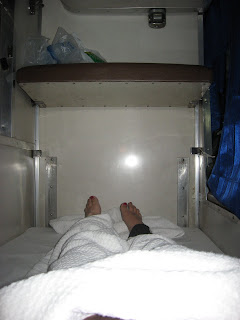 My seat mate commented snidely on my profession in light of my breakfast; 1/3 of a baguette with spreadable cheese and 2 kinds of lunch meat and my second donut, plus a box of apple juice. I’m not sure what I was supposed to eat - it’s not like there’s a great supply of fresh fruits and veggies on a train (or in the train station.) Finally, we arrive at the Nong Khai train station, were I decided to try taking the little train from thai to Lao. This saves money because otherwise you get a tuk-tuk to the border which is the same price, and then a bus across. Plus, it’s more convenient. However, I discovered it does NOT save money on the other end - the train station is maybe 1 KM from the rest of the border, the city bus does not go there, and you are at the mercy of the tuk tuk and mini-van drivers who are waiting for you. I refused several expensive offers of rides into town (which would also have required me to wait for some of the rest of the train passengers, who were all still in line for Visas), but one of the mini-van drivers took pity on me, or appreciated my bargaining in Lao, or had to leave to come into town anyway, and offered to take me right away for 100 baht (3.3 dollars.) It’s 26 KM, so that seemed like a reasonable price to me. (Though the bus is <1 dollars, the minibus was also more comfortable, and dropped me at the end of my alley.) I ended up paying him in kip - 5 dollars - sort of a tip for breaking ranks with his compatriots. Returning along the road from the friendship bridge, I felt like I was coming home, which is a really nice feeling, and I’m glad to have it here after only 4 months.
The ferry had indoor seating upstairs (VIP, 50 baht to sit in it, with a slight smell of gasoline exhaust), indoor seating downstairs (regular, free, and completely filled with gas fumes), and the ability to sit on the deck in front or the walkway to the front (but no benches or chairs). The front quickly filled up, so we ended up downstairs, but made frequent trips to the back deck for fresh air and picture taking. At this point, we were too frustrated with the package transit company to give them any more money to sit in the VIP area.
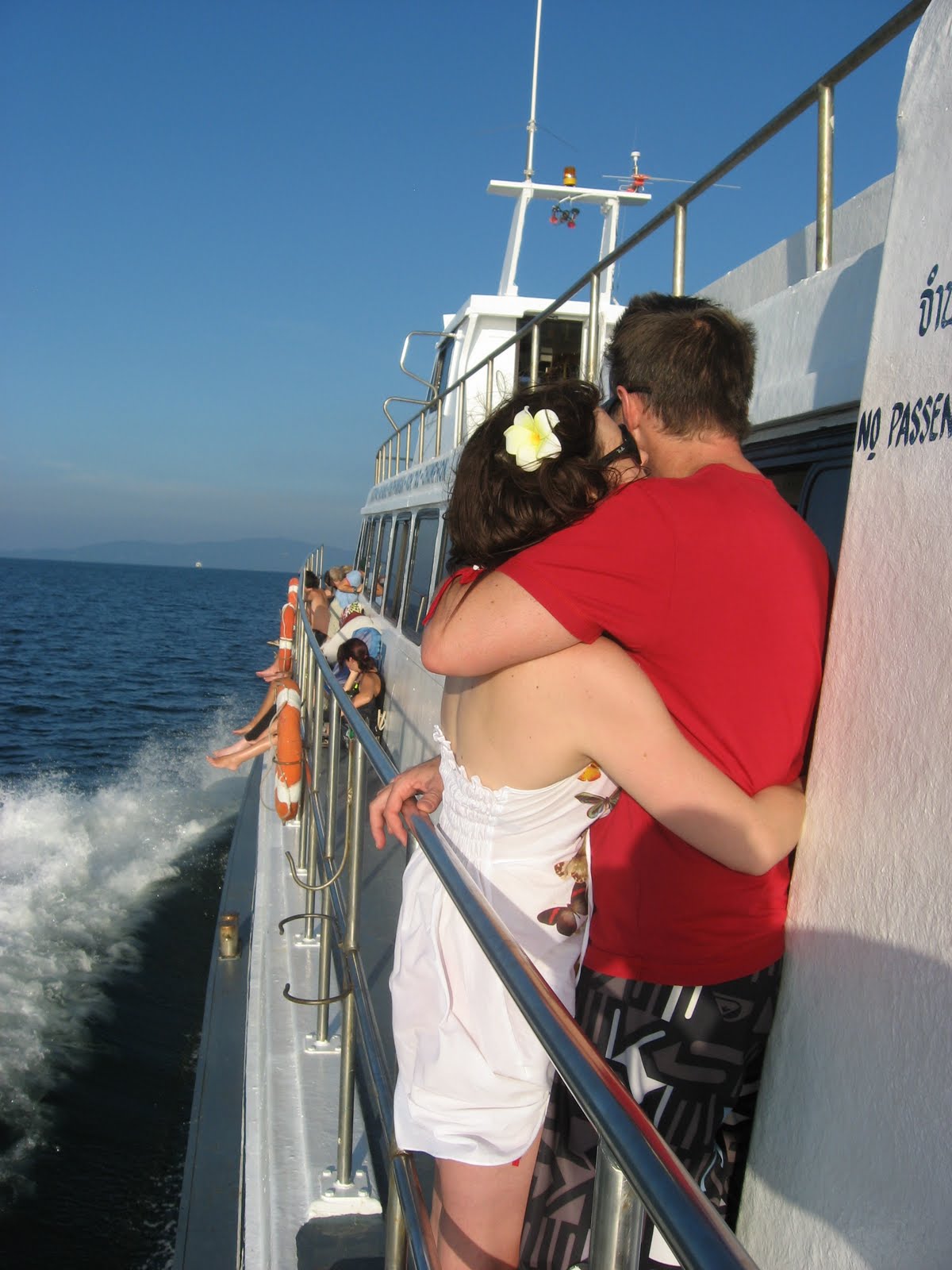
The deck of the ferry - full of people who don't want to sit dowstairs in the fumes or pay for slightly less fumes. They're all young and on vacation, so they seem to be handling it well.
My last journey was from Ko Samui back to Vientiane. It started with the hotel hostess asking if I could go to the airport at 2 because my parents wanted the taxi to the ferry at 2:20, and she only knows one taxi driver. I told her no, I would walk to the taxi stand (about 3 blocks.) I needed the extra 20 minutes to eat lunch and pack. I got a fair price to the airport at the taxi stand, and we drove through what looked like small country roads to me, finally arriving at a small airport. Check in went smoothly, an I was soon inside security at the Ko Samui Airport. The whole airport is made up of small hut-like buildings, I suppose trying to be authentically island-style, with covered walkways between. It was actually quite picturesque, especially the outdoor shopping mall on the way to the 6 gates. At my gate, I sat and read the Bangkok Post, which was hilarious in that every article was both reporting and editorializing on the news. A fellow traveler tipped me off that I could get my very own copy in the “Courtesy court.” What is a “Courtesy Court?” I thought to myself. Turns out, it is a little hut filled with free food, drinks, and newspapers. Bangkok Airlines really is a boutique airline! I loaded up with croissants, cake, pudding, and newspapers and really enjoyed the rest of my wait for the plane. On board, after riding little golf-cart like trolleys to the plane, we had chicken sandwiches and juice or water during the 45 minute flight to Bangkok.
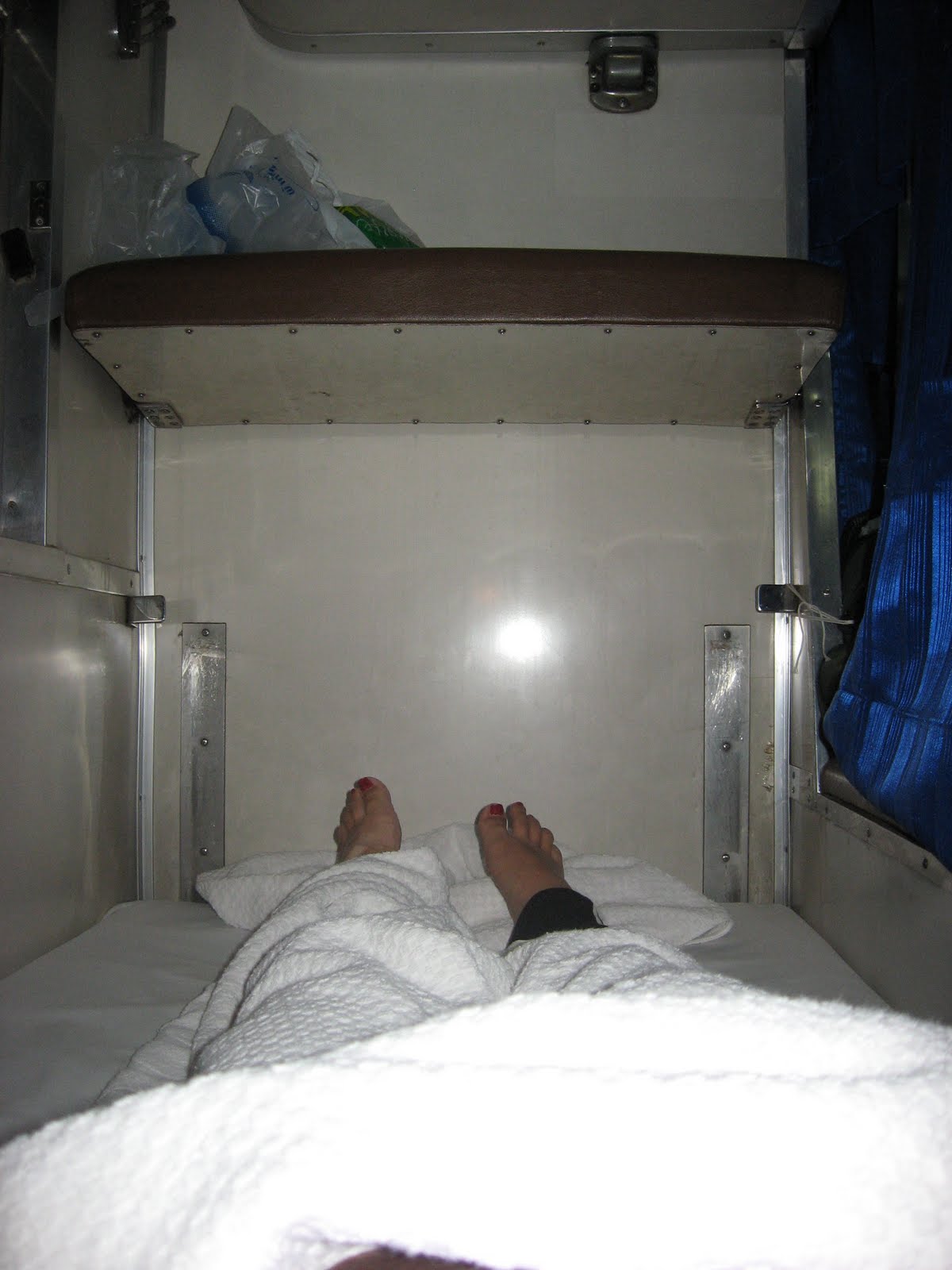
I knew that I could get to the train station in Bangkok on the new high-speed train that connects to the airport from the city, then by subway, or on an express bus. The subway/train would be cheaper, but the bus would be simpler. But, I made the mistake of asking a fellow Thai traveler how was the best way, and he told me to take a taxi on the express way (400 bhat) because 2 hrs between my plane arrival and the train departure might not be enough to get there on the train/subway. I don’t think he knew the express bus existed. But, that made me anxious while trying to find the bus stop. (It also made me decide not to risk the train/subway connection.) I did find the express bus, and after all that worry, was more than a half hour early for my train. The train station was also NOT confusing (my Thai friend reported I might need a half hour to find things) and I had plenty of time to buy water, juice, milk, and 2 donuts from Mister Donut before getting on the train and sitting for 20 minutes before departure. This was my first time on a sleeper train - I had booked a second class lower bunk with AC. I had been warned that the upper bunks are quite narrow (this is true, plus you have to climb a ladder to get to them) and the cabins are freezing (also true.) An hour or more into the trip, and after one donut, the train attendant came along and made my bench seat and the one across from me into a lower bunk. It was fun watching him - he clearly has an incredibly honed set of motions to make all the beds up as efficiently as possible. I changed into my pajamas and settled down for the night. There were some stops to pick up passengers and some longer delays throughout the night, and we arrived 2 hours late, but the bed was comfortable and I slept through most of the night. (I had to fold my blanket in half to have 2 layers, and wear 3 shirts, but luckily I am short enough that that worked.) And since I don’t have a watch and my cell phone battery was dead, I had little sense of the passage of time, and no ability to worry about it.
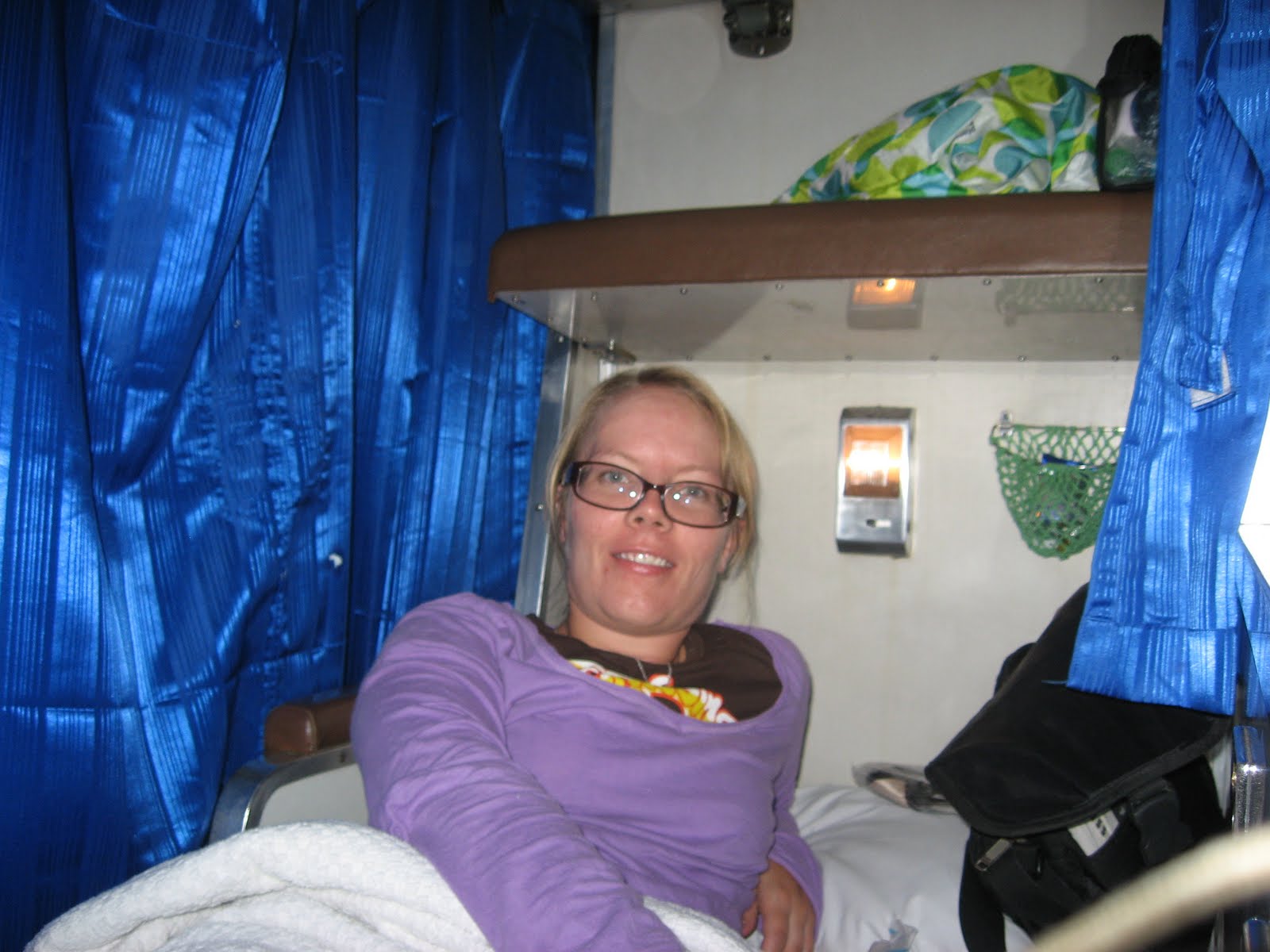
Two views of my sleeper bunk
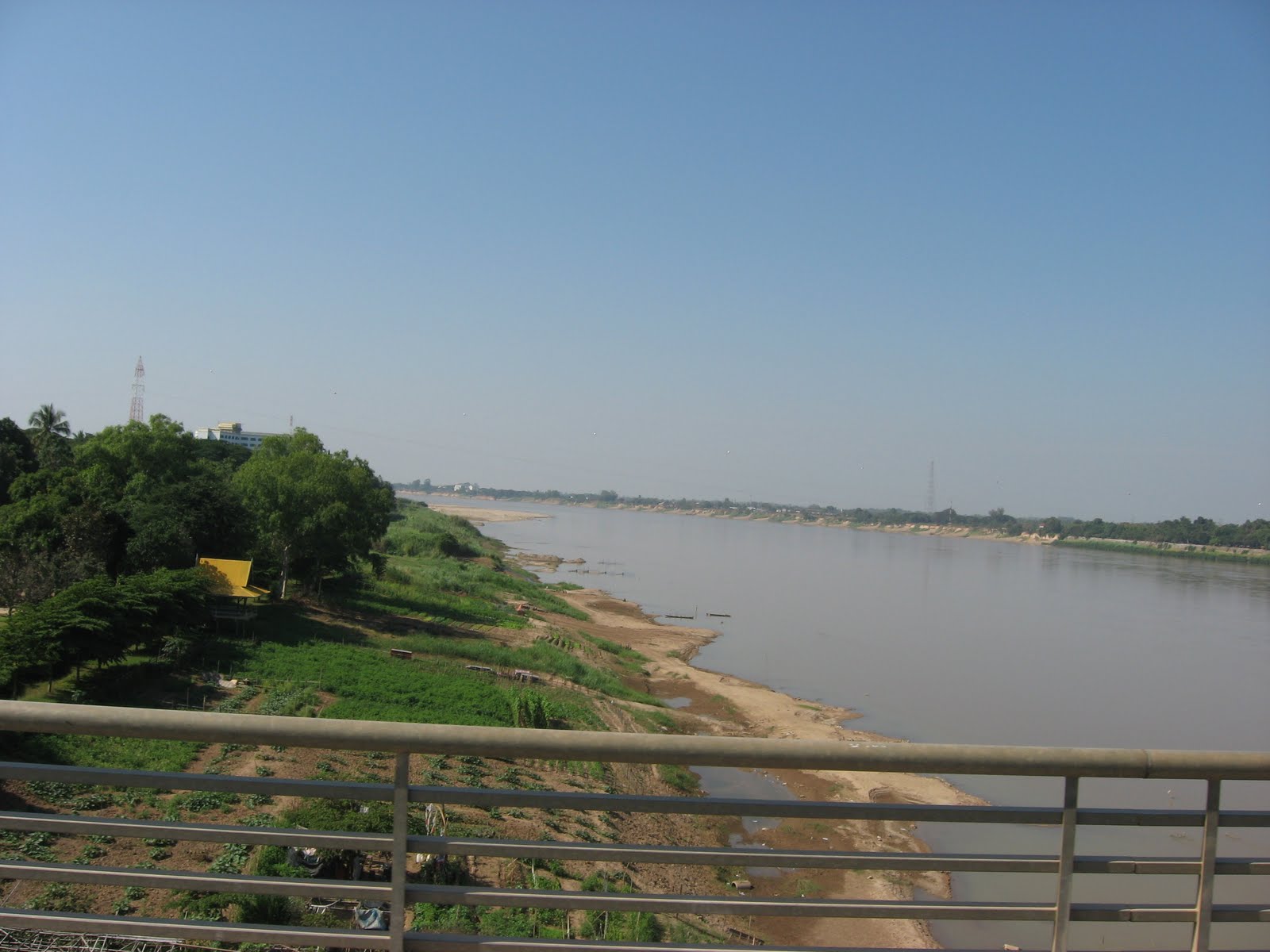
Mekong from the train
My parents, in their journeys through Thailand, had even more adventures, but those are their stories to tell, and this post is already long. Each of these travel days was sometimes adventuresome, sometimes nerve-wracking, sometimes rewarding of good communications or planning, sometimes boring, and sometimes interesting or beautiful. I am sure I will remember some parts of these trips for as long as I remember the fish I saw snorkeling or the food I ate in Thailand - so maybe the journey really is the destination.
Saturday, December 11, 2010
Holiday
It has been a busy couple weeks. The week Hakon and Karen (The health frontiers founders) were here, we had 3-4 meetings daily with various government and university officials. This meant I didn’t get out to Setta to round, and while they were interesting and useful meetings, it is fatiguing to have that many. I’m glad that in my day-to-day work meetings are rare enough that I generally look forward to them, or at least feel neutral about them.
The residents at Setta right now are not the strongest in english, so I feel especially bad for missing so many days with them - and today I leave for Phuket and Ko Samui (Thailand) where I will meet my parents. Especially because despite their limited english they are always happy to try and present a case, and if we both work we can understand each other, and then they are very happy to be getting teaching and english practice. But I’m excited to see my parents, and to have a vacation. Life in Vientiane is not as busy and stressful as residency was, but after a week of meetings and then 4 days of catch up and trying to get ready to go away for a week, I need a holiday!
This morning the first thing I did was ride my bike to the bus station to find out the times for busses to Udon Thani. I managed to find out where the busses were and get the departure times in Lao, and at the end of the discussion the bus driver said my lao was “Keng” (strong) which was the first positive comment I’ve gotten on my Lao communication, and then asked me if I was working in Laos and how long I’ve been here, all of which were questions I was able to answer. He smiled broadly at me when I told him I was working at the hospital, and I headed home feeling like I’ve finally made some progress in learning Lao. I hope this week I’ll have some beach time that can be spent with flashcards to expand my vocabulary. Last weekend I successfully gave directions to the pizza delivery place that got them to the end of our small road before they had to call help, so I am starting to be functional at the critical activities of daily living. Pizza and the ability to take the bus - what more could I want?
Aside from the mild fatigue of many daily meetings, Hakon and Karen’s visit was great. It was nice to hear more about the history of the organization I’m working for. But better than that, was the obvious recognition, respect, and appreciation of their Lao colleagues. So many foreigners are here in Lao working now, and Health Frontiers is certainly not spending as much as most of them. However, the Lao recognize that the establishment of the residency programs is a significant contribution, and remember that Hakon and Karen were here before most NGOs knew Lao existed. It is really great to be working for an organization you can be proud of. So I’ll be happy to be back at work next a week from Monday. . .
The residents at Setta right now are not the strongest in english, so I feel especially bad for missing so many days with them - and today I leave for Phuket and Ko Samui (Thailand) where I will meet my parents. Especially because despite their limited english they are always happy to try and present a case, and if we both work we can understand each other, and then they are very happy to be getting teaching and english practice. But I’m excited to see my parents, and to have a vacation. Life in Vientiane is not as busy and stressful as residency was, but after a week of meetings and then 4 days of catch up and trying to get ready to go away for a week, I need a holiday!
This morning the first thing I did was ride my bike to the bus station to find out the times for busses to Udon Thani. I managed to find out where the busses were and get the departure times in Lao, and at the end of the discussion the bus driver said my lao was “Keng” (strong) which was the first positive comment I’ve gotten on my Lao communication, and then asked me if I was working in Laos and how long I’ve been here, all of which were questions I was able to answer. He smiled broadly at me when I told him I was working at the hospital, and I headed home feeling like I’ve finally made some progress in learning Lao. I hope this week I’ll have some beach time that can be spent with flashcards to expand my vocabulary. Last weekend I successfully gave directions to the pizza delivery place that got them to the end of our small road before they had to call help, so I am starting to be functional at the critical activities of daily living. Pizza and the ability to take the bus - what more could I want?
Aside from the mild fatigue of many daily meetings, Hakon and Karen’s visit was great. It was nice to hear more about the history of the organization I’m working for. But better than that, was the obvious recognition, respect, and appreciation of their Lao colleagues. So many foreigners are here in Lao working now, and Health Frontiers is certainly not spending as much as most of them. However, the Lao recognize that the establishment of the residency programs is a significant contribution, and remember that Hakon and Karen were here before most NGOs knew Lao existed. It is really great to be working for an organization you can be proud of. So I’ll be happy to be back at work next a week from Monday. . .
Tuesday, November 30, 2010
Thankful Again
My last post was exclusively about social stuff, and I think my work deserves a thanksgiving post as well.
A few weeks ago, one of the residents complained that some residents (not him) lack physical exam skills, and I should spend more time teaching exam skills. In general, Americans think of doctors in the developing world as having much better physical exam skills, because they have fewer imaging resources and lab tests to confirm their diagnosis. However, this has not been my experience, here or in Africa. I think it’s because you do still need a teacher skilled in physical exam to encourage and supervise your learning. My residents here are very good at some things - they can confirm ascites with a fluid wave or shifting dullness at the drop of a hat (thanks Hepatitis B!) - a skill I never practiced much in America because it requires 2 people, and also because American patients tend to look askance at you when you try to have one person press down firmly on the middle of their abdomen and have another tapping and feeling either side. And in America, if there is every any question, you just get an ultrasound (or look yourself with the portable.) But some of the more basic exam skills - good cardiovascular exam, neuro exam, etc are at or below the level I would expect from an American resident, probably because they don’t have good teaching for this. (They have a great GI teacher. They also have good cardio and neuro teachers, but I think they get less face-to-face time on the wards with them.) So I told the resident that was complaining that I believe learning good physical exam skills is mostly achieved by taking the time to do a thorough exam on many patients, even those you expect to have a normal exam, so you get in the habit of doing things well and efficiently, and so you get familiar enough with normal to recognize small abnormalities. Of course, this practice has to be paired with the willingness to ask a teacher when you’re not sure, and the availability of a teacher who can answer your question. I’ve been trying to do more exams on rounds, watch the residents do more exams, and focus more on physical findings in our discussion of assessment and plan since the complaint.
One of the things I have noticed residents here do not do (much like residents in America) is examine wounds. I have seen several patients with diabetes and possibly infected foot wounds who were presented to me and the residents could not describe the wound for me when asked. I have tried to model good behavior by unwrapping and looking at the wounds, but decided to do some formal teaching as well. So, last week I lectured on Diabetic Foot Wounds and created a hands-on lab where they used pig feet that I created wounds on to practice the probe-to-bone tests. (For my non medical readers, if you can feel bone at the bottom of a wound it changes your decisions about antibiotics significantly.) It turns out, pigs feet have pretty tough skin, too, so if anyone is tempted to repeat this exercise, I advise you to buy as scalpel or two before starting your wound-creation. I ended up using my matt knife extensively. The probe-to-bone demonstration was also harder that I thought it would be, because after visiting several medical supply stores I had to come to the conclusion that there are no sterile swabs in Laos. So we used Q tips soaked in Iodine as clean (but probably not sterile) probes. The residents all giggled when I brought out the pigs feet, but they did all practice, and hopefully learned something. And several cameras emerged from bags to take pictures, so I think they liked the exercise. Hopefully, it will change the way they approach (or don’t approach, currently) diabetic foot wounds and give them some confidence in their ability to examine and assess them.
I think in America if I had made residents practice exams on pigs feet, they would have felt like it was unrealistic and a waste of their time. So I’m thankful to be teaching here in Lao where any extra effort you expend in teaching is much appreciated by the residents.
A few weeks ago, one of the residents complained that some residents (not him) lack physical exam skills, and I should spend more time teaching exam skills. In general, Americans think of doctors in the developing world as having much better physical exam skills, because they have fewer imaging resources and lab tests to confirm their diagnosis. However, this has not been my experience, here or in Africa. I think it’s because you do still need a teacher skilled in physical exam to encourage and supervise your learning. My residents here are very good at some things - they can confirm ascites with a fluid wave or shifting dullness at the drop of a hat (thanks Hepatitis B!) - a skill I never practiced much in America because it requires 2 people, and also because American patients tend to look askance at you when you try to have one person press down firmly on the middle of their abdomen and have another tapping and feeling either side. And in America, if there is every any question, you just get an ultrasound (or look yourself with the portable.) But some of the more basic exam skills - good cardiovascular exam, neuro exam, etc are at or below the level I would expect from an American resident, probably because they don’t have good teaching for this. (They have a great GI teacher. They also have good cardio and neuro teachers, but I think they get less face-to-face time on the wards with them.) So I told the resident that was complaining that I believe learning good physical exam skills is mostly achieved by taking the time to do a thorough exam on many patients, even those you expect to have a normal exam, so you get in the habit of doing things well and efficiently, and so you get familiar enough with normal to recognize small abnormalities. Of course, this practice has to be paired with the willingness to ask a teacher when you’re not sure, and the availability of a teacher who can answer your question. I’ve been trying to do more exams on rounds, watch the residents do more exams, and focus more on physical findings in our discussion of assessment and plan since the complaint.
One of the things I have noticed residents here do not do (much like residents in America) is examine wounds. I have seen several patients with diabetes and possibly infected foot wounds who were presented to me and the residents could not describe the wound for me when asked. I have tried to model good behavior by unwrapping and looking at the wounds, but decided to do some formal teaching as well. So, last week I lectured on Diabetic Foot Wounds and created a hands-on lab where they used pig feet that I created wounds on to practice the probe-to-bone tests. (For my non medical readers, if you can feel bone at the bottom of a wound it changes your decisions about antibiotics significantly.) It turns out, pigs feet have pretty tough skin, too, so if anyone is tempted to repeat this exercise, I advise you to buy as scalpel or two before starting your wound-creation. I ended up using my matt knife extensively. The probe-to-bone demonstration was also harder that I thought it would be, because after visiting several medical supply stores I had to come to the conclusion that there are no sterile swabs in Laos. So we used Q tips soaked in Iodine as clean (but probably not sterile) probes. The residents all giggled when I brought out the pigs feet, but they did all practice, and hopefully learned something. And several cameras emerged from bags to take pictures, so I think they liked the exercise. Hopefully, it will change the way they approach (or don’t approach, currently) diabetic foot wounds and give them some confidence in their ability to examine and assess them.
I think in America if I had made residents practice exams on pigs feet, they would have felt like it was unrealistic and a waste of their time. So I’m thankful to be teaching here in Lao where any extra effort you expend in teaching is much appreciated by the residents.
Monday, November 29, 2010
Thankful
This week, I didn’t celebrate Thanksgiving, but I do find myself thankful on a daily basis for this opportunity. I’m also glad I know myself well enough to know that trying to orchestrate Thanksgiving dinner here was going to be a lot of stress and hassle, which would outweigh the small gratification I would get from sharing and American holiday with my new friends and colleagues in Vientiane. A few years ago, I would have felt I had to prove something to myself about my ability to host a good dinner. If there’s anything American residency taught me, it’s to carefully assess the benefit / cost of such and undertaking carefully, though. :) And tonight I’ll go have a nice French meal to mark the holiday, hopefully to include Chocolate Souffle, which will be a rare treat, will probably cost less than feeding a large group, and will not require any prep time or errand running on my part.
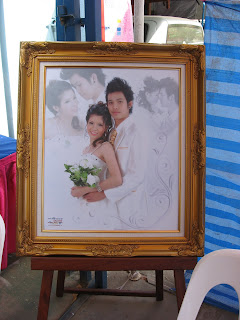 Pre-wedding photo
Friday was mostly devoted to Ning’s (our housekeeper) daughter’s wedding. At 9 AM I got dressed up in my silk sin and satin shirt and Amy, Amy’s parents and I went to the bassi. Each table in the tent set up outside Ning’s house had a bottle of Johnny Walker on it and several large Beer Laos in preparation for lunch. Before the ceremony even began, I was pressured to have a shot of whiskey, but Amy took it for me, since I was the driver. The groom arrived in a celebratory procession, had a gold belt placed on his waist, and had his feet symbolically washed by a cute little girl. The guests were all gathered in a carpeted room with 2 giant banana leaf and marigold and string centerpieces/altars with various items important to the ceremony gathered around the bottom. (Eg: water, sticky rice, a whole chicken, another bottle of Johnny walker, etc) The bride entered from inside the house with a fabulous tall, cone-shaped hairdo and long, sparkely fake nails. The officiant called the spirits and there was some rice and marigold leaves thrown (so everyone had rice in their updo’s for the rest of the morning) and then there was a ceremony which culminated in bride and groom tying white string around each other’s wrists. Then we all lined up to tie white strings on each of their wrists, with their parents and other important people going through first. Then everyone started tying strings on each other. It is important to tie at least 3 knots, and the string is supposed to stay on until it falls off on it’s own, but after 3 days you’re allowed to cut the ends quite short to encourage the process. There is a lot of dust in Vientiane, so my string is already looking kind of grayish after only 24 hours. We did not stay for lunch because by the time the ceremony was over Amy and her mom had each had 2 shots of whiskey, and her Dad had had 4, one of which was at least a half wine glass full. We had work to do in the afternoon, so we left before the heavy drinking began. . .
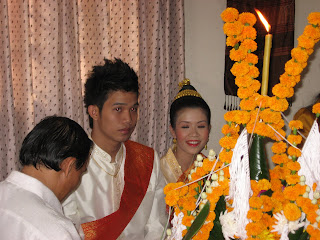 (The bride and groom with the officiant. You can't see it well here, but the groom still has his Faux-hawk, despite his otherwise traditional garb.)
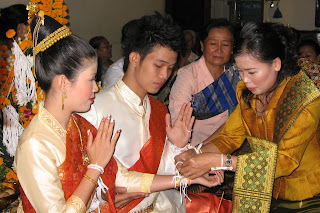 Ning doing her string tying
At 6:00 I went to the hair shop next to Amy’s house where I had my hair coiffed - there were braids, twists, sparkely barrettes, and curls when I as done. We then went to the hotel for the reception. In Lao, there are no wedding gifts, you just put some money in your invitation envelope, and then put it in a giant box on your way into the reception after going through the greeting line. Then you have a shot of whiskey and entered the reception area. We arrived at around 7:45 and ended up sitting at table 60/67 (10 people/table.) Each of these tables also had a bottle of Johnny Walker. After some wait, the bride and groom and their families processed in and we were served dinner. Then the bride sang a song and the bride and groom cut the cake and opened a giant bottle of champagne which they poured into a tower of glasses. Clearly, the French did a shoddy job of teaching the Lao about champagne because the groom was instructed to shake the bottle vigorously prior to attempting to remove the cork. He had trouble getting the cork out so he ended up shaking it 4-5 times before he actually managed to get it open. I was worried that someone was going loose an eye, but it must’ve been the flattest bottle of champagne ever because it didn’t even foam after all that shaking. (The whiskey was authentic, though) After this, the dancing began. Unfortunately, I didn’t get to learn the traditional Lao wedding dance, because there was a lot of new Lao line dancing happening. But Ning looked happy, and we had fun. At about 10:30 we headed out, and after 15 minutes of waiting for a tuk tuk, we had the hotel call a taxi. (Oh yeah, there is not a lot of late night transport in Vientiane, so most of the guests drove themselves home. A good reason to leave early.)
 Me in my silk sin and fancy shirt at the reception.
After all that, I see why Ning has been so stressed the last month or so, and I can’t imagine how the Lao afford such giant weddings - this would have been expensive in America, and I’m sure costs are equivalent or more than America in terms of what people earn and what weddings cost. I guess it’s good that they can use all the gifts to replete the bank accounts and pay the rest of the catering bill. I liked the basi - it was relatively short and sort of personal (thought the officiant had to ask the bride and groom what their names were, so not THAT personal) but the giant reception was a bit overwhelming. I hope the bride and groom are very happy, though, and I hope Ning feels like all her stress paid off.
 Pre-wedding photo
Friday was mostly devoted to Ning’s (our housekeeper) daughter’s wedding. At 9 AM I got dressed up in my silk sin and satin shirt and Amy, Amy’s parents and I went to the bassi. Each table in the tent set up outside Ning’s house had a bottle of Johnny Walker on it and several large Beer Laos in preparation for lunch. Before the ceremony even began, I was pressured to have a shot of whiskey, but Amy took it for me, since I was the driver. The groom arrived in a celebratory procession, had a gold belt placed on his waist, and had his feet symbolically washed by a cute little girl. The guests were all gathered in a carpeted room with 2 giant banana leaf and marigold and string centerpieces/altars with various items important to the ceremony gathered around the bottom. (Eg: water, sticky rice, a whole chicken, another bottle of Johnny walker, etc) The bride entered from inside the house with a fabulous tall, cone-shaped hairdo and long, sparkely fake nails. The officiant called the spirits and there was some rice and marigold leaves thrown (so everyone had rice in their updo’s for the rest of the morning) and then there was a ceremony which culminated in bride and groom tying white string around each other’s wrists. Then we all lined up to tie white strings on each of their wrists, with their parents and other important people going through first. Then everyone started tying strings on each other. It is important to tie at least 3 knots, and the string is supposed to stay on until it falls off on it’s own, but after 3 days you’re allowed to cut the ends quite short to encourage the process. There is a lot of dust in Vientiane, so my string is already looking kind of grayish after only 24 hours. We did not stay for lunch because by the time the ceremony was over Amy and her mom had each had 2 shots of whiskey, and her Dad had had 4, one of which was at least a half wine glass full. We had work to do in the afternoon, so we left before the heavy drinking began. . .
 (The bride and groom with the officiant. You can't see it well here, but the groom still has his Faux-hawk, despite his otherwise traditional garb.)
 Ning doing her string tying
 Me in my silk sin and fancy shirt at the reception.
After all that, I see why Ning has been so stressed the last month or so, and I can’t imagine how the Lao afford such giant weddings - this would have been expensive in America, and I’m sure costs are equivalent or more than America in terms of what people earn and what weddings cost. I guess it’s good that they can use all the gifts to replete the bank accounts and pay the rest of the catering bill. I liked the basi - it was relatively short and sort of personal (thought the officiant had to ask the bride and groom what their names were, so not THAT personal) but the giant reception was a bit overwhelming. I hope the bride and groom are very happy, though, and I hope Ning feels like all her stress paid off.
Sunday, November 14, 2010
Pbai Saa Saa
The longer you go without blogging, the harder it is to restart, because prioritizing what to write about gets harder as more events accumulate. . . So I’m going to just start at some random middle spot and write about a few things.
Jon and Rose, the doctors from Regions hospital who ‘recruited’ me to be the HF residency coordinator are visiting Lao for 2 weeks. This has been fun for many reasons - they brought me some silver sulfadiazine for my burn and several tubes of Neutrogena sunscreen and moisturizer from home (the only thing I haven’t found here as far as cosmetics go - it’s hard to find moisturizer without whitening agents, which I don’t want and am pretty sure my dermatologist would not approve of.) They also brought me a gold Buddha poster from Luang Prabang - I had wanted to buy one but we missed the second night of the night market because we were busy sending our sins down the river. And they buy me dinner every night as a way to “support my volunteerism.” But most importantly, they give me good perspective about how things have changed (mostly for the better) or not changed (again, mostly for the better.) And after a few months here by myself, it’s nice to have some other people familiar with the systems of internal medicine to bounce things off. I know I could do this by e-mail any time if I had a big question, but for 2 weeks I can bring up small questions that might not be worth writing an e-mail about. Plus, there’s something that’s just different about discussing things in person - there are nuances that can’t be conveyed by e-mail. So one week into their visit, I am very happy to have them here.
I had several challenging patients last week - a woman younger than me with Acute Myeloid Leukemia M5 (A disease which is fatal more than 50% of the time in America) who had gone to Thailand and had several rounds of chemotherapy, survived at least one episode of neutropenic sepsis in Thailand, and been sent home after her last round of chemo. She relapsed and came in to the Lao hospital with GI bleeding, low platelets, and fever, with a high enough white blood cell to be sure her leukemia was back. (Which was the far most likely outcome after chemo, so not surprising.) She didn’t have enough money to go back to Thailand, so died at Setta of “cardio-pulmonary arrest” overnight one night. It’s always hard to see someone younger than you that you know is going to die (or has died) but it’s even harder when you also know that family just spent their life savings on chemo for a disease that is hard to cure even with bone marrow transplant, and to cure it with chemo alone would be almost a miracle. I don’t know what kind of informed consent is possible given the immense difference in education and the fact that Thai and Lao are similar, but not the same language, but I feel like it probably wasn’t enough. I think if you told most 27 year olds here that they could get chemo but still had a 90+ percent chance of dying, and it would deplete their family’s life savings, they would go home to spend their remaining days with their family, because there is a much more acute awareness here of the value of even a little money to make many people’s lives better.
On a happier note, yesterday I went to the Nam Ngum Dam with some lovely Swiss-Germans. Tanja invited me, I think as a sort of thank you for looking after her for a few days 2 weeks ago while she had Dengue. (Which I really hope not to get, after watching her have it.) It was beautiful - much larger than I expected. On the way there we stopped at a salt factory, which was really interesting. Then we drove on to the dam, which looked small from the bottom, but had a giant reservoir behind it, and supplies most of the power to Lao, plus exports a lot of hydroelectric power to Thailand. We had lunch on a restaurant overlooking the water - delicious lake fish - and then took a short boat ride in a giant, noisy boat before the minivan ride home. I didn’t get to swim, and the water wasn’t the clearest, but I think if you set out a bit earlier you could do some pretty cool hiking or boating with lunch on an island.
Jon and Rose, the doctors from Regions hospital who ‘recruited’ me to be the HF residency coordinator are visiting Lao for 2 weeks. This has been fun for many reasons - they brought me some silver sulfadiazine for my burn and several tubes of Neutrogena sunscreen and moisturizer from home (the only thing I haven’t found here as far as cosmetics go - it’s hard to find moisturizer without whitening agents, which I don’t want and am pretty sure my dermatologist would not approve of.) They also brought me a gold Buddha poster from Luang Prabang - I had wanted to buy one but we missed the second night of the night market because we were busy sending our sins down the river. And they buy me dinner every night as a way to “support my volunteerism.” But most importantly, they give me good perspective about how things have changed (mostly for the better) or not changed (again, mostly for the better.) And after a few months here by myself, it’s nice to have some other people familiar with the systems of internal medicine to bounce things off. I know I could do this by e-mail any time if I had a big question, but for 2 weeks I can bring up small questions that might not be worth writing an e-mail about. Plus, there’s something that’s just different about discussing things in person - there are nuances that can’t be conveyed by e-mail. So one week into their visit, I am very happy to have them here.
I had several challenging patients last week - a woman younger than me with Acute Myeloid Leukemia M5 (A disease which is fatal more than 50% of the time in America) who had gone to Thailand and had several rounds of chemotherapy, survived at least one episode of neutropenic sepsis in Thailand, and been sent home after her last round of chemo. She relapsed and came in to the Lao hospital with GI bleeding, low platelets, and fever, with a high enough white blood cell to be sure her leukemia was back. (Which was the far most likely outcome after chemo, so not surprising.) She didn’t have enough money to go back to Thailand, so died at Setta of “cardio-pulmonary arrest” overnight one night. It’s always hard to see someone younger than you that you know is going to die (or has died) but it’s even harder when you also know that family just spent their life savings on chemo for a disease that is hard to cure even with bone marrow transplant, and to cure it with chemo alone would be almost a miracle. I don’t know what kind of informed consent is possible given the immense difference in education and the fact that Thai and Lao are similar, but not the same language, but I feel like it probably wasn’t enough. I think if you told most 27 year olds here that they could get chemo but still had a 90+ percent chance of dying, and it would deplete their family’s life savings, they would go home to spend their remaining days with their family, because there is a much more acute awareness here of the value of even a little money to make many people’s lives better.
On a happier note, yesterday I went to the Nam Ngum Dam with some lovely Swiss-Germans. Tanja invited me, I think as a sort of thank you for looking after her for a few days 2 weeks ago while she had Dengue. (Which I really hope not to get, after watching her have it.) It was beautiful - much larger than I expected. On the way there we stopped at a salt factory, which was really interesting. Then we drove on to the dam, which looked small from the bottom, but had a giant reservoir behind it, and supplies most of the power to Lao, plus exports a lot of hydroelectric power to Thailand. We had lunch on a restaurant overlooking the water - delicious lake fish - and then took a short boat ride in a giant, noisy boat before the minivan ride home. I didn’t get to swim, and the water wasn’t the clearest, but I think if you set out a bit earlier you could do some pretty cool hiking or boating with lunch on an island.
Subscribe to:
Posts (Atom)
